
When two big companies clash over a patent, it doesn’t always end in court. In fact, fewer than 15% of patent disputes ever go to trial. Most are settled quietly-behind closed doors, with lawyers, engineers, and executives haggling over money, access, and future rights. This isn’t about who invented what first. It’s about who can afford to wait, who has the stronger patents, and who’s willing to trade something valuable to walk away without a fight.
Why Companies Settle Instead of Fighting
Patent lawsuits are expensive. The average case costs between $3 million and $5 million just to get to trial. For a small company, that’s enough to bankrupt them. Even for giants like Apple or Samsung, it’s a distraction. Time spent in court is time not spent building products. That’s why 85.7% of patent disputes end in settlement, according to a 2022 Stanford study. The goal isn’t to win. It’s to reduce risk. Settlements let companies avoid unpredictable jury decisions. They also let them control the outcome. Instead of leaving their fate to a judge or jury, they negotiate terms that protect their business. Sometimes, that means paying a lump sum. Other times, it means sharing technology or agreeing to cross-license patents. The real win isn’t the money-it’s the certainty.How the Negotiation Process Actually Works
There’s no single way to settle a patent dispute, but most follow a similar path. First, both sides assess their patent portfolios. They don’t look at every patent. They pick 3 to 15 key ones that matter most. These are the patents they’ll fight over-or trade away. Then comes the claim chart. This is a detailed map showing exactly how one company’s product uses the other’s patented technology. It’s not guesswork. Every line of code, every circuit design, every function is matched to a patent claim. If the claim chart is weak, the case collapses before it starts. Next, validity analysis. Are the patents even enforceable? A 2021 USPTO study found that nearly 40% of patents asserted in litigation were later invalidated. That’s a huge risk. Smart companies spend $150,000 to $300,000 before even sitting down to negotiate, running deep checks to find prior art that could kill the other side’s patent. If you can prove a patent shouldn’t have been granted in the first place, your leverage skyrockets.The High-Low Settlement: A Game-Changing Strategy
One of the most clever tools in patent negotiation is the high-low settlement. It’s like betting on a coin flip-but with millions at stake. Here’s how it works: both sides agree on two numbers. The low is the minimum payment if the court rules in your favor. The high is the maximum you’ll pay if you lose. The actual outcome doesn’t matter. You pay whichever number applies. This structure removes the fear of a catastrophic loss. It also forces both sides to be realistic. Stanley Black & Decker pioneered this in 2015. Since then, it’s been used in 78% of competitor disputes that succeed. But it rarely works with patent trolls-non-practicing entities (NPEs) that don’t make anything. They want quick cash, not structure. High-low settlements fail in 92% of those cases.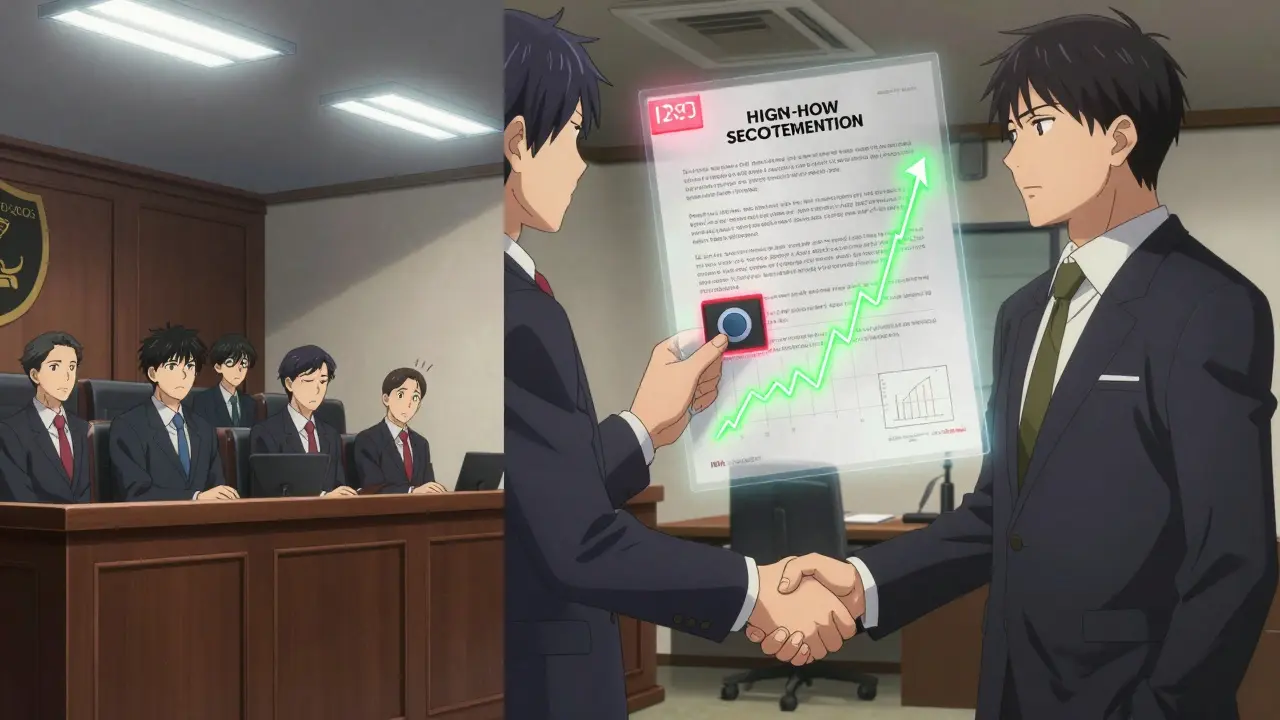
Cross-Licensing: When You Give to Get
In industries like semiconductors and telecom, companies don’t just settle-they swap. Cross-licensing means you give me access to your patents, and I give you access to mine. No money changes hands. Or maybe a small royalty flows one way, depending on who has the stronger portfolio. This is common in 73% of disputes between big tech firms. Why? Because no single company owns all the patents needed to make a modern smartphone, router, or chip. If you’re building a 5G device, you’re likely using tech covered by hundreds of patents from dozens of companies. Fighting them all is impossible. So you license. The trick is valuation. How much is your patent portfolio worth compared to theirs? Leading firms use royalty stacking models to avoid paying too much. If you’re paying 2% on every phone for Patent A, 1.5% for Patent B, and 3% for Patent C, you’re already at 6.5%. Add more, and your profit vanishes.Mediation, Arbitration, and the Role of Neutral Parties
Sometimes, companies bring in a third party to help. Mediation is the most common. A retired judge or neutral expert listens to both sides and helps them find common ground. It doesn’t bind anyone. But it often works. The CPR Institute found mediation succeeds in 65% of patent cases. Arbitration is different. The arbitrator makes a final decision. No appeal. It’s faster than court-often under six months-but riskier. If you lose, you lose everything. Still, 81% of arbitration cases are resolved this way, because speed matters. In 2021, Ericsson and Samsung settled after eight months of talks, with former Federal Circuit Judge Randall Rader guiding them. They ended up with a six-year licensing deal worth $650 million upfront, plus royalties based on device price. No trial. No appeal. Just a contract.What Goes Wrong in Negotiations
Not every settlement works. One big reason? Anchoring. If you start by demanding $100 million, you’re not setting a target-you’re setting a ceiling. A 2022 University of Chicago study found plaintiffs who ask for three times their real target end up getting 28% more than those who start reasonable. But if you ask for too little, you leave money on the table. The art is knowing your bottom line-and sticking to it. Another problem? Weak patents. Companies sometimes overestimate their own IP. They think their patent is bulletproof. Then, during discovery, a prior art reference surfaces that proves otherwise. Suddenly, your leverage disappears. That’s why pre-settlement validity analysis isn’t optional. It’s survival.
Emerging Trends: AI, Blockchain, and Global Courts
Technology is changing how settlements happen. AI tools like PatentSight can now scan millions of documents to find prior art in days instead of weeks. But they still miss nearly 20% of key references. Human experts are still essential. Blockchain is being tested to automate royalty payments. IBM and Microsoft are piloting smart contracts that adjust payments in real time based on sales data. That could cut post-settlement disputes by 40%. In Europe, the Unified Patent Court (UPC), launched in June 2023, is already changing the game. Before, companies had to file separate lawsuits in each country. Now, one court covers 17 EU nations. Cross-border settlements have jumped 22% in just six months. Companies are settling faster to avoid the UPC’s tight deadlines.Who Wins and Who Loses
Large companies with 1,000+ patents settle 89% of cases before trial. Small firms? Only 63%. Why? Big companies can afford the long game. They have teams of lawyers, patent analysts, and economists. They know how to use the system. The real winners aren’t the ones who pay the most. They’re the ones who turn a fight into a partnership. Intel’s 2018 settlement with MEDIATEK didn’t just end a lawsuit-it led to a joint 5G project worth over $200 million in shared R&D savings. That’s the future of patent negotiation: not just avoiding conflict, but creating value from it.What You Need to Know Before You Enter a Negotiation
If you’re facing a patent challenge, here’s what actually matters:- Know your bottom line before you sit down. Add up litigation costs, lost time, and reputational risk.
- Don’t overvalue your patents. Run a validity stress test. If you can’t defend it, don’t use it as leverage.
- Look for trade-offs. Can you offer access to your tech in exchange for a lower royalty? Can you extend a license term for a one-time payment?
- Use neutral mediators early. Don’t wait until you’re in court.
- Remember: settlement isn’t surrender. It’s strategy.
Patents aren’t just legal documents. They’re business tools. The best negotiators don’t fight over ownership. They figure out how to share it in a way that keeps everyone moving forward.
What’s the difference between a patent settlement and a license?
A patent settlement resolves a dispute, often involving money, licensing, or cross-terms. A license is just an agreement to use a patent, usually for a fee. Settlements can include licenses, but licenses don’t always settle disputes. Most settlements end with a license agreement as part of the deal.
How long do patent settlement negotiations usually take?
Most take 6 to 9 months, especially for big companies. The bulk of settlements happen between the Markman hearing (where courts interpret patent claims) and summary judgment. Some settle in weeks if both sides are ready. Others drag on for years if one party refuses to budge.
Can a small company win a patent settlement against a big one?
Yes-but only if they have strong, enforceable patents and solid evidence of infringement. Big companies often settle with small innovators to avoid the risk of a jury awarding huge damages. The key is proving your patent is valid and that the other side is using it without permission.
What role do patent trolls play in settlements?
Non-practicing entities (NPEs), or patent trolls, often push for quick, low-value settlements because they don’t make products. They rely on the cost of litigation to scare companies into paying. High-low settlements rarely work with them because they’re not interested in long-term deals-just cash. Many companies now fight back aggressively to discourage these tactics.
Are patent settlements public record?
Only if they’re filed with the court. Many settlements are confidential and sealed. Companies prefer secrecy to avoid setting precedents or alarming investors. But if a case goes to trial or involves public interest (like standard-essential patents), terms may be disclosed.
What happens if a settlement is broken?
If one side violates the terms-say, by continuing to use the patented tech after paying a lump sum-the other side can go back to court for breach of contract. Courts enforce settlement agreements like any other contract. Penalties can include additional damages, injunctions, or even triple damages if the violation is willful.
How do antitrust laws affect patent settlements?
When patents cover technologies required for industry standards-like Wi-Fi or 5G-they’re called standard-essential patents (SEPs). Settlements for SEPs must follow FRAND terms: fair, reasonable, and non-discriminatory. If a company uses its SEP to block competitors or charge unfair rates, regulators can step in. The European Commission fined Qualcomm €242 million in 2018 for exactly this.
Patent negotiations aren’t about winning. They’re about choosing the least bad option. The companies that thrive don’t just fight harder-they think smarter.







Henry Sy January 14, 2026
Man, I’ve seen this play out in my startup. We got hit with a patent troll claim for a feature we built in 3 weeks. They wanted $500k to go away. We called their bluff, dug up prior art from a 1998 Japanese patent database, and they folded. Turns out, their ‘invention’ was just a rehash of a Nintendo controller mod. Sometimes the real power isn’t in the patent-it’s in knowing where to look.
Sarah Triphahn January 16, 2026
Of course they settle. Big companies don’t care about innovation. They care about control. This whole system is rigged to protect the rich. The real crime isn’t infringement-it’s that the patent office grants junk patents like they’re trading cards. And then the lawyers turn it into a casino.
Allison Deming January 17, 2026
It is deeply troubling, and frankly, morally bankrupt, that our legal and economic systems have come to valorize the art of negotiation over the pursuit of justice in intellectual property disputes. The very notion that a company can buy its way out of accountability-by paying a sum that is, in many cases, less than the cost of litigation-undermines the foundational purpose of patent law, which was to incentivize innovation, not to enable corporate extortion under the guise of legal procedure. The erosion of principle into transactional convenience is not progress-it is decay.
Susie Deer January 19, 2026
USA invented patents. Other countries just copy and sue. We built the future. Stop letting foreigners bleed us dry with their cheap labor and stolen tech. If they want to play, they play by our rules. No more deals. No more sharing. Just win.
TooAfraid ToSay January 20, 2026
Wait wait wait. So you’re telling me the entire global tech economy is just a giant game of rock-paper-scissors where the winner is whoever has the most lawyers? And the real inventor? They’re out here selling tacos. This isn’t capitalism. This is a dystopian sitcom written by Kafka on a caffeine bender.
Dylan Livingston January 22, 2026
Oh wow. So the elite have figured out how to turn law into a luxury spa experience-mediation, arbitration, high-low settlements… all while the little guy gets served a subpoena and a debt collector’s call. How poetic. The patent system isn’t broken. It’s perfectly calibrated to serve those who already own everything. Bravo, oligarchs. You’ve made legal warfare look like a TED Talk.
Jason Yan January 24, 2026
I’ve spent years working in patent analytics, and honestly, the most underrated part of this whole process is the human element. Engineers and lawyers talk past each other constantly. The claim charts? Often built by junior associates who don’t understand the product. The validity analysis? Sometimes done by firms that just run keyword searches. The real magic happens when someone bridges that gap-when a tech lead sits down with a patent attorney and says, ‘This feature isn’t even in the spec anymore.’ That’s when settlements get real. Not because of money. Because of truth.
Anna Hunger January 24, 2026
The structural imbalance in patent litigation is not merely a legal issue-it is a systemic failure of governance. Small entities, despite possessing legitimate innovations, are systematically disadvantaged by the cost of discovery, the complexity of claim construction, and the opacity of settlement dynamics. The high-low mechanism, while clever, is not a panacea; it merely shifts the burden of risk from litigation to negotiation, without addressing the root cause: the monopolization of legal capital by institutional actors. Until patent reform prioritizes accessibility over efficiency, the system will continue to reward endurance over ingenuity.
Vicky Zhang January 24, 2026
I used to work at a tiny biotech firm. We had one patent on a protein delivery method. Big pharma came knocking. We were scared. But we didn’t panic. We didn’t take their first offer. We said, ‘Here’s what we’ll give you: access to our tech if you fund our next trial.’ They agreed. Two years later, our drug got FDA approval. We didn’t get rich-but we got to keep building. That’s the real win. Settlements aren’t surrender. They’re strategy with soul.
Alvin Bregman January 25, 2026
Patents are supposed to protect innovation but they’ve become weapons. I’ve seen engineers quit because they’re scared their code might get sued. We need to rethink this whole thing. Maybe patents should expire faster. Maybe only companies that actually make stuff should get them. The system feels like it was designed by lawyers for lawyers. Not by makers for makers.
Robert Way January 26, 2026
wait so if a company has a patent on like a button shape and sues someone for using a circle instead of a square… is that even legal? i thought patents were for inventions not design choices? or is this just how it works now? someone pls explain im confused
shiv singh January 28, 2026
Big tech thinks they’re smart. But they’re just scared. They know their products are built on stolen ideas. They settle because they’re guilty. And the worst part? The people who actually invented the tech? They’re in a basement in Bangalore making $12/hour. This isn’t negotiation. It’s theft with a law degree.
says haze January 30, 2026
Let’s be real-this entire system is a performance art piece funded by venture capital and powered by legal FOMO. The ‘high-low settlement’? It’s not clever. It’s cowardice dressed in a three-piece suit. The fact that 92% of patent troll cases fail under this model proves one thing: the system works only when the players have skin in the game. Trolls? They’re just the ghosts haunting the machine. And we’re all just paying rent to the specters.
Sarah -Jane Vincent January 30, 2026
Did you know the USPTO has a backlog of 300,000 pending patents? And half of them are filed by shell companies? This isn’t innovation-it’s a financial weaponization scheme. AI tools are just making it faster to game the system. The Unified Patent Court? It’s not global justice-it’s a corporate tax dodge with a European flag. Wake up. This isn’t law. It’s algorithmic looting.
Andrew Freeman January 31, 2026
Settlements are just corporate surrender with a fancy name. The real winners? The law firms. They bill $800/hour and get paid whether you win or lose. Meanwhile, the guy who built the tech? He got a bonus check and a pat on the back. And now he’s working at Google. The system doesn’t reward creators. It rewards the people who know how to sign the papers.