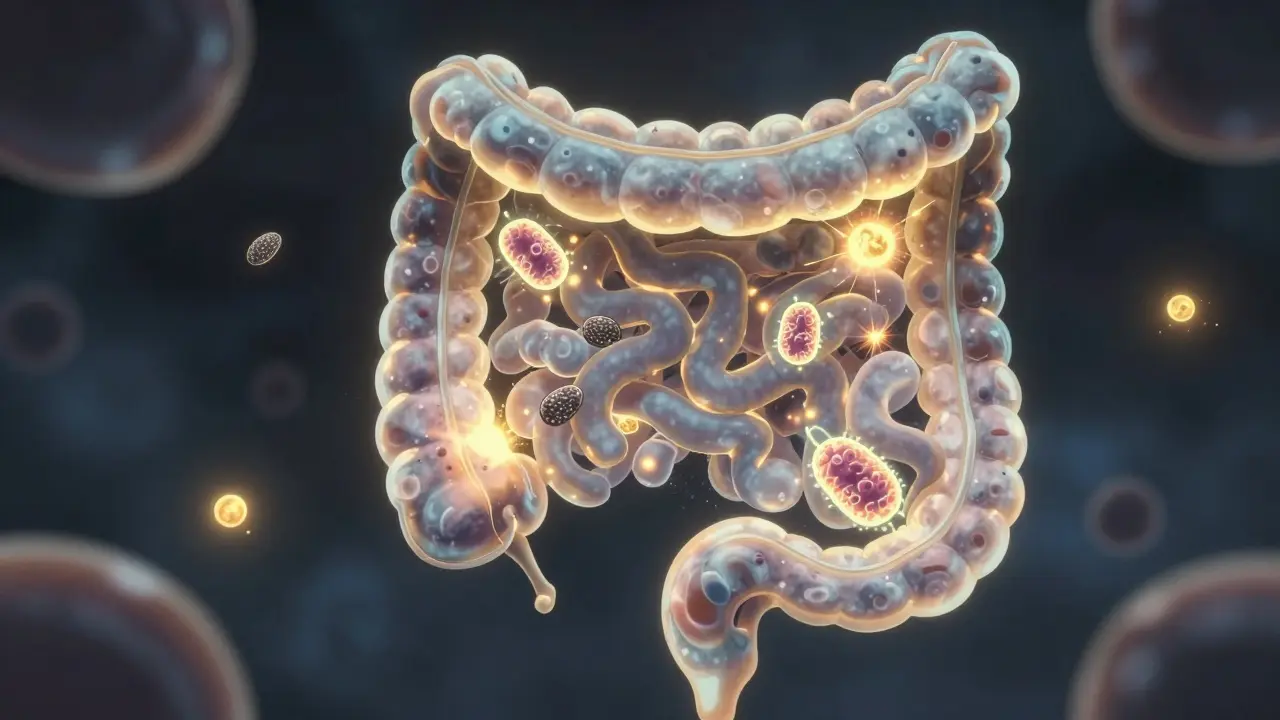
Most people know fiber is good for you-but few understand how it actually works in your gut. If you’re struggling with bloating, constipation, or unpredictable bowel movements, the answer might not be just eating more fiber. It’s about choosing the right type of fiber. Soluble and insoluble fiber aren’t just two sides of the same coin-they’re two different tools with different jobs. Getting the balance wrong can make things worse, not better.
What soluble fiber actually does in your gut
Soluble fiber doesn’t just pass through your system. It turns into a thick, gel-like substance when it meets water. Think of it like oatmeal soaking up milk-except inside your intestines. This gel slows down digestion, which means sugar from your meal enters your bloodstream more gradually. Studies show this can lower post-meal blood sugar spikes by 20-30%. That’s why people with diabetes often feel more stable after eating oats, beans, or chia seeds. But here’s the real magic: your gut bacteria eat this gel. When they ferment soluble fiber, they produce short-chain fatty acids-especially butyrate. Butyrate is like fertilizer for the cells lining your colon. It keeps them healthy, reduces inflammation, and even helps regulate your immune system. Research from 2024 confirms that soluble fiber is the main driver behind a diverse, thriving gut microbiome. It’s not just about digestion-it’s about communication between your gut and your brain. Foods rich in soluble fiber include:- Oats (1-2 grams per 100g)
- Beans (5-8 grams per 100g)
- Lentils (2-3 grams per 100g)
- Chia seeds (5.6 grams per 30g serving)
- Apples (1.4 grams per medium apple)
- Carrots (0.7 grams per medium carrot)
If you have IBS, soluble fiber is often the key to relief. Many people report fewer episodes of both diarrhea and constipation after adding psyllium husk or soaked chia seeds to their diet. Why? Because the gel helps regulate stool consistency-thickening loose stools and softening hard ones.
What insoluble fiber actually does in your gut
Insoluble fiber doesn’t dissolve. It doesn’t turn to gel. It’s more like a sponge that soaks up water and sweeps debris along. It’s made of cellulose and lignin-the tough parts of plants that your body can’t break down. Its job? Speed things up. Insoluble fiber adds bulk to your stool and increases its weight by 30-50%. That’s why whole wheat bread, bran, and nuts help with constipation. It literally pushes waste through your system faster. Studies show it can cut transit time by 24-48 hours. That’s a game-changer for people who go days without a bowel movement. But here’s the catch: if your gut is already inflamed-like during a Crohn’s or ulcerative colitis flare-up-this rough-and-tumble fiber can irritate the lining. Many people with active IBD are told to avoid wheat bran, raw vegetables with skins, and nuts until symptoms calm down. Good sources of insoluble fiber:- Whole-wheat flour (7.9 grams per 100g)
- Wheat bran (12 grams per 100g)
- Nuts (2-4 grams per 30g serving)
- Seeds (3-5 grams per 30g serving)
- Kiwi skin (2.5 grams per fruit)
Insoluble fiber also helps prevent diverticulosis-the tiny pouches that form in the colon wall. Long-term studies show people who eat more insoluble fiber cut their risk by nearly 40%. It’s not glamorous, but it’s essential.
Why you need both
Your gut doesn’t care about labels like “soluble” or “insoluble.” It just wants balance. Think of it like a garden: soluble fiber feeds the good bacteria (the pollinators), while insoluble fiber keeps the pathways clear (the gardeners). One without the other leads to problems. The Mediterranean Diet, backed by decades of research, gets this right. It delivers about 30-50 grams of total fiber daily from a mix of whole grains, legumes, fruits, vegetables, nuts, and seeds. The ratio? Roughly 3 parts insoluble to 1 part soluble. That’s not an accident-it’s nature’s design. If you’re eating only apples and oats, you’re missing out on the bulk and cleansing power of whole grains and skins. If you’re only eating bran and brown rice, you’re starving your gut bacteria. Both extremes lead to imbalances.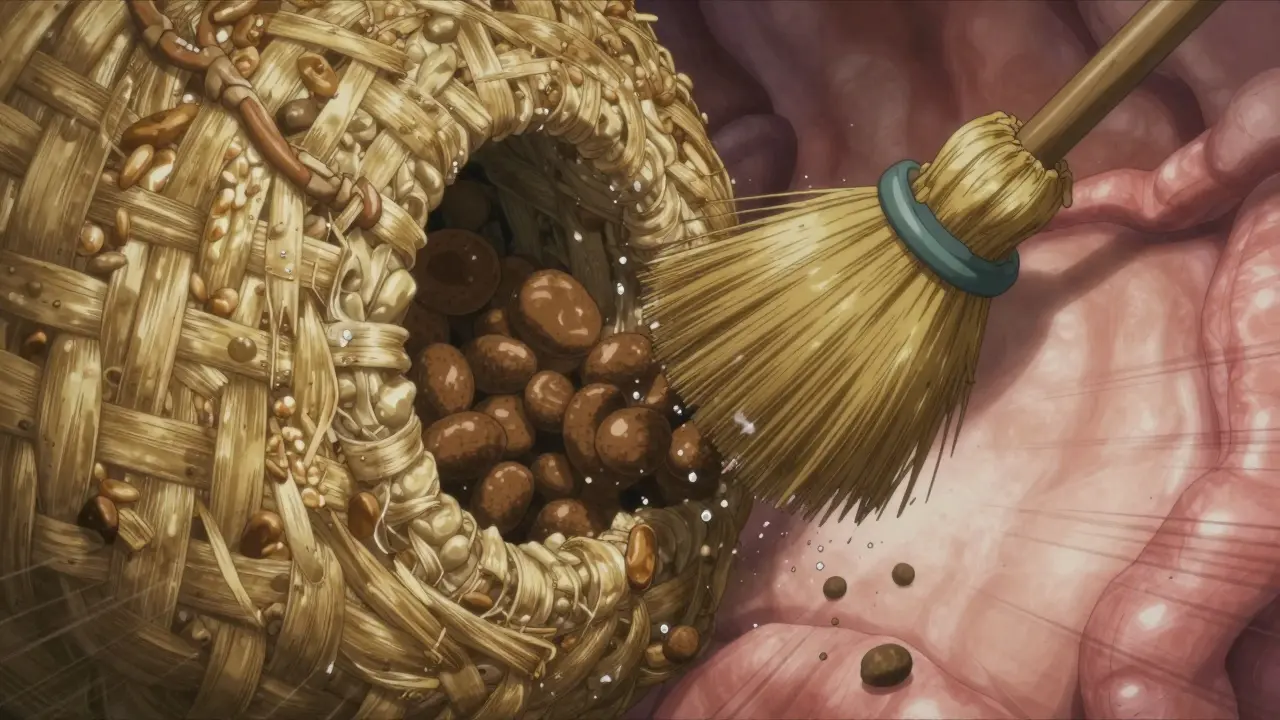
Who needs what-and how to adjust
There’s no one-size-fits-all fiber plan. Your needs depend on your gut health.- General population: Aim for 25g (women) or 38g (men) total fiber daily. Start slow. Jumping from 10g to 30g in a week will make you bloated and gassy. Increase by 5g per week.
- IBS sufferers: Focus on soluble fiber first-oats, psyllium, bananas, carrots. Avoid high-FODMAP insoluble sources like broccoli and cabbage until symptoms improve.
- IBD flare-ups: Limit insoluble fiber to 10-15g per day. Stick to peeled vegetables, cooked grains, and low-residue fruits. Once stable, slowly reintroduce whole foods.
- Diabetics: Soluble fiber is your friend. A daily 5-10g boost from beans or flaxseed can lower LDL cholesterol by 5-10% and reduce blood sugar spikes by 15-20%.
Hydration is non-negotiable. For every 25g of fiber you eat, drink at least 1.5-2 liters of water. Without enough water, fiber turns from a helper into a clog.
Supplements vs. whole foods
You can buy psyllium husk, inulin, or methylcellulose pills. They work-but they’re not better than food. The 2024 review in PMC made this clear: isolated fiber supplements can’t replicate the complex mix of nutrients, antioxidants, and phytochemicals found in whole plants. A chia seed isn’t just fiber-it’s omega-3s, magnesium, and protein all wrapped in one package. A bowl of lentils delivers fiber plus iron, folate, and slow-burning carbs. The global fiber supplement market hit $3.2 billion in 2022. But experts agree: you’re paying for convenience, not superiority. If you can get fiber from food, do it.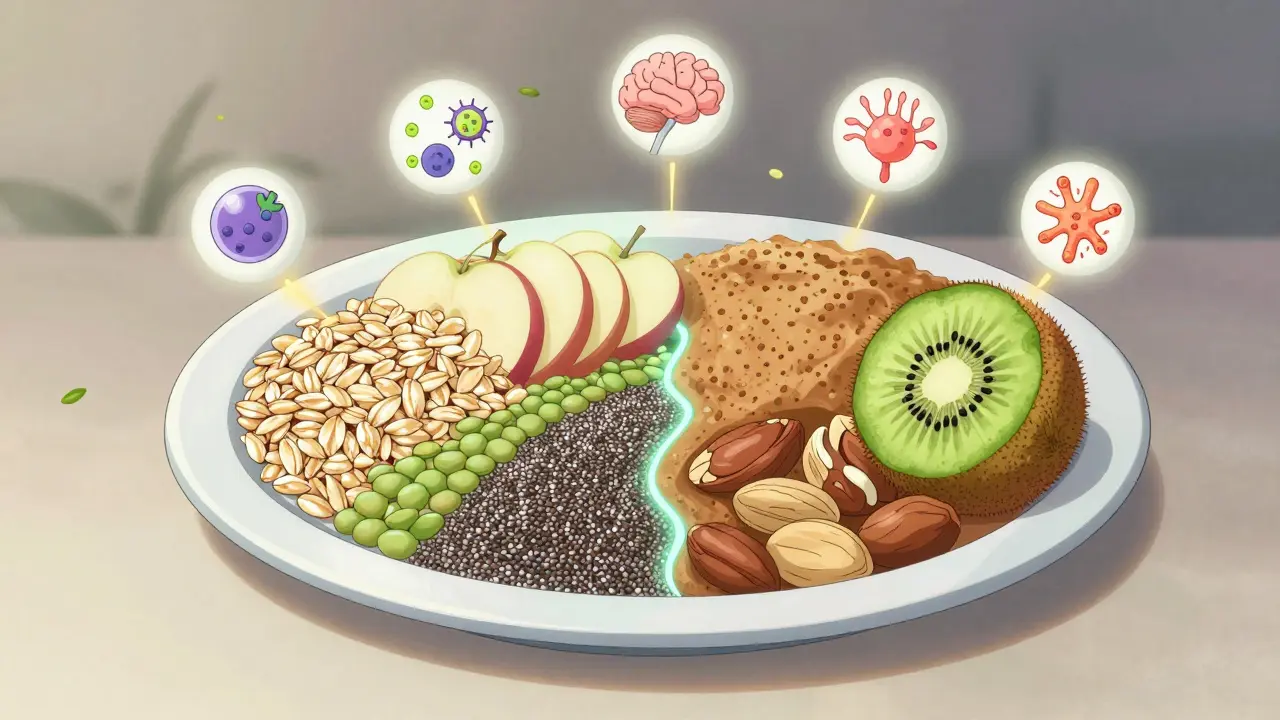
What’s next in fiber science
The future of gut health isn’t just about how much fiber you eat-it’s about how your body responds to it. Companies like Zoe and Viome are already testing individual microbiomes to predict which fibers boost your glucose levels or trigger bloating. In five years, your doctor might tell you: “Your gut ferments oats well but doesn’t handle bran. Cut the bran. Add more lentils.” Right now, the best advice is simple: eat a wide variety of plants. Don’t just go for the fiber count. Go for color, texture, and variety. A purple carrot, a handful of almonds, a spoonful of oats, and a kiwi with the skin on-that’s the kind of mix your gut was built for.Frequently Asked Questions
Can soluble fiber help with diarrhea?
Yes. Soluble fiber forms a gel that thickens loose stools and slows down transit time. Foods like oats, psyllium, and bananas are often recommended for managing diarrhea, especially in IBS. It doesn’t stop the cause, but it helps regulate the outcome.
Is insoluble fiber bad for IBS?
Not always, but it can trigger symptoms in some people. High-insoluble foods like wheat bran, raw broccoli, and nuts are common triggers during IBS flare-ups. Many find relief by reducing these and focusing on soluble sources first. Once stable, they may tolerate small amounts again.
Why does fiber make me bloated?
Bloating usually happens when you increase fiber too fast or don’t drink enough water. Your gut bacteria need time to adjust. Start with 5g extra per week and drink at least 1.5 liters of water daily. Also, soak beans and legumes before cooking to reduce gas-producing compounds.
Does fiber help with weight loss?
Indirectly, yes. Soluble fiber slows digestion and triggers the release of satiety hormones like GLP-1 and peptide YY. This can reduce hunger and lead to eating fewer calories. People who eat more fiber tend to weigh less-not because fiber is magic, but because it replaces calorie-dense, low-nutrient foods.
Should I take a fiber supplement?
Only if you can’t get enough from food. Supplements like psyllium can help with constipation or cholesterol, but they don’t offer the same range of nutrients as whole plants. If you’re eating a variety of fruits, vegetables, legumes, nuts, and whole grains, you likely don’t need a pill.






Pooja Kumari January 8, 2026
Okay but have you ever tried going from zero fiber to 40g in one week? I did. I thought I was being healthy. Turns out my gut was screaming for mercy. I was bloated like I was 7 months pregnant and farting like a tuba concert. Took me 3 weeks to recover. Now I start with 5g a week, drink water like it’s my job, and suddenly my digestion is smoother than my morning coffee. Soluble fiber saved my life, honestly. Oats and chia seeds are my new best friends. No more panic attacks before leaving the house.
Maggie Noe January 8, 2026
This is why I love science 😊
It’s not just about ‘eating more fiber’ - it’s about *listening* to your body like it’s a sentient garden. Soluble fiber = nurturing the soil. Insoluble = clearing the weeds. And if you ignore the soil, the plants die. And if you ignore the weeds, the whole thing collapses. 🌱💚
My gut microbiome is basically my emotional support ecosystem. I feed it with lentils, berries, and silence. No supplements. Just real food and patience. It’s not a diet. It’s a relationship.
Gregory Clayton January 9, 2026
Y’all are overcomplicating this. Eat meat. Eat veggies. Don’t eat junk. Fiber’s not magic. It’s just what grandma did before Big Pharma sold you pills. If you’re bloated, maybe stop eating gluten and sugar instead of chasing chia seeds like they’re holy water. This post reads like a supplement ad with footnotes. Real food > lab-made fiber powders. End of story.
Jacob Paterson January 10, 2026
Wow. So you’re telling me I’ve been doing everything wrong for 10 years? I ate bran cereal every morning like a good little health zombie. Turns out I was shredding my colon like a sandpaper towel. And now you say I need to eat *oats*? Like, from a bowl? Not the kind in the box with 18 ingredients? 🙄
Also, who the hell is this ‘2024 research’? Did it get peer-reviewed or just sponsored by a chia seed company? I’m not buying this ‘gut-brain axis’ nonsense unless you show me the actual study. And no, ‘PMC’ doesn’t count as a citation.
Angela Stanton January 12, 2026
Let’s contextualize this. Soluble fiber → SCFA production → butyrate → histone deacetylase inhibition → epigenetic modulation of colonic epithelial integrity. Insoluble → increased stool bulk → accelerated transit → reduced colonic residence time → decreased pathogen colonization. The 3:1 insoluble:soluble ratio aligns with ancestral dietary patterns (see Cordain 2005, then adjust for modern microbiome depletion). But here’s the kicker - hydration thresholds are non-linear. At >25g fiber, water intake must scale exponentially. Most people fail here. Hence, constipation paradox. Also, psyllium > methylcellulose. Always. And yes, I’ve reviewed the 2024 meta-analysis. It’s solid.
Johanna Baxter January 13, 2026
I hate fiber. I really do. I tried everything. Oats made me gassy. Chia seeds felt like gravel in my throat. Bran gave me cramps that felt like labor. I just want to poop normally without feeling like my insides are in a war zone. Why is this so hard? Everyone acts like it’s easy. Like I’m broken because I can’t handle a kiwi with skin. I’m not lazy. I’m just tired of being told what to eat like I’m a toddler. Can we just admit that some people’s guts are just… broken? And that’s okay?
Jerian Lewis January 14, 2026
My gut’s been stable since I started eating only white rice, boiled chicken, and eggs. No fiber. No drama. No bloating. No ‘gut-brain axis’ nonsense. I don’t need to ‘feed my bacteria.’ They’re fine without me pretending to be a plant. If your body says no to fiber, listen. You’re not failing. The advice is just wrong for you. I’ve seen too many people ruin their digestion trying to follow trends. Sometimes less is more. And sometimes, the quietest gut is the healthiest one.
Diana Stoyanova January 14, 2026
Y’all. I was in so much pain. Diarrhea. Constipation. Bloating that made me cry in the bathroom. I tried everything. Then I found this: 1 tbsp soaked chia in water every morning. 1/2 cup oats at breakfast. 1 apple with skin. 1 carrot. That’s it. No supplements. No fancy apps. No keto. No paleo. Just… food. And water. A LOT of water. I didn’t change my life. I just changed my plate. And now? I feel like I’m 25 again. My energy? Better. My mood? Calmer. My gut? Quiet. It’s not magic. It’s consistency. And you don’t need to eat 50g of fiber. You just need to eat one thing differently. Start today. You got this. 💪❤️
Jenci Spradlin January 16, 2026
psyllium is the real MVP. I used to go 4 days without pooping. Now I take 1 tsp with water before bed. Wake up like a new person. And yeah, I spell it wrong sometimes. I’m not a doctor. I’m just a guy who used to be constipated and now isn’t. Don’t overthink it. Eat more plants. Drink water. Be patient. Your gut ain’t gonna fix itself in a week. But it will if you give it half a chance.