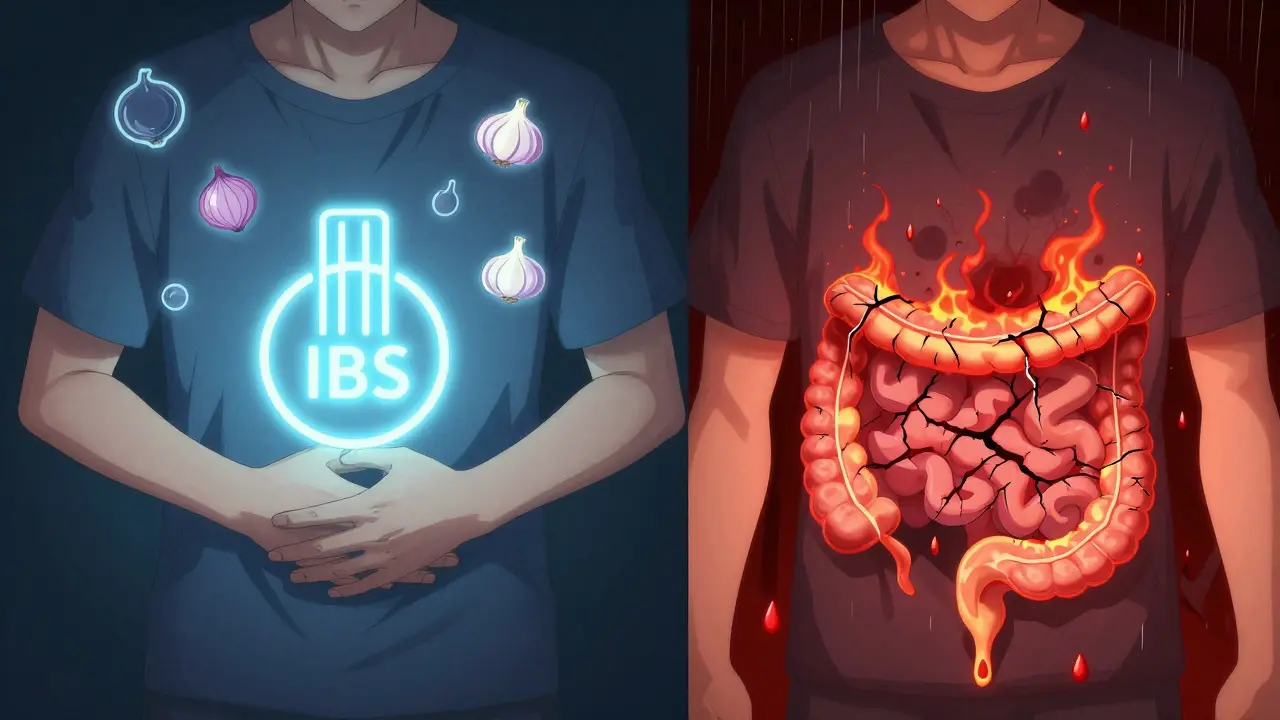
It’s easy to mix up IBS and IBD. Both cause belly pain, bloating, diarrhea, and urgency. You might even hear people say, "I have IBS," when they really mean IBD. But here’s the truth: IBS and IBD are not the same. One is a malfunctioning system. The other is a damaged one. Confusing them can delay real treatment-or worse, make you ignore dangerous warning signs.
What Is IBS? A Broken Signal, Not a Broken Gut
IBS stands for Irritable Bowel Syndrome. It’s not an infection. It’s not cancer. There’s no visible damage in your intestines. No ulcers. No inflamed tissue. Your colon looks perfectly normal on a colonoscopy. But your gut doesn’t work right. It’s like a miswired thermostat: your nerves are too sensitive, your muscles contract too hard or too slow, and your brain gets confused about what’s happening down there.
The Rome IV criteria, used by doctors worldwide since 2016, say IBS means you’ve had abdominal pain at least one day a week for three months, along with changes in bowel habits. That’s it. No blood in stool. No weight loss. No fever. If you have those, it’s not IBS. It’s something else.
Most people with IBS fall into one of three types: diarrhea-predominant (IBS-D), constipation-predominant (IBS-C), or mixed (IBS-M). About 76% report constant bloating. Nearly half notice mucus in their stool. Symptoms often flare after eating-especially foods high in FODMAPs, like onions, garlic, beans, and certain fruits.
Here’s what doesn’t happen with IBS: your intestines don’t get damaged. You won’t develop strictures, fistulas, or cancer from IBS alone. The Mayo Clinic, CDC, and WebMD all agree: IBS doesn’t lead to IBD. It doesn’t turn into anything worse. It’s a chronic condition, yes-but not a progressive one.
What Is IBD? Inflammation That Eats Away at Your Gut
IBD-Inflammatory Bowel Disease-is two diseases in one: Crohn’s disease and ulcerative colitis. Both are autoimmune. Your immune system attacks your own digestive tract. That’s not a glitch. That’s destruction.
In ulcerative colitis, inflammation starts in the rectum and creeps up the colon. In Crohn’s, it can hit anywhere-from mouth to anus-and digs deep into the bowel wall. This isn’t surface irritation. It’s full-thickness damage. You get ulcers. Scar tissue. Narrowing. Fistulas. Abscesses.
IBD symptoms go way beyond cramps and bloating. Blood in your stool? That’s a red flag. Black, tarry stools? That’s internal bleeding. Unexplained weight loss? Fever? Joint pain? Eye redness? Skin rashes? These aren’t "just stress." They’re signs your immune system is on fire.
Studies show 92% of ulcerative colitis patients have bloody stools at diagnosis. 65% of IBD patients lose weight during flares. 40% run fevers. One in five develop arthritis. One in ten get painful skin bumps called erythema nodosum. These aren’t side effects. They’re part of the disease.
And the damage doesn’t stop there. After 10 years of pancolitis (ulcerative colitis affecting the whole colon), your risk of colorectal cancer jumps by 2% per year. Toxic megacolon-a life-threatening swelling of the colon-happens in 2-4% of severe cases. Crohn’s patients have a 33% chance of developing intestinal blockages within a decade.
How Doctors Tell Them Apart
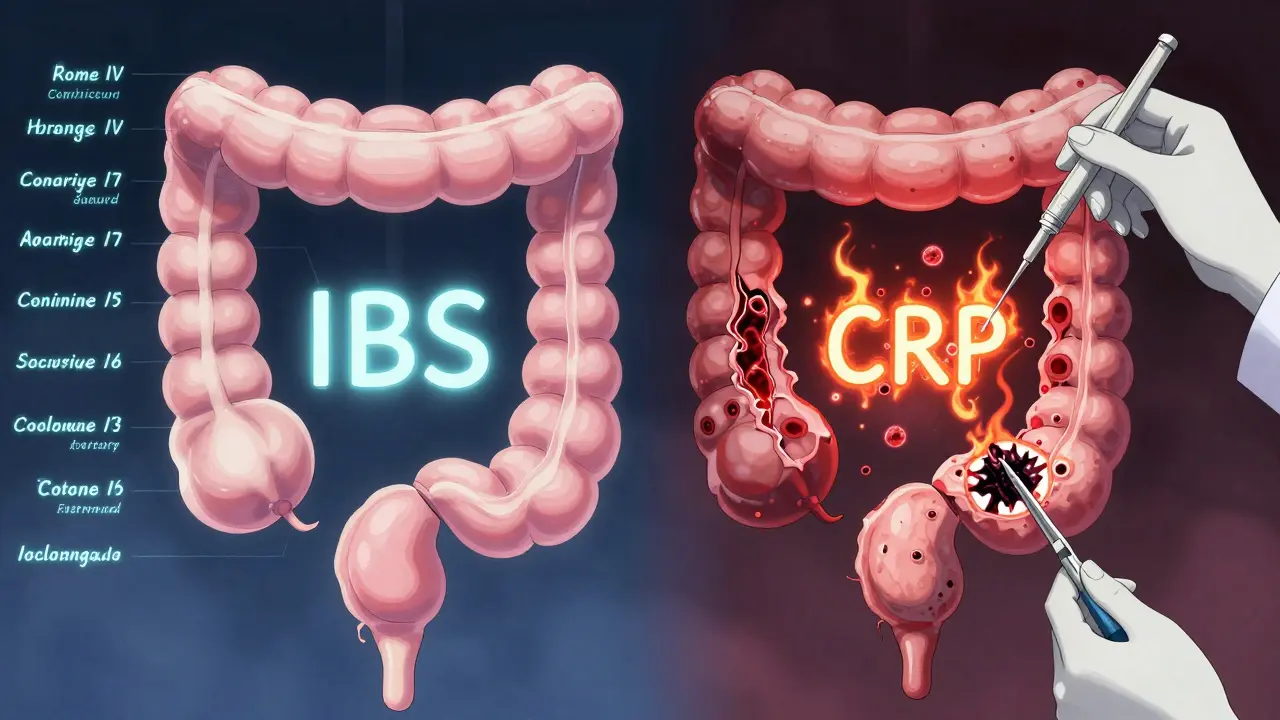
There’s no single test for IBS. That’s because it’s a diagnosis of exclusion. Your doctor runs tests to rule out everything else. Blood work? Normal. Stool tests? No infection, no blood. Colonoscopy? Clean lining. Biopsy? No inflammation. If all that checks out, and your symptoms match Rome IV criteria, it’s IBS.
IBD? It shows up everywhere. Blood tests reveal elevated CRP (C-reactive protein)-a marker of inflammation. Normal is under 3 mg/L. IBD patients often hit 5, 10, even 20. Fecal calprotectin? That’s a stool test for gut inflammation. Normal is under 50 µg/g. IBD patients? Often over 250. That’s a clear signal: your gut is inflamed.
Endoscopy is the gold standard. In IBD, your doctor sees red, swollen tissue, ulcers, bleeding, and sometimes cobblestoning (a patchy, bumpy appearance). In IBS? Everything looks normal. MRI or CT scans can show thickened bowel walls, fistulas, or abscesses in Crohn’s. You can’t fake that.
The CDC says it plainly: "IBD causes physical damage to the digestive tract. IBS does not." If you have bleeding, fever, or weight loss, don’t wait. Don’t assume it’s "just IBS." Get tested. Now.
How Treatment Is Totally Different
IBS treatment is about calming the system. No drugs to heal anything-because there’s nothing to heal. Instead, you adjust what you eat, how you manage stress, and sometimes take low-dose medications to ease nerve signals.
The low-FODMAP diet works for 76% of IBS patients. It cuts out fermentable carbs that feed gut bacteria and cause gas and bloating. Peppermint oil capsules? Proven to reduce cramping. Low-dose antidepressants like amitriptyline? They help block pain signals from the gut to the brain, cutting pain by half in 60% of users. Eluxadoline helps with diarrhea-predominant IBS. It’s not a cure. It’s management.
IBD? You need powerful drugs to stop your immune system from eating your intestines.
Anti-TNF drugs like infliximab put 50-60% of Crohn’s patients into remission within 14 weeks. Steroids like prednisone knock down flares fast-but you can’t stay on them. They wreck your bones, blood sugar, and mood. Newer biologics like vedolizumab target only the gut, reducing side effects. For some, surgery is needed: removing the colon in ulcerative colitis, or cutting out damaged sections in Crohn’s.
And here’s something most people don’t know: you can have both IBS and IBD. About one in three IBD patients in remission still have IBS-like symptoms. That doesn’t mean their IBD came back. It means their gut nerves are still overreacting. They need both types of treatment.
What You Need to Watch For
IBS is frustrating. It can ruin your life. But it won’t kill you. IBD? It can.
If you have IBS and suddenly start bleeding, losing weight without trying, or running fevers, stop. That’s not IBS flaring. That’s something new. That’s IBD-or something worse.
And if you have IBD and stop taking your meds because you feel fine? Don’t. Inflammation doesn’t always cause symptoms. But it’s still eating away at your gut. That’s how cancer starts.
Don’t self-diagnose. Don’t Google symptoms and assume you know. A bloated belly after beans? Could be IBS. A bloody stool? That’s not normal. Ever. Go to the doctor. Get tested. Get the right label. Because treatment depends on it.
Bottom Line: One Is a Misfire. The Other Is a Fire.
IBS is like a faulty alarm system. It goes off when there’s no danger. IBD is like a house on fire. The damage is real. The risk is real. The treatment must match the problem.
IBS: Manage symptoms. Eat smart. Reduce stress. Live well. You won’t die from it.
IBD: Control inflammation. Take your meds. Get monitored. Watch for cancer risk. You can live with it-but only if you treat it right.
They both hurt. But only one can kill you. Know the difference. Act on it.
Can IBS turn into IBD?
No. IBS does not turn into IBD. They are completely different conditions. IBS is a functional disorder with no physical damage. IBD is an inflammatory disease with visible tissue damage. Leading medical organizations like the Crohn’s & Colitis Foundation and the CDC confirm that IBS cannot progress into IBD. However, it’s possible to have both at the same time, especially if you have IBD in remission and still experience IBS-like symptoms.
Is blood in the stool a sign of IBS?
No. Blood in the stool is never a symptom of IBS. If you see red blood in your toilet, on toilet paper, or in your stool, it’s a warning sign of IBD, infection, hemorrhoids, or something more serious like colorectal cancer. IBS causes changes in bowel habits and pain, but never bleeding. If you have blood, see a doctor immediately. Don’t wait. Don’t assume it’s stress.
Can a colonoscopy diagnose IBS?
No. A colonoscopy cannot diagnose IBS. In fact, it’s used to rule out IBD and other diseases. If your colonoscopy shows a normal, healthy-looking lining with no inflammation, ulcers, or bleeding-and your symptoms match the Rome IV criteria-then your doctor can diagnose IBS. The diagnosis is based on symptoms and the absence of structural disease, not on what’s seen during the scope.
Do I need to take medication for IBS forever?
Not necessarily. Many people with IBS manage symptoms successfully with diet changes-like the low-FODMAP diet-stress reduction, and gut-directed therapies. Some take low-dose antidepressants or antispasmodics for months or years, but others find relief without long-term meds. Unlike IBD, IBS doesn’t require lifelong immune-suppressing drugs. Treatment is tailored to your symptoms and how they change over time.
Can IBD be cured?
There’s no cure for IBD yet. But it can go into long-term remission. With the right combination of biologics, immunosuppressants, and sometimes surgery, many people live symptom-free for years. Ulcerative colitis can be "cured" by removing the colon-but that’s major surgery. Crohn’s disease can’t be cured that way because it can return anywhere in the digestive tract. The goal is to control inflammation, prevent damage, and avoid complications like cancer or bowel obstructions.
Are there any foods that cause IBD?
No foods cause IBD. It’s an autoimmune disease triggered by genetics and immune system dysfunction, not diet. But certain foods can worsen symptoms during flares-like dairy, spicy foods, alcohol, or high-fat meals. People with IBD often benefit from personalized diets to reduce bloating, diarrhea, or pain, but diet doesn’t cause or cure the disease. Unlike IBS, where diet plays a major role in triggering symptoms, IBD requires medical treatment to stop inflammation.



swarnima singh January 16, 2026
so i’ve had ‘ibs’ for 7 years and last year i started bleeding… i thought it was just stress or my period being weird… turns out it was ulcerative colitis. why does no one tell you that blood = not ibs? i almost died because i trusted google over doctors. don’t be me.
Isabella Reid January 16, 2026
thank you for writing this. i’m so tired of people saying ‘oh i have ibs’ when they mean they got food poisoning. it’s like calling a broken leg a sprain. the pain might feel similar but the stakes? totally different.
Jody Fahrenkrug January 17, 2026
my mom has ibd and she’s been on infliximab for 5 years. she’s had zero flares since starting. the meds saved her life. i used to think it was just ‘bad digestion’ until i saw her go from barely walking to hiking again. don’t ignore symptoms.
Chelsea Harton January 18, 2026
ibs = brain glitch. ibd = body on fire. that’s it. stop overcomplicating it.
Corey Chrisinger January 19, 2026
👏 the alarm system vs house fire analogy? chef’s kiss. also, i’m glad someone mentioned you can have both. my cousin’s been in remission for 3 years but still gets bloated after garlic bread. turns out she’s got ibs on top of ibd. mind blown.
Bianca Leonhardt January 19, 2026
if you think you have ibs and you’re not getting a colonoscopy, you’re not being careful-you’re being reckless. people die from this. stop self-diagnosing like it’s a tiktok trend.
Travis Craw January 21, 2026
just wanted to say i had ibs for years and the low fodmap diet changed everything. no meds, no drama. just cut out onions, garlic, and beans… and boom. i could actually eat dinner without crying. also, peppermint oil capsules? magic.
Christina Bilotti January 22, 2026
oh wow. another article pretending ibs is just ‘stress’? cute. have you met the people who live with it? it’s not ‘just’ anything. and yet you treat it like a minor inconvenience while ignoring the real danger of ibd. hypocrisy much?
Nick Cole January 23, 2026
my sister was misdiagnosed with ibs for 4 years. when she finally got the right test, her colon was covered in ulcers. she’s 28. she almost lost her colon. please-don’t wait. get tested. even if you think you know what it is.
waneta rozwan January 25, 2026
IBD = your immune system is literally trying to murder your intestines. IBS = your gut is just mad because you ate too much pizza. one needs chemo. the other needs a nap and a banana. stop equating them. please.
Bobbi-Marie Nova January 26, 2026
you’re all right. but also… i’ve had both. and honestly? the ibs part is worse when i’m in ibd remission. at least with ibd i know i’m being treated. with ibs? i just feel like a weirdo who can’t eat anything. so yeah. both suck. but only one can kill you. thanks for the clarity.