What Patent Term Restoration Really Means for Drug Companies
Imagine spending 12 years and $2.6 billion to develop a new drug. You finally get FDA approval. But your patent? It’s already been active for 8 years. That leaves just 4 years of market exclusivity before generics can copy your product. This isn’t a hypothetical-it’s the reality for most pharmaceutical companies. That’s where Patent Term Restoration (PTE) comes in. It’s not a loophole. It’s a legal fix designed to give drug makers back some of the patent life they lost waiting for regulators to approve their product.
PTE is governed by the Hatch-Waxman Act of 1984, a law that tried to balance two competing goals: letting generic drugs enter the market faster while still giving innovators a fair shot at recouping their investment. The math is simple: if the FDA takes too long to approve your drug, you get extra patent time. But it’s not automatic. You have to prove you didn’t waste any time. You have to show every step, every submission, every delay that wasn’t your fault.
How the PTE Clock Actually Works
The formula for calculating how much time you get back is complicated, but the idea isn’t. Here’s the breakdown:
- Regulatory Review Period (RRP): The total time from when you first submit your application to the FDA until they approve it.
- Pre-Grant Regulatory Review Period (PGRRP): The time between your patent filing and your first FDA submission. This doesn’t count toward your extension.
- Days of Applicant Due Diligence (DD): Any time you caused a delay-like missing a deadline or submitting incomplete data-gets subtracted.
- Total Patent Term (TP): Your original 20-year patent clock, starting from the first filing date.
The formula looks like this: PTE = RRP - PGRRP - DD - ½(TP - PGTP). But you don’t need to do the math yourself. The FDA calculates the eligible time and sends it to the USPTO, which then issues the extension.
There are hard limits: you can’t get more than 5 extra years, and your total patent life after extension can’t exceed 14 years from the date the FDA approves your product. So even if your FDA review took 8 years, you still only get up to 5 years back-and only if your original patent had enough time left to make it worth it.
Who Qualifies for PTE? It’s Not Just Pills
Most people think PTE is only for new drugs. It’s not. The law covers four categories:
- Human drug products
- Medical devices
- Food additives
- Color additives
In 1988, Congress added animal drugs to the list. That’s why you’ll see PTEs for veterinary medicines too. More recently, the 21st Century Cures Act expanded eligibility to include certain regenerative medicine products-think cell therapies and tissue-engineered products.
But here’s the catch: only one patent per product can get extended. If your company has 12 patents covering the same drug, you pick the one that gives you the most value. Usually, that’s the patent covering the active ingredient itself, not a formulation or delivery method. But many companies now file secondary patents strategically, hoping to get extensions on those instead. In fact, FDA data shows 78% of PTE applications now involve secondary patents, not the original compound patent.

The Hidden Trap: Due Diligence Is Everything
The biggest reason PTE applications get denied? Failure to prove due diligence. The FDA doesn’t just want to know when you submitted your application. They want day-by-day proof you were moving forward. Emails. Meeting notes. Lab logs. Regulatory correspondence. Every single delay you caused? You have to document why it happened-and prove you fixed it immediately.
A 2023 survey by the Intellectual Property Owners Association found that 67% of pharmaceutical patent attorneys call PTE applications “high-risk, high-reward.” Why? Because one missing email or unrecorded phone call can sink your entire extension. One senior patent specialist on Reddit shared that their team once lost a 3-year extension because they didn’t log a 48-hour delay in submitting a response to an FDA request. That’s not a typo. Two days cost them $400 million in projected revenue.
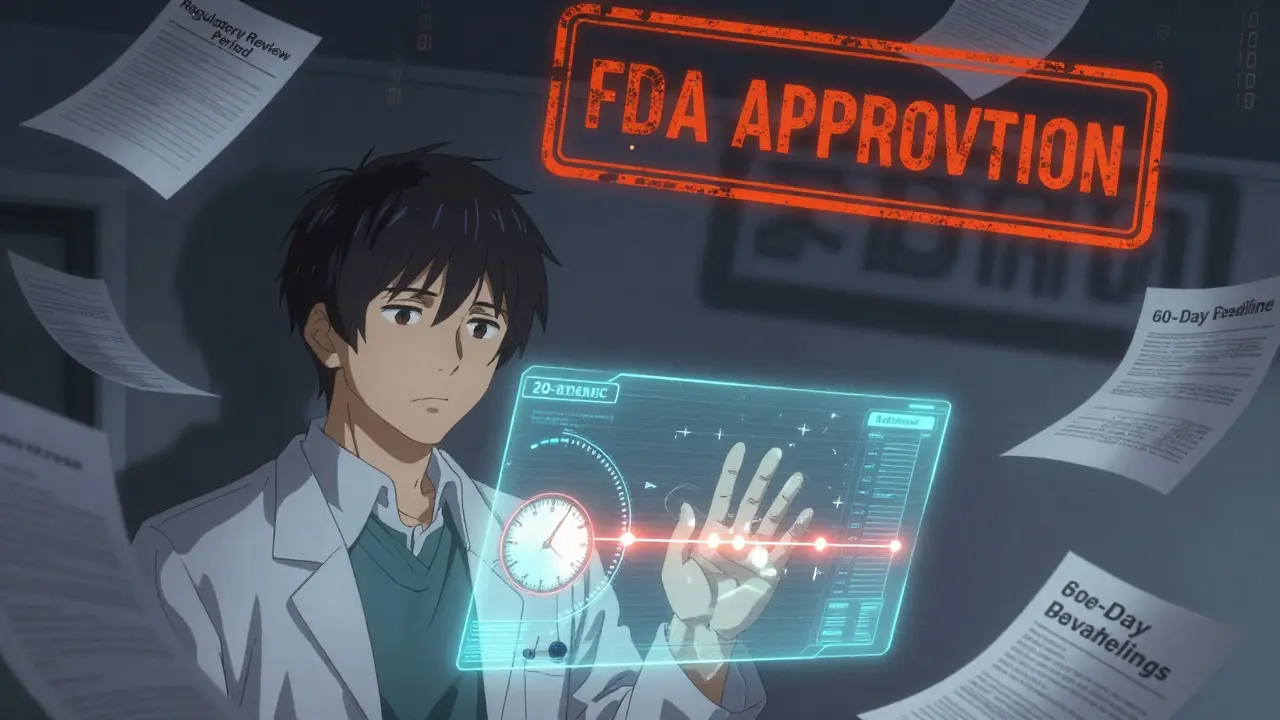
The USPTO denied 12.7% of PTE applications in 2022, mostly for inadequate documentation. And it’s not just about being thorough-it’s about being timely. You have only 60 days after FDA approval to file your PTE application. Miss that window, and you’re out of luck. No exceptions. No grace period.
Interim Extensions: A Lifeline for Late-Stage Drugs
What if your patent expires in six months, but the FDA hasn’t approved your drug yet? That’s where the interim extension comes in. You can apply for a temporary 1-year extension during the 6-month window before your patent expires. This keeps your protection alive while you wait for final approval.
This is critical for drugs in late-stage trials. One biotech company used this tactic to keep a cancer drug protected while waiting for a final FDA review. Without it, generics could have launched the moment their patent expired-even though the drug wasn’t on the market yet. The interim extension gave them breathing room to finalize approvals and launch commercially.
Why PTE Is Controversial-and Why It’s Not Going Away
On paper, PTE sounds fair. But critics say it’s been weaponized. A 2022 Yale Law & Policy Review study found that 91% of drugs that got a patent extension still kept monopolies for years after the extension ended, thanks to secondary patents, litigation, and other tactics. The Congressional Budget Office estimates PTE adds $4.2 billion a year to U.S. drug spending by delaying generics.
Some argue the system is broken. James Love of Knowledge Ecology International calls it a tool for creating “patent thickets”-layers of overlapping patents that block competitors. The FTC found that drugs with PTE maintain 92% market share during the extension period. After generics enter, that drops to 37%.
But the industry doesn’t want to lose it. Biologics-complex drugs made from living cells-are increasingly using PTE. In 2023, 34% of applications involved biologics, up from 19% in 2018. These drugs cost even more to develop and take longer to approve. Without PTE, companies would have little incentive to invest in them.
Recent court rulings are tightening the rules. In early 2024, a Federal Circuit decision (Eli Lilly v. USPTO) made it harder to prove due diligence during the pre-approval phase. Experts predict this could shrink average extensions by 8-12 months. Meanwhile, the FDA is working on a digital submission platform to streamline the process, launching in Q2 2026.

What This Means for You
If you’re a patient, PTE means your favorite brand-name drug stays expensive longer. If you’re a generic manufacturer, it means waiting longer to enter the market. If you’re a drug developer, it’s a lifeline-and a minefield.
The system works as designed: it rewards innovation and compensates for regulatory delays. But it’s also being stretched beyond its original intent. The Government Accountability Office is set to release a major review in December 2025. That report could lead to changes-tighter rules, shorter extensions, or even new limits on secondary patents.
For now, PTE remains a powerful tool. But it’s not magic. It’s paperwork. It’s timing. It’s proof. And if you don’t get every detail right, you lose everything.
Common Questions About Patent Term Restoration
Can any patent get extended under PTE?
No. Only patents covering human drugs, medical devices, food additives, color additives, or animal drugs qualify. The patent must be active, not expired, and must claim the product that went through FDA review. You can’t extend a patent that covers a method of use unless that method is the basis for FDA approval.
How long does it take to get a PTE approved?
The FDA takes about 217 days on average to review and send the extension recommendation to the USPTO. The USPTO then takes another 30-60 days to issue the final extension. That’s roughly 8-9 months total. But if your application is incomplete or lacks documentation, it can take much longer-or be denied.
Can I apply for PTE after my patent expires?
No. You must file within 60 days of FDA product approval. If your patent expires before you file, you lose your chance. There’s no exception-even if the delay was caused by the FDA. Timing is absolute.
Is PTE the same as Patent Term Adjustment (PTA)?
No. PTA is for delays caused by the USPTO-like slow examination or missed deadlines on their end. PTE is for delays caused by the FDA during regulatory review. They’re two separate programs with different rules, agencies, and calculations.
Do other countries have PTE systems?
Yes, but they’re different. The European Union, Japan, Canada, and Australia all have some form of patent term extension for pharmaceuticals. But the rules vary. The U.S. system is one of the most generous, with a 5-year cap and 14-year total limit. Other countries cap extensions at 5 years too, but some use different calculation methods or have stricter due diligence requirements.
What Happens Next?
The next big milestone is the GAO’s December 2025 report on PTE’s impact on drug prices. If they find the system is being abused, Congress could act. Proposed bills like the Preserve Access to Affordable Generics and Biosimilars Act aim to limit secondary patent extensions and shorten the window for filing PTE applications.
For now, the best advice is simple: if you’re developing a drug, treat PTE like a legal deadline, not a bonus. Start documenting early. Coordinate your patent team with your regulatory team. Don’t wait until approval to think about your extension. The clock starts ticking the day you file your patent-and it doesn’t stop for anyone.







Susie Deer January 13, 2026
This whole system is rigged. We pay billions for drugs that should be cheap, and then they get extra years just because the FDA is slow? That's not fairness, that's corporate theft.
Allison Deming January 15, 2026
While it is true that pharmaceutical companies invest enormous sums in research and development, the notion that Patent Term Restoration serves as a mere 'legal fix' is profoundly misleading. The regulatory review period, though often protracted, is not an arbitrary delay but a necessary safeguard for public health. To equate the loss of patent life with financial hardship ignores the fact that these companies operate with projected returns that account for regulatory timelines. The real issue lies not in the extension mechanism itself, but in the strategic filing of secondary patents-often for trivial modifications-that extend monopolies far beyond the spirit of the Hatch-Waxman Act. This is not innovation; it is legal engineering designed to suppress competition.
Henry Sy January 15, 2026
Bro, imagine spending 12 years and 2.6 billion just to make a pill and then some bureaucrat takes 8 years to sign off and you’re left with 4 years to make back your money? That’s not capitalism, that’s a rigged game. And now they’re playing chess with patents like it’s monopoly money. I get why they do it, but damn, the way they stretch every damn patent to the breaking point just to keep prices high? That’s not innovation, that’s extortion with a law degree.
Sarah -Jane Vincent January 17, 2026
You think this is about fairness? Wake up. The FDA is in bed with Big Pharma. Every delay they 'claim' to have caused? Probably orchestrated. The 60-day window? A trap. The digital platform launching in 2026? A distraction. They want you to think this is about paperwork when it’s really about control. And don’t get me started on how they use regenerative medicine as a backdoor to extend patents on biologics. This isn’t a loophole-it’s a backdoor to a monopoly factory. The GAO report in 2025? Already rigged. They’ll say everything’s fine because the lobbyists wrote it.
Alvin Bregman January 17, 2026
i mean yeah the system is messy but honestly if you spent 12 years on a drug you kinda deserve some extra time. the problem is when they file 12 patents for the same pill just to keep generics out. i get it, big pharma needs to make money but like… why does a new insulin cost 300 bucks when the chem is 20 years old? the paperwork thing is wild though, one missed email = 400 mil? that’s insane. i hope the digital system helps but i doubt it
Anna Hunger January 18, 2026
It is imperative to underscore that the Patent Term Restoration framework, as codified under the Hatch-Waxman Act, constitutes a carefully calibrated equilibrium between incentivizing innovation and ensuring timely market access for generic competitors. The requirement for rigorous documentation of due diligence is not an administrative burden but a necessary safeguard against fraudulent claims. Moreover, the statutory cap of five additional years and the fourteen-year post-approval ceiling reflect deliberate legislative restraint. To conflate the legitimate application of PTE with anticompetitive patent thickets is to misunderstand both the law and its implementation. The solution lies not in dismantling the system, but in enforcing its existing boundaries with greater diligence.
Jason Yan January 19, 2026
I’ve been thinking about this a lot lately. Like, what does ‘fair’ even mean here? If a drug takes 12 years to get approved, and your patent clock started ticking the day you filed it, then you’ve lost half your life to bureaucracy. But then again, if you get 5 extra years and charge $100,000 a dose while generics are still in development… is that fair to the person who needs it? Maybe the real question isn’t how long the patent lasts, but who gets to decide what ‘fair’ looks like. And who’s paying for it? I don’t have answers, but I think we’re all just trying to survive a system that was never meant to be this complicated.
shiv singh January 19, 2026
You think this is bad? In my country we don’t even have this system. They just let generics in right away. And guess what? People live longer. No one is rich because of a patent. The real criminals are the ones who make you believe you need to pay for your medicine. I saw a kid cry because he couldn’t afford his insulin. And you’re arguing about paperwork? That’s not justice. That’s greed in a suit. I hope your FDA burns down.
Robert Way January 19, 2026
wait so if you miss a deadline by 2 days you lose 400 million? that sounds like a typo. i think they meant 4 million. also why does the uspto even care if you sent an email? can’t they just ask the fda? this whole thing feels like someone made it up to keep lawyers employed. i’m gonna go cry in a corner now