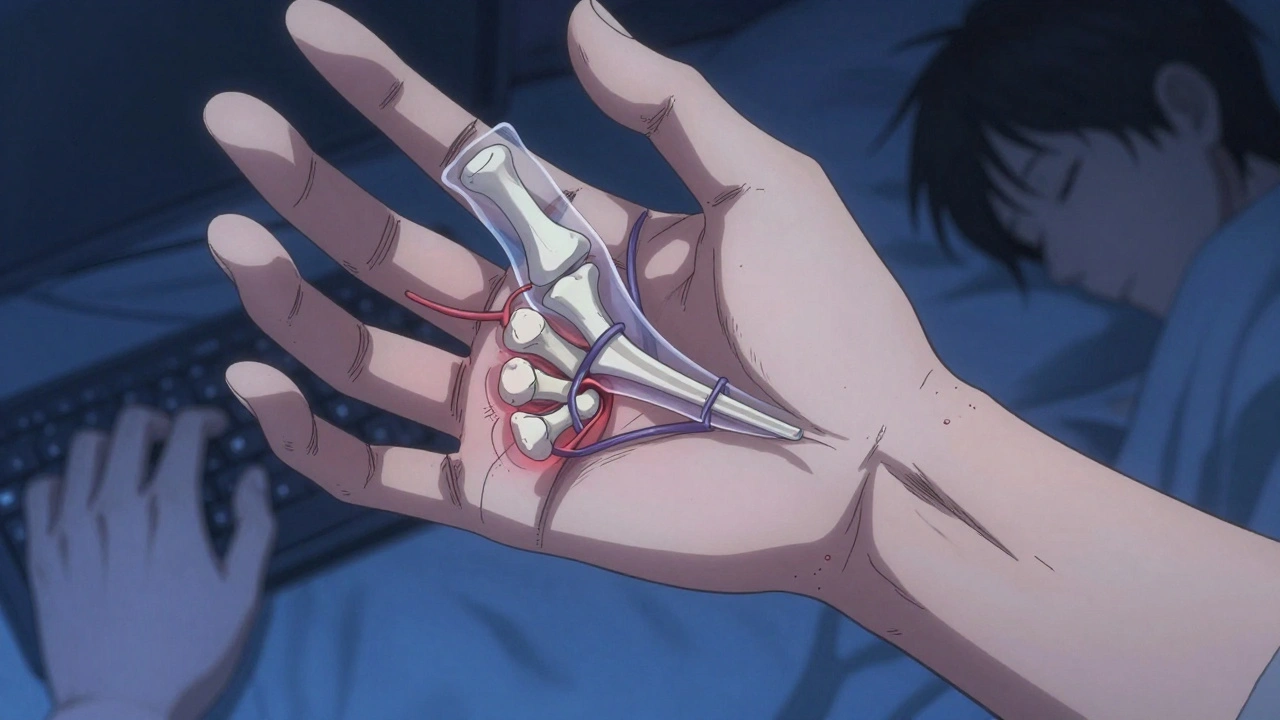
Most people don’t think about their wrists until they start hurting. But for millions, a quiet, creeping numbness in the hand-especially at night-isn’t just a nuisance. It’s a sign that the median nerve is being squeezed inside the carpal tunnel, a narrow passageway in the wrist. This is carpal tunnel syndrome (CTS), the most common nerve compression disorder in the upper body. It doesn’t just cause tingling. Left untreated, it can lead to permanent weakness, loss of grip, and real trouble doing everyday tasks like opening jars or buttoning shirts.
What Exactly Is Happening in Your Wrist?
Your wrist isn’t just skin and bone. Inside it lies a tight tunnel made of eight small carpal bones on the bottom and a tough ligament on top. Nine tendons that bend your fingers and thumb squeeze through it, along with the median nerve. That nerve is the one that gives feeling to your thumb, index, middle, and half of your ring finger. It also controls the small muscle at the base of your thumb. When that tunnel gets crowded-thanks to swelling, repetitive motion, or even just genetics-the nerve gets squished. It’s not like a pinched wire. The pressure cuts off blood flow to the nerve, causes swelling inside the nerve itself, and over time, damages its protective coating (demyelination). If it goes on long enough, the nerve fibers start dying. That’s when numbness becomes permanent, and your thumb muscle starts to waste away.How Do You Know It’s Carpal Tunnel?
The symptoms don’t show up all at once. They creep in. At first, you might wake up with a tingling hand, like it’s asleep. Shake it a little, and it clears up. That’s stage one: mild. You might ignore it. But if it starts happening during the day-while typing, driving, or holding a phone-that’s stage two: moderate. By stage three, your fingers feel numb all the time. You drop things. You can’t tell if you’re holding a coin or a key. And your thumb feels weak, like it’s lost its strength. The pain doesn’t stay in the wrist. It often shoots up the forearm, sometimes all the way to the shoulder. It’s not just discomfort-it’s interference. A 2023 survey of over 1,200 people with CTS found that 78% reported symptoms starting at night and worsening over 6 to 18 months before they sought help. Doctors don’t just guess. They use a few simple tests. The Phalen test? Hold your wrists bent forward for a minute. If your fingers tingle, it’s a red flag. The Tinel sign? Tap over the wrist. If it shocks your fingers, that’s another clue. Then there’s the Katz hand diagram-a drawing of a hand where you mark where you feel numbness. If it matches the median nerve’s path, it’s classic CTS. For certainty, nerve conduction studies measure how fast signals travel through the nerve. A delay over 3.7 milliseconds across the wrist confirms the diagnosis.When Should You Act?
Time matters. The longer you wait, the harder it is to fix. Studies show that if symptoms last less than 10 months, conservative treatments work in 75% of cases. But if it’s been over a year, that drops to just 35%. Why? Because nerve damage becomes irreversible. Muscle atrophy in the thumb is a late sign-meaning if you see it, the nerve has been under pressure for a long time. That’s why early action isn’t optional. It’s the difference between regaining full function and living with permanent weakness.Conservative Treatments That Actually Work
Before surgery, try these. They’re not magic, but they’re backed by solid data. Wrist splints at night are the first-line treatment. Not just any brace-properly fitted, holding your wrist in a neutral position (not bent up or down). Studies show 60-70% of people with mild to moderate CTS see big improvement after wearing one for 4 to 6 weeks. The key? Consistency. Wear it every night for at least 8 hours. Many people skip nights and wonder why it’s not working. Nerve gliding exercises help the nerve move freely inside the tunnel. They’re not stretches for your muscles-they’re gentle, guided movements that slide the nerve back and forth. A physical therapist can teach you these in 2 to 4 sessions. Do them daily. Corticosteroid injections reduce swelling around the nerve. They’re not a cure, but they can give you 3 to 6 months of relief. About 70% of patients benefit. It’s a good option if you need temporary relief while waiting for surgery or trying other treatments. Activity changes matter more than you think. Avoid bending your wrist more than 30 degrees for long periods. If you type, raise your keyboard so your wrists stay flat. If you work on an assembly line, take breaks every 20 minutes. Use your whole hand to grip, not just your fingers. These small shifts can cut pressure on the nerve.
When Surgery Becomes Necessary
If splints, exercises, and injections don’t help after 6 to 8 weeks-or if you’re losing muscle strength-it’s time to talk surgery. Carpal tunnel release is one of the most common hand surgeries in the U.S., with about 500,000 done each year. There are two main types: open release and endoscopic release. Open means a 2-inch cut along the palm. Endoscopic uses one or two tiny cuts and a camera. Both cut the ligament above the nerve to give it space. Success rates are high: 90-95% of patients report major improvement. But it’s not risk-free. About 15-30% get pillar pain-tenderness on the sides of the palm that can last weeks. Scar tenderness happens in 5-10%. Nerve injury is rare-under 1%. A newer option is ultrasound-guided percutaneous release, approved by the FDA in 2021. It’s done through a needle-sized device. Patients report 40% less pain after and return to work 50% faster than with traditional surgery.Costs and Recovery
Conservative care-splints, therapy, injections-typically costs $450 to $750 in the U.S. A custom splint runs $150-$250. Therapy sessions are $100-$200 each. Injections cost $300-$500. Surgery? Out-of-pocket costs range from $1,200 to $2,500 with insurance. Endoscopic is 15-20% more than open, but recovery is quicker. Most people return to light work in 2 to 3 weeks. Full recovery for manual labor jobs takes 6 to 12 weeks. Physical therapy after surgery usually involves 6 to 8 sessions over 4 to 6 weeks.Who’s Most at Risk?
Women are three times more likely to get CTS than men. It peaks between ages 45 and 60. Why? Hormones, smaller carpal tunnels, and higher rates of conditions like arthritis and thyroid disease play a role. Work matters too. The Bureau of Labor Statistics recorded 27,300 work-related CTS cases in 2022. The top jobs? Manufacturing (23%), healthcare (19%), and food service (14%). If you’re doing the same hand motion for hours-typing, gripping tools, assembling parts-you’re at higher risk.
What Doesn’t Work
Don’t waste time on unproven fixes. Yoga? Some people swear by it, but there’s no solid evidence it treats CTS. Acupuncture? May help pain, but not nerve compression. Anti-inflammatory diets? No proof they reverse nerve damage. And don’t rely on online self-diagnosis. Many people with numb hands have something else-neck issues, arthritis, or even diabetes. The only reliable tools are clinical exams and nerve tests. If your symptoms match CTS, get evaluated. Don’t wait for it to get worse.Looking Ahead
New tools are changing how CTS is diagnosed. High-resolution ultrasound can now measure the median nerve’s size. If it’s over 12mm² at the wrist, it’s likely compressed. One 2023 study showed this method is 92% accurate-close to nerve conduction tests. More clinics are starting to use it. And prevention? It’s possible. The EU requires ergonomic assessments for high-risk jobs. The U.S. doesn’t. But that doesn’t mean you can’t push for better setups at work. Adjust your workstation. Use voice-to-text. Take breaks. These small steps could keep you from needing surgery.What to Do Next
If you’re waking up with numb hands, don’t shrug it off. Start with a wrist splint tonight. Keep a symptom journal-note when it happens, how long it lasts, what makes it better or worse. See a doctor within a month. If you’re in your 50s, female, and work with your hands, you’re in a high-risk group. Early action saves function. CTS isn’t a life sentence. It’s a treatable condition. But like any nerve problem, timing is everything. The sooner you act, the better your chances of getting back to normal.Can carpal tunnel syndrome go away on its own?
Rarely. Mild symptoms might improve with rest or splinting, but the underlying nerve compression doesn’t fix itself. Without treatment, symptoms usually get worse over time. Waiting for it to resolve on its own often leads to permanent nerve damage.
Is carpal tunnel syndrome caused by typing too much?
Not directly. While repetitive hand movements can worsen symptoms, research doesn’t support typing as a primary cause. More common triggers include forceful gripping, vibration, prolonged wrist flexion, and underlying health issues like diabetes or thyroid disease. Office workers get CTS, but so do assembly line workers and healthcare staff-people who use their hands in ways that compress the wrist.
Are wrist braces effective for carpal tunnel?
Yes, especially when worn at night. Studies show 60-70% of people with mild to moderate CTS see significant improvement after 4 to 6 weeks of consistent nighttime splinting. The key is proper fit-wrist in neutral position, not bent. Daytime use helps too if you’re doing tasks that strain the wrist.
How long does carpal tunnel surgery recovery take?
Most people return to light work in 2 to 3 weeks. Full recovery, especially for manual labor, takes 6 to 12 weeks. Endoscopic surgery may speed this up by 2 to 3 weeks compared to open surgery. Physical therapy is usually needed for 4 to 6 weeks to restore strength and motion.
Can carpal tunnel come back after surgery?
It’s uncommon. Success rates for surgery are 90-95%. Recurrence usually happens only if the original cause-like repetitive strain or an underlying medical condition-isn’t addressed. In rare cases, scar tissue can form and compress the nerve again, but this happens in less than 5% of cases.
Do I need an MRI or X-ray to diagnose carpal tunnel?
No. X-rays and MRIs don’t show nerve compression well. The gold standard is nerve conduction studies (NCS) or electromyography (EMG). Ultrasound is becoming a reliable alternative in clinics with the right equipment. Clinical exams-like the Phalen and Tinel tests-are often enough to start treatment.








Chad Kennedy December 3, 2025
I've been ignoring this for months. Now my thumb feels like a dead fish. Why did I wait so long?
Cyndy Gregoria December 4, 2025
You're not alone. I started with a $20 splint from Walmart and wore it every night. Within 3 weeks, the numbness was gone. Just don't skip nights. Consistency is everything.
Palanivelu Sivanathan December 4, 2025
Bro... this is the universe whispering: 'Stop scrolling, stop typing, stop existing like a machine.' The wrist is the soul's first warning. We are not circuits. We are flesh. And flesh remembers. And flesh cries. And now... it screams.
Brian Perry December 6, 2025
so i got the splint but i keep forgetting to wear it... like i just... forget... then my hand wakes me up at 3am again. why is this so hard??
Stacy Natanielle December 7, 2025
I'm not sure if I should be concerned or just accept that I'm a 47-year-old woman who types too much. 🤷♀️ The pain is real, but so is my paycheck. #FirstWorldProblems
kelly mckeown December 8, 2025
I had this for 18 months before I saw a doctor. I thought it was just 'carpal tunnel vibes.' Turns out my nerve was almost dead. Please don't wait like I did. Get checked.
Tom Costello December 9, 2025
This is one of those topics where the science is clear, but people still ignore it. I work in HR and see a ton of this in manufacturing. The real tragedy isn't the pain-it's that employers don't fund ergonomic assessments. Prevention is cheaper than surgery.
dylan dowsett December 9, 2025
If you're not wearing a splint at night, you're just prolonging your suffering. And if you think yoga will fix this, you're delusional. Stop wasting time. Get a real brace.
Susan Haboustak December 11, 2025
You know who else gets this? People who don't stretch. People who don't hydrate. People who don't take breaks. This isn't bad luck-it's negligence. You chose this.
Siddharth Notani December 12, 2025
In India, many workers don't have access to splints. But simple wrist rest pads and 5-minute breaks every hour help a lot. Small changes matter.
Mark Gallagher December 14, 2025
This is why America needs mandatory workplace ergonomics. Other countries get it. We don't. And now we pay in nerve damage. Pathetic.
Wendy Chiridza December 14, 2025
I tried the injections and they worked for 4 months. Then it came back. Surgery was the only thing that fixed it. Worth every penny
Pamela Mae Ibabao December 14, 2025
I love how this post says 'don't wait' but doesn't mention how hard it is to get an appointment with a specialist. My waitlist was 6 months. 😔