
After cataract surgery, many people notice strange shapes drifting across their vision-dots, squiggles, or cobweb-like shadows. It’s unsettling, especially when you just had surgery to see better. But here’s the truth: floaters after cataract surgery are incredibly common, and in most cases, they’re completely harmless. The real question isn’t whether they’re normal-it’s knowing when they might mean something serious.
Why Do Floaters Happen After Cataract Surgery?
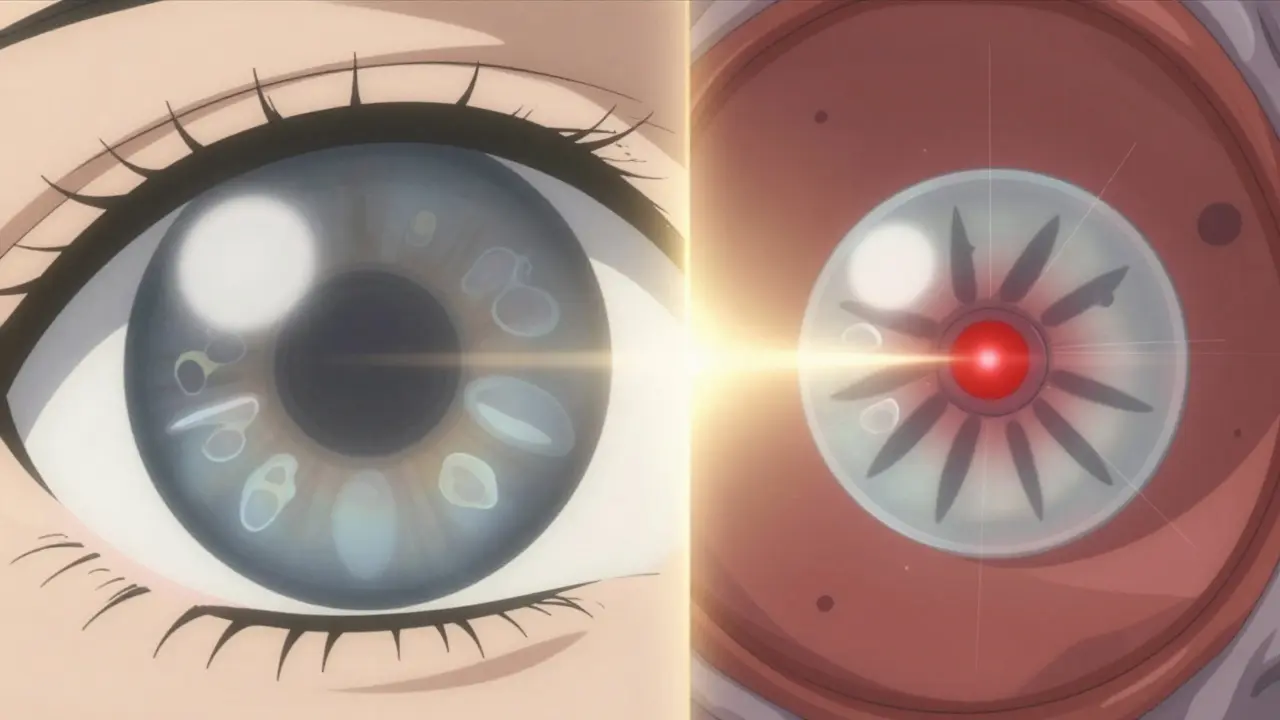
Cataract surgery replaces your cloudy natural lens with a clear artificial one. That’s great for vision-but it also changes how light moves inside your eye. Before surgery, the cataract acted like frosted glass, blurring out tiny imperfections in the vitreous gel-the clear, jelly-like substance that fills the back of your eye. After surgery, that blur is gone. Suddenly, you can see all the little clumps of collagen fibers that have been floating around in your vitreous for years. They weren’t new. They were just hidden. These clumps cast shadows on your retina, and your brain interprets them as floaters. They drift when your eye moves, which makes them feel like they’re alive. You’ll notice them most against bright backgrounds-like a white wall or a clear blue sky. It’s not your vision getting worse. It’s your vision getting better, and finally showing you what was always there.How Common Are They?
About 70% of people who have cataract surgery notice floaters in the first few days or weeks afterward. A study of over 3,700 patients found that the procedure itself-especially phacoemulsification-can trigger a natural process called posterior vitreous detachment (PVD). This is when the vitreous gel starts to shrink and pull away from the retina. It’s normal with age, but surgery speeds it up. About 85% of those floaters fade or become less noticeable within 3 to 6 months. By 12 weeks, nearly 9 out of 10 patients say they barely notice them anymore. One patient on Reddit shared: “Had surgery January 10th. Floaters were annoying for the first three weeks. Now, eight weeks later, I hardly think about them.” That’s the typical story.Normal vs. Warning Signs: The 3-2-1 Rule
Most floaters after cataract surgery are just noise. But sometimes, they’re a signal. Here’s how to tell the difference. Normal floaters:- Appear gradually over days or weeks
- Stay about the same number-no sudden increase
- Don’t come with flashes of light
- Don’t block part of your vision
- Slowly improve over weeks to months
- Sudden shower of 10+ new floaters in minutes
- Flashes of light-2 or more per minute
- A dark curtain or shadow creeping across your vision
- Blurred or distorted central vision
What Should You Do?
If you’re noticing floaters after surgery, don’t panic. But do monitor them. Most clinics recommend follow-up visits at 1 week, 1 month, and 3 months after surgery. During these visits, your eye doctor will dilate your pupils and check the retina for signs of tearing or detachment. That’s how they catch problems early. For mild floaters that are just annoying, try this: gently move your eyes in slow circles. It won’t make the floaters disappear, but it can shift them out of your direct line of sight. Many patients say this simple trick helps them adapt faster.When Should You Consider Treatment?
Most people don’t need treatment. But if floaters stick around for over a year and seriously interfere with reading, driving, or daily life, options exist. Laser vitreolysis uses a laser to break up large floaters. It’s non-invasive and works for about 65% of patients. It’s not perfect-some floaters return-but it’s safer than surgery. Vitrectomy is a more involved procedure where the vitreous gel is removed and replaced with a clear fluid. It’s over 90% effective at removing floaters, but it carries risks: cataract progression, infection, or retinal detachment. It’s usually only recommended if floaters are severely disabling.
What’s New in Treatment?
Recent advances are making life easier for people with persistent floaters. Studies show that using femtosecond lasers during cataract surgery reduces the chance of PVD by 18% compared to traditional methods. That means fewer floaters from the start. There’s also a new FDA Phase III trial testing an enzyme-based treatment that dissolves the clumps in the vitreous. Early results show 78% reduction in floaters at six months-with almost no side effects. It could become a common outpatient option in the next few years.What Patients Say
A survey of over 1,200 cataract patients found that 78% noticed floaters in the first month. But 89% said they either got used to them or saw them fade within 12 weeks. The biggest factor in patient satisfaction? Education. Those who were told ahead of time that floaters were common and usually harmless reported far less anxiety. One patient wrote: “My surgeon explained it all before surgery. When I saw them, I wasn’t scared. I just waited it out.”Final Thoughts
Floaters after cataract surgery are not a sign of failure. They’re a side effect of success. Your vision is clearer than it’s been in years-and that’s why you see them. For most, they fade. For a few, they linger. But if they suddenly multiply, come with flashes, or block your vision? That’s not normal. That’s an emergency. The key is awareness. Know what’s typical. Know the red flags. And don’t hesitate to call your eye doctor if something feels off. Modern cataract surgery is one of the safest procedures in medicine. With the right information, floaters won’t ruin your new vision-they’ll just be a footnote in your recovery story.Are floaters after cataract surgery normal?
Yes, floaters after cataract surgery are very common. Around 70% of patients notice them in the first few weeks. They happen because the new artificial lens lets more light into the eye, making pre-existing clumps in the vitreous gel more visible. Most fade or become less noticeable within 3 to 6 months.
How long do floaters last after cataract surgery?
For most people, floaters improve within 4 to 12 weeks. About 85% of cases resolve within 6 months. In 15-20% of patients, especially those with posterior vitreous detachment, floaters may persist longer-but they usually become less bothersome over time as the brain learns to ignore them.
When should I be worried about floaters after cataract surgery?
You should seek immediate medical attention if you experience a sudden increase of 10 or more new floaters, persistent flashes of light (2 or more per minute), or a dark shadow or curtain over part of your vision. These could signal a retinal tear or detachment, which requires treatment within 72 hours to prevent permanent vision loss.
Can floaters be treated after cataract surgery?
Yes, but treatment is rarely needed. For persistent, bothersome floaters, laser vitreolysis can reduce them in about 65% of cases. In rare cases, a vitrectomy (surgical removal of the vitreous) may be performed, with over 90% success-but it carries higher risks. Most patients adapt without any intervention.
Do floaters mean my cataract surgery failed?
No. Floaters are not a sign of surgical failure. In fact, they often mean your surgery worked-your vision is clearer, so you can now see the tiny debris that was always there but hidden by the cataract. They’re a side effect of improved vision, not a complication of the procedure.
Can I prevent floaters after cataract surgery?
You can’t completely prevent them, but newer techniques like femtosecond laser-assisted cataract surgery reduce the risk of posterior vitreous detachment by 18% compared to traditional methods. Pre-op OCT scans also help identify patients at higher risk. Still, floaters remain common even with advanced techniques.








Marie Fontaine February 9, 2026
Just had my surgery 3 weeks ago and yeah, the floaters were wild at first 🤯 But now? Barely notice them. Seriously, it’s like your brain just turns off the noise. Trust the process! 🌞
Brandon Osborne February 11, 2026
You people are acting like this is some miracle cure. Newsflash: your eye is still a biological mess. Floaters aren’t ‘normal’-they’re a sign your vitreous is decaying. If you’re not panicking, you’re not paying attention. This isn’t ‘just part of healing’-it’s your eyeball falling apart.
Lyle Whyatt February 12, 2026
Okay, I’m gonna go full nerd here because I’ve been researching this since my surgery last year. The vitreous doesn’t just ‘shrink’-it undergoes syneresis and liquefaction, and the collagen fibrils aggregate into dense, light-scattering complexes. What we call ‘floaters’ are actually microstructural remnants of the gel’s phase separation. The reason they fade isn’t because they disappear-it’s because your visual cortex starts filtering them out via neural adaptation. It’s like noise-canceling for your retinal input. And yeah, phacoemulsification does accelerate this by creating microfluidic disturbances in the posterior chamber. But here’s the kicker: studies from 2022 show that patients with higher baseline vitreous density (measured via OCT) report floaters 3x longer. So it’s not just ‘wait it out’-it’s personalized ocular biology. Also, I still see one. It’s shaped like a tiny squid. I named him Squidward.
Joseph Charles Colin February 14, 2026
Posterior vitreous detachment (PVD) occurs in 50-70% of post-phaco patients within 6 weeks. The vitreous cortex detaches from the retinal internal limiting membrane due to altered hydrostatic gradients post-lens extraction. This triggers localized release of cytokines like VEGF and IL-6, which may transiently increase vitreous opacities. Most resolve as the vitreous reorganizes into a more homogeneous gel phase. No intervention required unless you’re experiencing Weiss ring detachment or preretinal hemorrhage-then it’s vitrectomy territory.
Chelsea Cook February 14, 2026
So let me get this straight-you had surgery to see better… and now you’re mad because you can finally see the junk that’s been floating in your eye for 30 years? 🤦♀️ Welcome to adulthood, folks. Your eyeballs have been lying to you. The real miracle isn’t the lens-it’s your brain pretending not to notice the tiny demons.
Andy Cortez February 16, 2026
lol they said ‘it’s normal’ but I swear one of mine looked like a tiny screaming face. I’m not crazy. I’ve seen it. Twice. I’m gonna get a second opinion. Or a exorcist. One of the two.
Jacob den Hollander February 17, 2026
I just want to say-this is such a relief to read. I was terrified when I saw my first floater after surgery. Thought I’d ruined my vision. But reading how common this is, and how the brain adapts… it helped me breathe. Seriously. I’m not alone. And if you’re reading this and panicking? You’re gonna be okay. It gets better. I promise.
Andrew Jackson February 17, 2026
It is imperative to note that the modern medical establishment's casual dismissal of postoperative vitreous opacities reflects a systemic erosion of clinical rigor. In the 19th century, physicians would have conducted fundoscopic examinations within 48 hours. Today? ‘Wait and see.’ This is not medicine. This is negligence dressed in white coats. The retina is not a suggestion-it is a biological imperative. And we are failing it.
Chima Ifeanyi February 19, 2026
Let’s be real. This whole ‘floaters are normal’ narrative is just Big Ophthalmology’s way of selling more laser procedures. They know 85% fade-but they still charge $2,500 for vitreolysis. And don’t get me started on femtosecond lasers. That’s just a fancy way to charge extra for a machine that makes a pretty noise. You think they care about your vision? They care about your insurance card.
John Sonnenberg February 19, 2026
It’s been 14 weeks. I still see them. Every. Single. Day. I’m not ‘adapting.’ I’m just learning to live with the fact that my eyes are haunted. And now I’m paranoid every time I blink. What if it’s not a floater? What if it’s a tumor? A parasite? A government drone? I’ve started wearing sunglasses indoors. I don’t care what anyone says. I’m not normal anymore.
Tori Thenazi February 21, 2026
Wait… so you’re telling me the floaters were ALWAYS there? And they’re just… visible now? Like… what if they weren’t just debris… what if they’re… spirits? I read online that after eye surgery, your third eye opens. I think one of mine is trying to communicate. I’ve been writing to it. It responds by moving when I look left. I think it’s saying ‘help me.’
Randy Harkins February 22, 2026
I had the same thing after my surgery. First week was rough. But honestly? I started doing the eye circles thing. It’s dumb, but it works. I also started using my phone’s brightness setting to dim the background. Makes the floaters way less obvious. I’m 7 months out now. I forgot I had them until today. Best feeling ever. You got this 💪
Marie Fontaine February 22, 2026
^^^ this! The eye circles trick changed my life. Also, try looking at a sunset. The colors make them blend in. It’s weirdly beautiful. I even took a pic once. Looked like a galaxy in my eye. I’m not even mad anymore.
Elan Ricarte February 23, 2026
Y’all are acting like this is some mystical experience. It’s not. It’s just your eyeball’s version of static on an old TV. You didn’t ‘get better’-you just got a clearer window into the decay. Congrats, your eyes are now a haunted house. And the ghosts? They’re your collagen. And they’re not going anywhere. Enjoy your new VIP pass to the void.
Joshua Smith February 24, 2026
Just curious-did anyone else notice the floaters moved differently depending on which direction you looked? Like, they’d cluster near the periphery when looking straight ahead? I’ve been tracking mine for months and it’s oddly soothing. Like watching clouds. I think I’m becoming a weirdo.