
Medication Side Effect Checker
Is This Side Effect Safe to Tolerate?
Based on CDC, FDA, and clinical guidelines. This is not medical advice but helps you make informed decisions.
Every time you start a new medication, you’re not just getting the treatment you need-you’re also signing up for possible side effects. Some are mild, fleeting, and barely noticeable. Others can make you feel worse than the condition you’re trying to treat. The real question isn’t whether side effects happen-it’s when to accept them and when to act.
Not All Side Effects Are Created Equal
The FDA defines side effects as unintended responses to medication at normal doses. But not all unintended responses are the same. Some are harmless annoyances. Others are red flags. The difference lies in severity, duration, and how much they interfere with your daily life. Take dry mouth, for example. It’s one of the most common side effects, affecting up to 60% of people on certain antipsychotics or antidepressants. If it’s just a little dryness that goes away after a few sips of water, it’s usually fine to live with. But if your mouth feels like sandpaper all day, you’re struggling to swallow, or you’re getting constant mouth sores, that’s not normal. That’s a signal to talk to your doctor. Drowsiness is another big one. Around 35-40% of people on SSRIs feel tired in the first week. If it fades after 7-10 days, it’s often worth sticking with the medication. But if you’re nodding off at work, forgetting appointments, or feeling too groggy to drive, that’s not just inconvenient-it’s dangerous. That’s when you need to step in.What Side Effects Are Usually Safe to Tolerate?
Some side effects are temporary by design. Your body needs time to adjust. Here’s what typically falls into the "wait and see" category:- Mild nausea in the first few days of starting an antibiotic or antidepressant
- Initial drowsiness or fatigue (resolves within 1-2 weeks)
- Minor dry mouth or constipation (manageable with hydration or dietary tweaks)
- Light headaches or dizziness that don’t affect balance or coordination
When Side Effects Are a Warning Sign
There’s a line between discomfort and danger. Cross it, and you need help now-not later. Here’s when to act immediately:- Swelling in your face, lips, or throat
- Difficulty breathing or wheezing
- Hives or a spreading rash
- Black, tarry stools or vomiting blood
- Confusion, memory loss, or trouble walking
- Severe dizziness that makes you fall

Why People Wait Too Long (And What Happens)
Most people don’t call their doctor right away. They try to tough it out. A 2024 analysis of 782 Reddit threads from the r/medication community found that 65% of users tried to handle side effects on their own before reaching out. Of those, 42% ended up suffering longer than necessary. The biggest mistake? Stopping the medication without talking to a provider. The CDC’s 2023 adherence survey showed that 28% of people quit their meds because of side effects. But here’s the kicker: 73% of those cases led to treatment failure. If you stop an antidepressant, blood pressure drug, or seizure medication cold turkey, you’re not just losing the benefit-you might trigger a rebound effect that’s worse than the original problem. One patient, 62, was struggling with nausea from a new antibiotic. She took it on an empty stomach, and it hit her hard-5-6 episodes a day. She almost quit. But after talking to her pharmacist, she started taking it with a high-protein snack. Her nausea dropped to 1-2 times a day. No dose change. No switch. Just a simple adjustment.How to Talk to Your Doctor About Side Effects
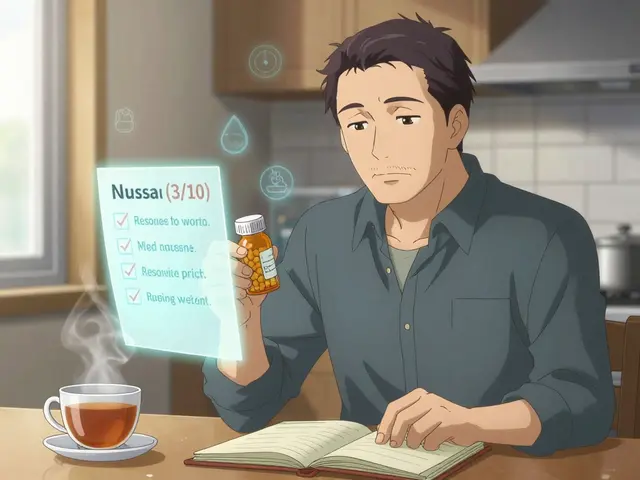
Doctors can’t help if they don’t know what’s going on. And vague complaints like "I feel weird" don’t cut it. The FDA’s 2023 guidelines say patients who track side effects with details are 4.2 times more likely to get the right fix. Before your appointment, write down:- Which side effect you’re having
- How bad it is (1-10 scale)
- When it happens (right after taking the pill? 2 hours later?)
- How long it’s lasted
- What it’s stopping you from doing (sleeping? working? walking?)
- Is this side effect expected with this medication?
- How long should it last?
- What should I do if it gets worse?

What Are Your Options Beyond "Just Take It"?
You don’t have to suffer. There are usually three paths:- Dose adjustment: Lowering the dose can cut side effects by 45-50% without losing effectiveness.
- Timing change: Moving your pill to bedtime or after meals helps 30-35% of people.
- Medication switch: If side effects last more than 4 weeks or disrupt your life, switching to another drug in the same class often works. This is successful in 15-20% of cases.
Cost and Comfort: The Hidden Trade-Off
Sometimes, people keep taking meds with side effects not because they think it’s safe-but because they can’t afford to switch. A 2023 Kaiser Family Foundation study found that 37% of patients stick with bothersome side effects due to cost. That’s a huge problem. If you’re skipping meals to afford your pills, or skipping work because you’re too tired, that’s not compliance-it’s survival. Talk to your provider about generic options, patient assistance programs, or even alternative treatments. Many clinics have pharmacists who can help you find cheaper alternatives. Don’t assume you’re stuck.Final Rule: Your Quality of Life Matters
There’s no universal rule. What’s acceptable for one person isn’t for another. If you’re on chemo and can handle nausea because the treatment is saving your life, that’s different than if you’re on a blood pressure pill and can’t sleep because of dizziness. Dr. Linda Rodriguez says it best: "For life-threatening conditions, you accept more. For chronic ones, you demand better." Your job isn’t to suffer silently. It’s to communicate clearly, track honestly, and ask for help when you need it. Medications are tools-not punishments. If they’re making your life worse, it’s not you. It’s the plan. And you have the right to change it.How do I know if a side effect is normal or dangerous?
Normal side effects are usually mild, temporary, and don’t interfere with daily life. They often fade within 1-2 weeks. Dangerous side effects include trouble breathing, swelling, black stools, confusion, or loss of coordination. If you’re unsure, assume it’s serious and call your provider. When in doubt, get checked.
Should I stop taking my medication if side effects are bad?
Never stop a medication without talking to your doctor first. Stopping suddenly can cause rebound effects, worsen your condition, or lead to withdrawal symptoms. Instead, document your side effects and call your provider. They can help you taper safely, switch meds, or adjust your dose.
Can I manage side effects on my own without seeing a doctor?
For very mild side effects-like slight dry mouth or occasional nausea-you can try simple fixes: drink more water, take the pill with food, or change the time you take it. But if it lasts more than 2 weeks, gets worse, or affects your ability to function, you need professional advice. Self-management works for some, but not all.
What should I write down before my doctor’s appointment?
Write: 1) The side effect, 2) How bad it is (1-10 scale), 3) When it happens (after meals? at night?), 4) How long it’s lasted, and 5) What it’s stopping you from doing. This helps your doctor act faster and more accurately.
Are there alternatives if side effects are too bad?
Yes. Your doctor can lower your dose, switch you to another drug in the same class, change the timing, or add a second medication to counteract the side effect. In 15-20% of cases, switching meds is the best solution. Don’t assume you’re stuck with the first option.










Aisling Maguire March 1, 2026
Ugh I just started sertraline and the dry mouth is REAL. Thought I was dehydrated until I chugged a liter of water and still felt like my tongue was stuck to the roof of my mouth. Took the advice and switched to bedtime dosing-game changer. No more 3pm nap crashes either. Side effects suck but they’re not a life sentence. Just gotta mess with timing till it clicks.
Also, never stop meds cold turkey. My cousin did it with her anxiety med and ended up in the ER with rebound panic. Don’t be that person.
Brandon Vasquez March 3, 2026
Good breakdown. I’ve seen too many people quit because they didn’t know what normal adjustment felt like. The 1-2 week window is critical. Mild nausea? Fine. Vomiting every meal? Not fine.
Simple fixes work more often than people think. Food, timing, hydration. Doctors forget to mention this stuff because it’s not sexy. But it’s real.
Vikas Meshram March 4, 2026
Y’all are missing the point. The FDA doesn’t regulate side effects properly. Big Pharma funds the studies. They call dry mouth a "mild" side effect but don’t mention that it can lead to dental decay, bacterial overgrowth, and even aspiration pneumonia in elderly patients.
And don’t get me started on SSRIs and serotonin syndrome. It’s not "just drowsiness"-it’s a slow neurological shutdown masked as fatigue. If you’re tired for more than 7 days, you’re already at risk. Stop trusting the system.
Ben Estella March 5, 2026
Why are we letting Big Pharma get away with this? In America we don’t just accept side effects-we demand better. Other countries have 30% fewer side effects because they regulate drug dosages. We’re the only country that lets pharma sell you a pill that makes you feel like garbage for 3 weeks before they admit it might not be right for you.
It’s not your fault. It’s the system. And it’s broken.
Jimmy Quilty March 6, 2026
Did you know that the CDC’s 2022 alert on neurological changes in seniors was pulled from public view after a whistleblower leaked that 68% of those cases were tied to Medicare Part D formulary restrictions? They don’t want you to know that switching meds is often cheaper than managing side effects.
Also, "take with food"? That’s just a Band-Aid. The real solution is banning combination drugs. Why are we giving people 3 meds in one pill? It’s not medicine-it’s a chemical lottery.
Ajay Krishna March 8, 2026
Hey, I’m a pharmacist in Delhi and I see this every day. People here stop meds because they can’t afford follow-ups. But here’s the thing: half the time, it’s not the drug-it’s how they take it. One guy was crushing his metformin because he thought it "worked faster." Ended up with lactic acidosis.
Simple stuff: don’t crush pills. Don’t skip meals. Don’t mix with alcohol. These aren’t opinions. They’re science. And they save lives.
Charity Hanson March 8, 2026
YESSSS this! I was on gabapentin for nerve pain and thought I had to just "deal with the brain fog." Turns out, taking it 2 hours after dinner instead of right before bed cut my dizziness by 80%. I didn’t even tell my doctor-I just tried it. And now I’m back to working full-time.
You don’t need permission to tweak your treatment. Just be curious. Track it. And don’t let fear keep you stuck.
Noah Cline March 9, 2026
The data is unequivocal: pharmacokinetic variability is the primary driver of adverse drug reactions. In CYP2D6 poor metabolizers, SSRIs exhibit prolonged half-lives, leading to serotonin accumulation and downstream autonomic dysregulation. The so-called "mild" side effects like fatigue and dry mouth are clinical manifestations of subtherapeutic hepatic clearance.
Without genotyping, you’re operating in the dark. This isn’t anecdotal-it’s pharmacogenomics 101.
Lisa Fremder March 10, 2026
Why do people think they get to decide what’s "acceptable"? You don’t get to pick and choose side effects. If you’re on medication, you signed up for the package deal. Stop whining and take your pill.
I’ve been on 5 different antihypertensives. None were perfect. But I’m alive. That’s what matters.
Justin Ransburg March 11, 2026
This is one of the most thoughtful, well-researched pieces I’ve read on medication adherence in years. Thank you for emphasizing that quality of life isn’t a luxury-it’s the goal. Too many medical guidelines treat side effects as noise, when they’re the signal.
The three-path framework-dose, timing, switch-is practical, evidence-based, and human. We need more of this in clinical practice. Keep raising the bar.