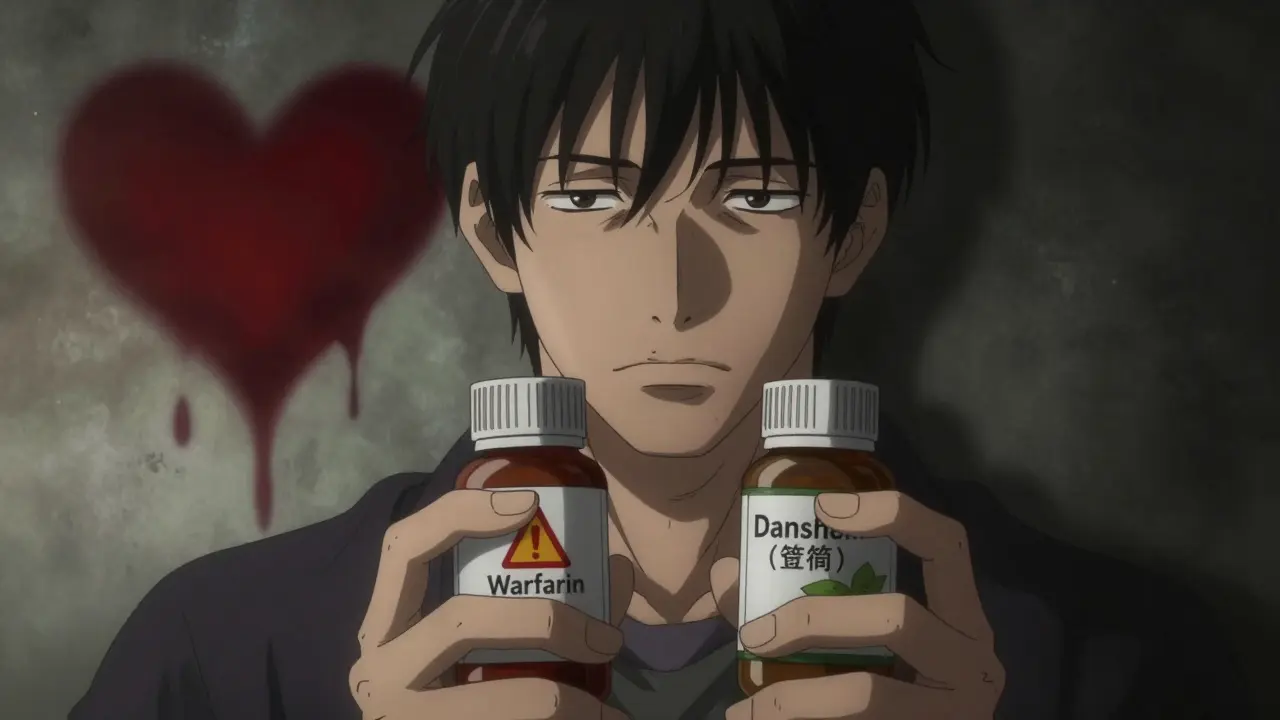
Many people turn to herbal supplements like Danshen thinking they’re safe because they’re natural. But when you’re on heart medication, especially blood thinners, that assumption can be deadly. Danshen - also known as red sage or Salvia miltiorrhiza - has been used in traditional Chinese medicine for over 2,000 years to support heart health. It’s sold in pills, teas, and extracts in the U.S. and Europe, often marketed as a way to improve circulation or prevent clots. But here’s the problem: mixing Danshen with common heart medications can cause life-threatening bleeding.
How Danshen Works - and Why It’s Dangerous with Heart Drugs
Danshen contains active compounds like tanshinones and salvianolic acids. These aren’t just harmless plant extracts. They directly interfere with blood clotting. Studies show Danshen can reduce platelet aggregation by up to 47% and lower blood pressure by 15-20 mmHg in animal models. That sounds beneficial - until you realize it’s doing the same thing as your prescribed blood thinner, but without any control.
Unlike pharmaceuticals, Danshen isn’t standardized. One bottle might have 0.05% tanshinone; another might have 5.2%. That’s a 100-fold difference in potency. There’s no way to know how strong your supplement is. And because it’s sold as a dietary supplement, it doesn’t go through FDA approval for safety or dosing. So you’re essentially gambling with your blood chemistry.
The Real Risk: Bleeding When You Least Expect It
The most dangerous interaction is with warfarin, a blood thinner prescribed for atrial fibrillation, mechanical heart valves, and deep vein thrombosis. Warfarin already requires careful monitoring with regular INR blood tests. Your doctor adjusts your dose to keep your INR between 2.0 and 3.0 - low enough to prevent clots, high enough to avoid bleeding.
Now add Danshen. Multiple case reports show INR levels skyrocketing. One patient on warfarin had an INR of 8.4 after taking Danshen for two weeks - over double the upper safe limit. His hemoglobin dropped to 7.6 g/dL (normal is 13.5-17.5). He needed a blood transfusion. Another patient’s INR jumped from 2.0 to 5.5 after just three days of Danshen use. These aren’t rare outliers. A 2020 study in Taiwan documented 17 such cases in just four years.
And it’s not just warfarin. Newer blood thinners like rivaroxaban and apixaban aren’t safe either. Research shows Danshen inhibits the liver enzymes that break down these drugs. That means the medication builds up in your system, increasing bleeding risk without you knowing. There’s no antidote for Danshen. If you start bleeding internally, doctors can’t reverse its effects - unlike with warfarin (vitamin K) or rivaroxaban (andexanet alfa).
Doctors Don’t Always Know You’re Taking It
Here’s the scary part: most patients don’t tell their doctors they’re taking Danshen. A 2019 JAMA Internal Medicine survey found only 28% of people using herbal supplements mentioned them to their physician. Why? Because they think it’s “just a herb.” Or their TCM practitioner told them it’s safe. Or they saw a YouTube video calling it a “natural alternative to blood thinners.”
But Danshen isn’t a gentle tea. It’s a potent pharmacological agent. In China, it’s approved as an injectable prescription drug. In the U.S., it’s sold on Amazon with no warning labels. That disconnect is deadly.

Who’s Most at Risk?
People of Asian descent are more likely to use Danshen - especially Chinese immigrants. A 2021 study found 41.7% of Chinese Americans taking heart medications also used Danshen regularly. Only 32.4% told their doctor. But risk isn’t limited by ethnicity. Anyone on anticoagulants, antiplatelets, or beta-blockers should avoid it.
Even if you’re not on medication yet, if you have a history of heart disease, stroke, or clotting disorders, Danshen could push you into danger. It’s not a preventive supplement - it’s a drug with unpredictable effects.
What About Other Heart Medications?
Danshen doesn’t just interact with blood thinners. It can also interfere with:
- Beta-blockers - may enhance blood pressure-lowering effects, leading to dizziness or fainting
- Calcium channel blockers - both lower blood pressure; combining them risks hypotension
- Statins - Danshen inhibits CYP3A4, the enzyme that metabolizes many statins, raising the risk of muscle damage
- Aspirin or clopidogrel - additive antiplatelet effects increase bleeding risk
There’s no safe combination. The Cleveland Clinic, Mayo Clinic, and WebMD all classify Danshen-warfarin interaction as “Major - Do not take this combination.” The Natural Medicines Comprehensive Database, one of the most trusted pharmacology resources, gives it the same warning.
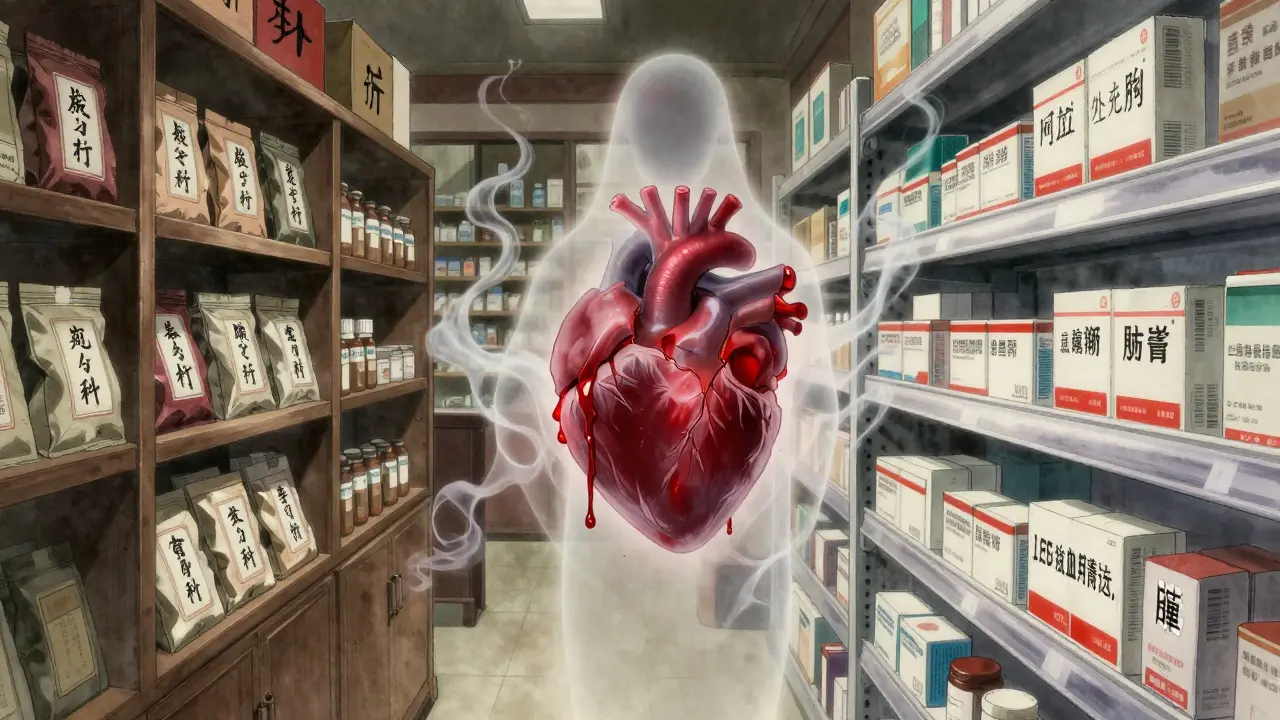
What Should You Do?
If you’re on any heart medication:
- Stop taking Danshen immediately. Even if you feel fine, the damage may already be building.
- Tell your doctor. Be honest. Say exactly what you’re taking - even if it’s “just a supplement.”
- Get an INR test. If you’re on warfarin, your INR could be dangerously high right now.
- Check all labels. Danshen may be listed as “Salvia miltiorrhiza,” “Red Sage,” “Dan Shen,” or “Chinese Sage.”
If you’re considering Danshen for heart health, understand this: there are no clinical trials proving it’s safer or more effective than FDA-approved drugs. What it does have is a long history of causing preventable hospitalizations.
Why Is This Still Happening?
The global Danshen market is projected to hit $1.84 billion by 2027. It’s booming because people believe “natural = safe.” But natural doesn’t mean harmless. Aspirin comes from willow bark - but we don’t hand out raw bark and call it medicine. We isolate the active compound, standardize the dose, and test it rigorously.
Danshen hasn’t been through that process. And until it is, it’s a gamble with your life.
The American Heart Association says it plainly: “Natural does not mean safe.” If you’re taking heart medication, Danshen isn’t a helpful herb - it’s a hidden danger.
Can I take Danshen if I’m not on any heart medication?
Even if you’re not currently on heart medication, taking Danshen can still be risky. It affects blood clotting and blood pressure, which could become dangerous if you later need surgery, suffer an injury, or start a new medication. There’s no safe long-term use profile for Danshen, and its effects are unpredictable. It’s better to avoid it entirely unless under strict medical supervision - which is rare in the U.S.
Is there a safe dose of Danshen?
No. There is no scientifically established safe dose. Commercial products vary wildly in active ingredient content - sometimes by more than 100 times. Even if you find a brand that claims to be “standardized,” there’s no independent verification in the U.S. The FDA doesn’t regulate supplements for potency or purity. So you can’t trust the label.
I’ve been taking Danshen for months with no side effects. Is it safe for me?
Just because you haven’t bled yet doesn’t mean you’re safe. Danshen’s effects can be delayed or cumulative. One patient in a 2020 study had no issues for six months before suddenly developing a dangerous INR spike. Bleeding can occur without warning - in the brain, stomach, or after a minor fall. The absence of symptoms now doesn’t rule out future risk, especially if you start a new medication.
What should I do if I accidentally took Danshen with my blood thinner?
Stop taking Danshen immediately. Contact your doctor or go to the ER if you notice unusual bruising, nosebleeds, blood in urine or stool, severe headaches, or dizziness. Get an INR test as soon as possible. If you’re on rivaroxaban or apixaban, your doctor may need to check for signs of excessive anticoagulation through blood tests. Don’t wait for symptoms - act fast.
Are there safer herbal alternatives to Danshen for heart health?
There are no herbal supplements proven to be both effective and safe for heart conditions without interfering with medications. Lifestyle changes - like a Mediterranean diet, regular walking, quitting smoking, and managing stress - are the most evidence-backed ways to support heart health. If you’re looking for supplements, omega-3 fatty acids (from fish oil) and CoQ10 have better safety profiles, but even these should be discussed with your doctor if you’re on blood thinners.
Bottom Line: Don’t Risk It
Danshen isn’t a harmless supplement. It’s a powerful, unregulated drug that can turn your prescribed heart medication into a ticking time bomb. No amount of “natural” marketing changes that. If you’re on warfarin, rivaroxaban, aspirin, or any other heart drug - skip Danshen. Your life isn’t worth the gamble.




Nadia Watson January 19, 2026
Danshen is one of those things that sounds so innocent until you read the fine print-and then you realize you’ve been playing Russian roulette with your heart.
Shane McGriff January 21, 2026
I used to take Danshen ‘just in case’-thought it was like a multivitamin for my arteries. Turns out it’s more like a silent saboteur. My INR spiked after two weeks. I didn’t even feel different until I started bruising like a grape. Don’t be me.
Paul Barnes January 21, 2026
The FDA doesn’t regulate supplements, so why do people treat them like medicine? This isn’t a revelation-it’s basic pharmacology. If it affects coagulation, it’s a drug. Call it what it is.
pragya mishra January 22, 2026
Why do Western doctors ignore traditional medicine? In India, we use Ashwagandha and Turmeric daily-no one dies. Why is Danshen suddenly a villain? Cultural bias much?
Andrew McLarren January 23, 2026
While I appreciate the intent behind traditional herbal practices, the absence of standardized dosing and clinical validation renders them incompatible with modern pharmacotherapy. The risk-benefit calculus is unequivocally unfavorable in this context.
christian Espinola January 24, 2026
Big Pharma hates this one weird trick. Danshen’s been banned in 3 countries. The FDA is covering it up because they can’t patent it. You think your doctor cares? They get paid by the pill. Read between the lines.
Naomi Keyes January 26, 2026
Let’s be clear: if you’re taking ANY blood thinner-warfarin, apixaban, rivaroxaban, clopidogrel, aspirin-then you are NOT safe with Danshen. Not even a little bit. Not if you’re ‘fine.’ Not if you’ve ‘never had side effects.’ Not if your cousin’s yoga teacher says it’s ‘balanced.’ It’s not a tea. It’s a chemical weapon.
sujit paul January 26, 2026
The universe speaks through plants, and Danshen is a messenger of balance. But modern medicine, blinded by patents and profit, has forgotten the wisdom of harmony. The body knows how to heal-when we stop interfering with its rhythm. Perhaps the bleeding is not the problem, but the symptom of a deeper disconnection.
Jacob Cathro January 28, 2026
bro. i took danshen for 8 months with my apixaban. no probs. my cardiologist didn’t even blink. this post is fearmongering. also, ‘salvianolic acids’? sounds like a villain in a Marvel movie. who wrote this? a pharmacology textbook with a grudge?
Andy Thompson January 29, 2026
They want you scared so you buy their pills. Danshen’s been used for 2000 years. Your blood thinner? 20 years. Who’s really playing with fire? 🤡
Jackson Doughart January 29, 2026
I appreciate the depth of this post. As someone who’s seen patients bleed out from unreported supplement use, I can confirm: the silence around herbal remedies is more dangerous than the remedies themselves. The real tragedy isn’t the interaction-it’s that so many people assume their doctor knows what they’re taking. They don’t. And they won’t unless you tell them. Please, if you’re reading this and you’re on anticoagulants-speak up. Even if it feels awkward. Your life isn’t a footnote.