
Alternate-Day Statin Dosing Calculator
Atorvastatin
Half-life: 14-30 hours
Long-acting statin
Rosuvastatin
Half-life: ~19 hours
Long-acting statin
Simvastatin
Half-life: 1-3 hours
Short-acting statin
Imagine taking a powerful medication that saves your life but leaves you feeling like you’ve run a marathon every single day. For millions of people prescribed statins, medications used to lower cholesterol and reduce the risk of heart disease, this is not just an exaggeration-it’s reality. Muscle pain, fatigue, and brain fog are common complaints. But what if you could cut the dosage frequency in half without losing most of the benefit? That is exactly what alternate-day statin dosing, a therapeutic strategy where statin medications are administered every other day rather than daily proposes.
This approach isn’t about skipping doses randomly. It is a calculated medical strategy designed for patients who struggle with standard daily regimens. By leveraging the specific chemical properties of certain statins, doctors can help patients maintain healthy low-density lipoprotein cholesterol (LDL-C) levels while significantly reducing adverse effects. If you have ever considered stopping your medication because it makes you feel terrible, this method might be the bridge between staying on treatment and giving up entirely.
How Alternate-Day Dosing Works
The core idea behind alternate-day dosing relies on pharmacokinetics-the way drugs move through your body. Not all statins behave the same way. Some, like simvastatin, have a short half-life of only 1 to 3 hours. This means they leave your system quickly, requiring daily intake to maintain effectiveness. Others, however, stick around much longer.
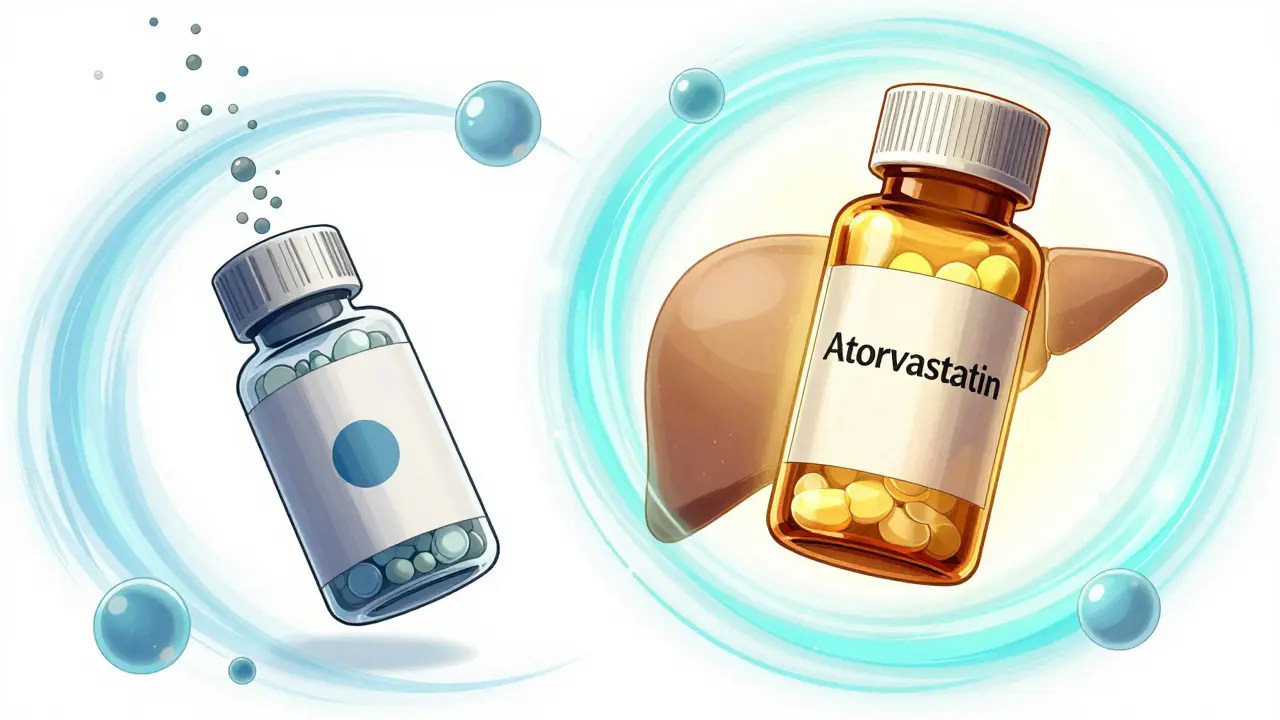
Atorvastatin, a widely prescribed statin with a long half-life has a half-life ranging from 14 to 30 hours. Similarly, rosuvastatin, another potent statin known for its extended duration of action stays active in the body for about 19 hours. Because these medications linger, taking them every other day still allows enough drug concentration to inhibit the enzyme responsible for cholesterol production in the liver.
This strategy originated from clinical observations that patients tolerating less frequent doses still saw meaningful drops in cholesterol. The first significant investigation into this was published by S. Pramanik et al. in 2012. They found that administering atorvastatin 20 mg every other day produced statistically equivalent LDL-C reduction compared to taking 20 mg daily. In their study of 38 hyperlipidemic patients, the every-other-day group saw a 42.3% drop in LDL-C, while the daily group saw a 44.1% drop. The difference was negligible, but the potential for reduced side effects was substantial.
Impact on LDL Reduction and Cholesterol Levels
The biggest fear for anyone considering changing their dose is that their cholesterol will spike back up. However, data suggests you do not need to sacrifice much efficacy. A comprehensive 2017 meta-analysis by Awad et al., which reviewed multiple studies, confirmed that alternate-day dosing of atorvastatin and rosuvastatin achieves 92-95% of the LDL-C reduction seen with daily dosing.
To put that in perspective, the mean difference in LDL-C reduction between the two methods was only 3.2 mg/dL. For many patients, this small gap is worth the trade-off for better quality of life. The study also showed comparable reductions in triglycerides, another key marker for heart health.
| Metric | Daily Dosing | Alternate-Day Dosing |
|---|---|---|
| LDL-C Reduction | 100% (Baseline) | 92-95% |
| Myopathy Incidence | Higher | 30-50% Lower |
| Annual Cost | $X | ~$X/2 |
| FDA Approval Status | Approved | Off-label |
It is important to note that this works best with high-intensity or moderate-intensity statins that have those longer half-lives. Shorter-acting statins like simvastatin or pravastatin are generally not suitable for this regimen because they clear the system too fast to provide coverage over a 48-hour window.
Side Effects and Tolerability Improvements
The primary driver for switching to alternate-day dosing is statin-associated muscle symptoms (SAMS), muscle pain, weakness, or cramps experienced by some statin users. These symptoms affect approximately 10-15% of statin users. For many, this leads to discontinuation of the drug, leaving them vulnerable to heart attacks and strokes.
By cutting the exposure time, alternate-day dosing can reduce myopathy incidence by 30-50%. In a notable case series reported in LIPID Spin (2013), 87% of patients who were completely intolerant to daily atorvastatin or rosuvastatin tolerated a regimen of twice-weekly statin combined with ezetimibe and colesevelam. While that involved combination therapy, it highlights how reducing statin frequency dramatically improves tolerability.
Patient testimonials often describe a dramatic improvement in daily function. One patient noted, “I can finally walk up stairs without pain.” This isn’t just anecdotal; the American College of Cardiology acknowledged in 2013 that alternate-day administration seems to decrease the incidence of adverse effects, particularly myopathy. However, it is crucial to monitor creatine kinase (CK) levels to ensure there is no underlying muscle damage, even if pain subsides.
Who Is a Candidate for This Strategy?
Not everyone should switch to every-other-day dosing. This approach is specifically designed for statin-intolerant patients, individuals who experience adverse effects from standard daily statin therapy. Ideal candidates typically meet the following criteria:
- Have documented statin intolerance, usually manifesting as myalgia (muscle pain) with normal or slightly elevated CK levels (less than 10x upper limit of normal).
- Have established cardiovascular disease or are at high risk for future events.
- Have failed attempts at taking at least two different daily statins at various doses.
- Are currently taking atorvastatin or rosuvastatin, as these have the strongest evidence base for this regimen.
If you are newly diagnosed with high cholesterol and have never taken a statin, starting with daily dosing is still the standard of care. Alternate-day dosing is a rescue strategy, not a first-line option for everyone. Furthermore, patients with very high baseline LDL-C levels may find that the 5-8% loss in efficacy prevents them from reaching strict target goals set by guidelines.

Cost Savings and Practical Implementation
Beyond health benefits, there is a financial incentive. Cutting your pill usage in half cuts your cost in half. Generic atorvastatin costs roughly $0.10-$0.50 per 20 mg tablet, and rosuvastatin ranges from $0.20-$1.00 per tablet. Over a year, this adds up to significant savings, especially for those paying out-of-pocket.
Compared to alternative treatments for statin intolerance, such as PCSK9 inhibitors (which can cost $5,000-$14,000 annually) or bempedoic acid ($480/month), alternate-day statin dosing is incredibly affordable. It offers a middle ground between doing nothing and spending thousands on newer, more expensive therapies.
Implementing this requires careful monitoring. Doctors typically check LDL-C levels 4-6 weeks after initiating the new schedule, then every three months until stable. Patients must also track their muscle symptoms using tools like the Statin Treatment-Related Adverse Effects Self-Assessment Tool (STREAS). Adherence can be tricky; remembering to take a pill “every other day” can be confusing compared to a daily routine. Using a calendar app or a pill organizer marked with days off can help prevent missed doses.
Limitations and Expert Perspectives
Despite the benefits, alternate-day dosing remains an off-label use. The FDA has not approved any statin for this specific schedule. This means insurance companies might occasionally question the prescription, though generic costs are usually low enough that prior authorization is rarely needed.
Dr. Robert S. Rosenson, Director of Cardiometabolic Disorders at Icahn School of Medicine, supports this approach, calling it a “rational approach for patients with documented statin intolerance.” However, caution is advised. The American College of Cardiology notes that no large-scale clinical trial exists proving that alternate-day dosing reduces cardiovascular events (like heart attacks) as effectively as daily dosing. We assume it does because LDL-C is lowered, but we lack direct outcome data.
Therefore, this strategy should be reserved for those who have exhausted conventional options. It is not a license to ignore cholesterol management. If your LDL-C rises above target on alternate-day dosing, your doctor might add ezetimibe, a non-statin cholesterol absorber, to boost the effect without adding muscle toxicity.
Is alternate-day statin dosing FDA approved?
No, alternate-day statin dosing is considered an off-label use. While the FDA approves statins for daily use, physicians frequently prescribe them differently based on clinical evidence and patient needs. This practice is supported by major medical organizations for statin-intolerant patients, despite the lack of formal regulatory approval for the specific schedule.
Which statins work best for every-other-day dosing?
Atorvastatin and rosuvastatin are the best candidates because they have long half-lives (14-30 hours and 19 hours, respectively). This allows them to remain effective in the body for more than 24 hours. Shorter-acting statins like simvastatin or pravastatin are generally not suitable for this regimen as they clear the system too quickly.
Will I still get enough cholesterol lowering with alternate-day dosing?
Yes, research shows that alternate-day dosing achieves 92-95% of the LDL-C reduction seen with daily dosing. For most patients, this small difference is clinically insignificant, especially when weighed against the benefit of being able to stay on the medication without debilitating side effects.
How much money can I save with this method?
You will save approximately 50% on the cost of the medication itself since you are buying half as many pills. For generic statins, this might mean saving $50-$100 annually. Compared to alternative therapies like PCSK9 inhibitors, which cost thousands per year, the savings are massive.
What should I do if my muscle pain returns on alternate-day dosing?
If symptoms persist or return, consult your doctor immediately. They may adjust the dose further, switch to a different statin, or add a non-statin medication like ezetimibe. Do not stop the medication abruptly without medical advice, as this can increase your cardiovascular risk.