
You've probably been there: your pharmacist tells you the brand-name drug you've used for years is now available as a generic. You're happy about the price drop, but then you notice a few different options on the shelf. One is a standard generic, and another is an "authorized generic." If you're wondering why one costs more than the other-and if that extra cost actually buys you better results-you're not alone. Switching medications can feel like a gamble, especially when your health depends on a precise dose.
The core of the problem is that not all generics are created equal. While the active ingredient is the same, the "stuff" around it can vary. For most people, this doesn't matter. But for some, a different filler or binder can be the difference between a stable condition and a health crisis. The goal here is to figure out if you can save the most money with a standard generic or if you need the safety net of an authorized generic.
| Feature | Authorized Generic | Regular Generic |
|---|---|---|
| Ingredients | Identical to Brand (Active & Inactive) | Same Active; Different Inactive |
| Manufacturing | Same facility as Brand | Different manufacturer |
| FDA Path | NDA (New Drug Application) | ANDA (Abbreviated NDA) |
| Typical Cost | 10-30% less than Brand | 80-85% less than Brand |
What exactly is an authorized generic?
Think of an Authorized Generic is an approved brand-name drug that is marketed without the brand name on its label. It is literally the same pill, made by the same company, in the same factory, using the exact same recipe as the brand-name version. The only real difference is that the fancy brand name is missing from the packaging.
These came into play largely because of the Hatch-Waxman Act, allowing brand manufacturers to keep a foothold in the market after their patents expire. Instead of letting a competitor take everything, the brand company releases its own generic version. For example, if you use a drug like Celebrex, an authorized generic version (like those from Greenstone Pharmaceuticals) will have the exact same inactive ingredients-lactose monohydrate and mannitol-as the brand, whereas a regular generic might use different binders.
The regular generic: How it differs
A regular generic is created by a different company that wants to produce a version of the drug once the patent is gone. They use the ANDA (Abbreviated New Drug Application) pathway. They don't have to redo all the clinical trials; they just have to prove to the FDA that their version is "bioequivalent."
Here is the catch: bioequivalence allows for a bit of a wiggle room. The FDA requires generics to fall within a 90% confidence interval of 80-125% compared to the brand. While that sounds precise, it means there can be some variance in how the drug is absorbed into your bloodstream. For a blood pressure pill, this is usually a non-issue. But for a drug with a "narrow therapeutic index"-where a tiny change in dose or absorption can be dangerous-it's a bigger deal.
When should you prioritize an authorized generic?
For most of us, a regular generic is the way to go because the savings are massive. But there are specific scenarios where paying a bit more for an authorized generic is a smart move. If you are taking medications for the following, you should talk to your doctor about formulation consistency:
- Anti-epileptics: Drugs like Lamotrigine can be touchy. Some patients report breakthrough seizures when switching to regular generics because the inactive ingredients change how the drug is absorbed.
- Thyroid Hormones: Levothyroxine is notoriously sensitive. Even a slight change in the filler can alter your TSH levels.
- Immunosuppressants: When you're preventing organ rejection, there is zero room for absorption variance.
Research shows that about 37% of people who struggle with switching to generics point to the inactive ingredients as the culprit. If you've had a bad experience with a generic in the past-like new stomach issues or the drug just not "working" as well-the authorized version removes that variable entirely.
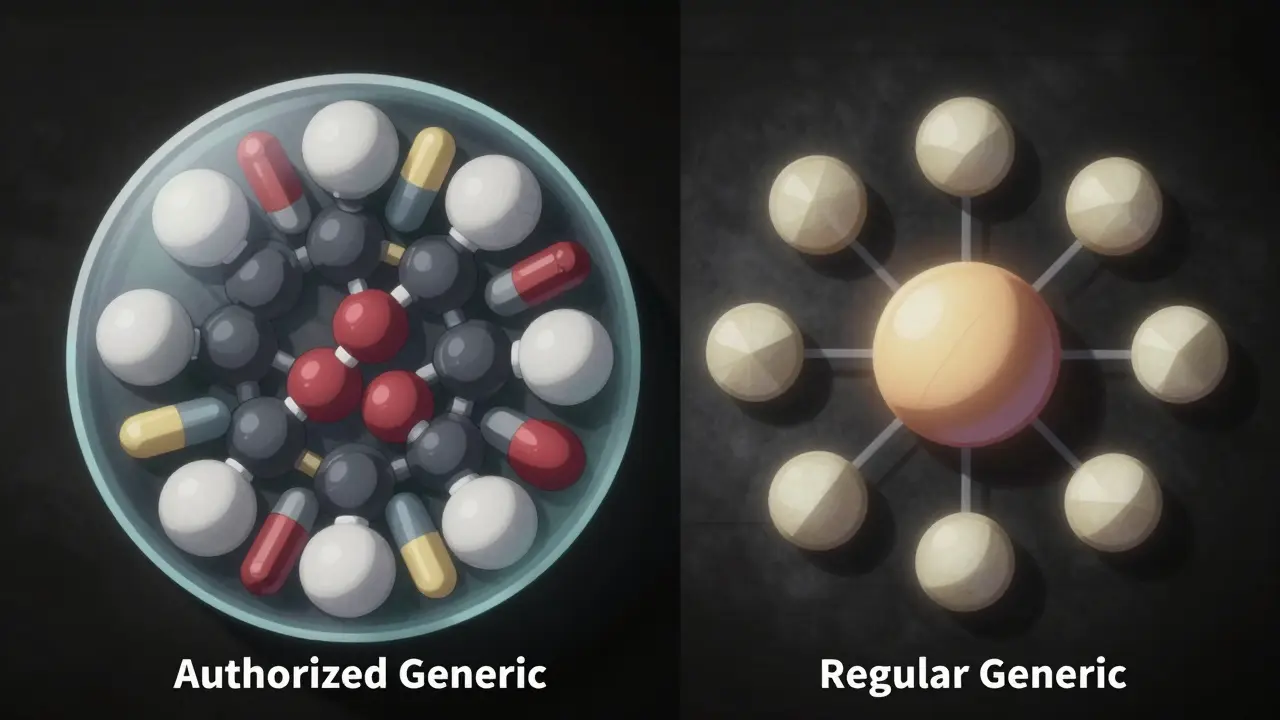
The cost trade-off: Is the premium worth it?
Let's talk money. Regular generics are the gold standard for savings, often costing 80% to 85% less than the brand. Authorized generics are cheaper than the brand, but they are almost always more expensive than regular generics.
Take a drug like Concerta. You might see the brand name at $210, the authorized generic at $185, and a regular generic at $165. Is that $20 difference worth it? If you're treating ADHD and feel a noticeable difference in focus between versions, yes. If you're taking a common statin for cholesterol, probably not.
A study of over 5,000 users found that 18.7% of people had issues with regular generics, compared to only 6.2% with authorized versions. However, the most common complaint for authorized generics wasn't medical-it was the cost (68% of complaints). You're essentially paying a "certainty premium" to ensure you're getting the exact same formula you're used to.
How to actually switch without the headache
Walking into a pharmacy and asking for "the authorized generic" can be confusing because labels aren't always clear. In fact, nearly half of patients can't tell the difference on their prescription bottle. If you want to be certain, follow these steps:
- Ask for the NDC Number: The National Drug Code is a unique identifier. Your pharmacist can check the NDC to see if the manufacturer is the same as the brand-name company.
- Check the Orange Book: The FDA's Orange Book lists therapeutically equivalent generics. Note that authorized generics often don't appear here because they don't need bioequivalence testing-they *are* the brand.
- Discuss "Dispense as Written": If your doctor believes you need the exact formulation, they can write "DAW" (Dispense as Written) on the prescription, though this may affect your insurance coverage.
- Track your symptoms: For the first 30 days after a switch, keep a simple log of any new side effects or changes in how you feel.

The future of generics in 2026
We're seeing a shift toward "complex generics." These are things like inhalers or topical creams where the delivery system (the pump or the cream base) is just as important as the medicine. The FDA has recently tightened requirements here, making authorized generics even more attractive for these complex products. We're also seeing more transparency; as of 2024, new labeling rules make it easier to spot where your medicine is actually coming from.
While hospital systems almost always lean toward regular generics to save millions in budgets, specialty clinics-like those focusing on endocrinology or neurology-are using authorized generics more often. They recognize that for certain patients, the "cheapest" option can actually be the most expensive if it leads to an emergency room visit.
Are authorized generics just a marketing trick?
Not exactly. While brand companies use them to protect their market share, they provide a genuine clinical benefit for patients who react poorly to the inactive ingredients in regular generics. You're getting the exact brand-name drug, just without the brand-name price tag.
Will my insurance cover an authorized generic?
It depends. Many insurance plans prefer the cheapest regular generic. However, some Medicare Part D plans are now required to provide information on authorized generic availability. You may need a "medical necessity" note from your doctor to get the insurance to cover the slightly higher cost of an authorized version.
Can I switch back and forth between regular and authorized generics?
You can, but it's generally not recommended for narrow therapeutic index drugs. Constantly changing the inactive ingredients or the manufacturer can cause your blood levels to fluctuate, which can lead to instability in your condition.
Does the FDA guarantee that regular generics work the same?
Yes, within a specific scientific range. The FDA requires bioequivalence, meaning the drug must be absorbed at a rate similar to the brand. For the vast majority of medications, this difference is clinically insignificant and won't affect your health.
How do I know if my drug is an authorized generic?
The easiest way is to check the manufacturer on the bottle. If the company that makes the brand-name version is also listed as the manufacturer of your generic, it's an authorized generic. You can also ask your pharmacist to verify the NDC number.
Next Steps for Your Switch
If you're feeling stable on your current brand-name drug and want to save money, start with a regular generic-it's the most cost-effective path. But if you have a history of sensitivity to fillers or are taking a high-stakes medication for epilepsy or thyroid issues, ask your doctor specifically about an authorized generic.
If you've already switched and feel "off," don't panic. Document your symptoms and take the bottle to your pharmacist. Ask them to compare the inactive ingredients of your current generic with the brand version. This data is the fastest way to determine if you need to move up to an authorized generic or if you're just experiencing a temporary adjustment period.