
Whether you're active duty or a retiree, the way TRICARE handles generic drugs isn't just about saving the government money-it's about creating a tiered system that rewards you for choosing cost-effective treatments. If you're confused about why one generic is covered and another requires a mountain of paperwork, you're not alone. The system is comprehensive, but it has a few quirks you need to know to avoid surprises at the pharmacy counter.
How the TRICARE Formulary Works
At the heart of your coverage is the TRICARE Formulary, which is essentially a master list of about 5,500 approved drugs. Think of it as the "approved menu" for your prescriptions. This list is updated every month by the Defense Health Agency and managed by Express Scripts.
The program breaks drugs down into four tiers. Generic formulary drugs sit at Tier 1, meaning they are the most preferred and cheapest option. Then you have Tier 2 for brand-name formulary drugs, Tier 3 for non-formulary drugs that might still be covered with a special request, and finally, non-covered drugs. For most of us, staying in Tier 1 is the goal. In fact, about 92% of all prescriptions filled through the program are generics because they offer the same therapeutic value as brand names but typically cost 80-85% less.
Breaking Down the Costs: Where You Fill Matters
One of the biggest mistakes beneficiaries make is assuming the cost is the same regardless of the pharmacy. In the TRICARE world, the "where" is just as important as the "what." Depending on your choice, your copayment can range from zero dollars to sixteen dollars.
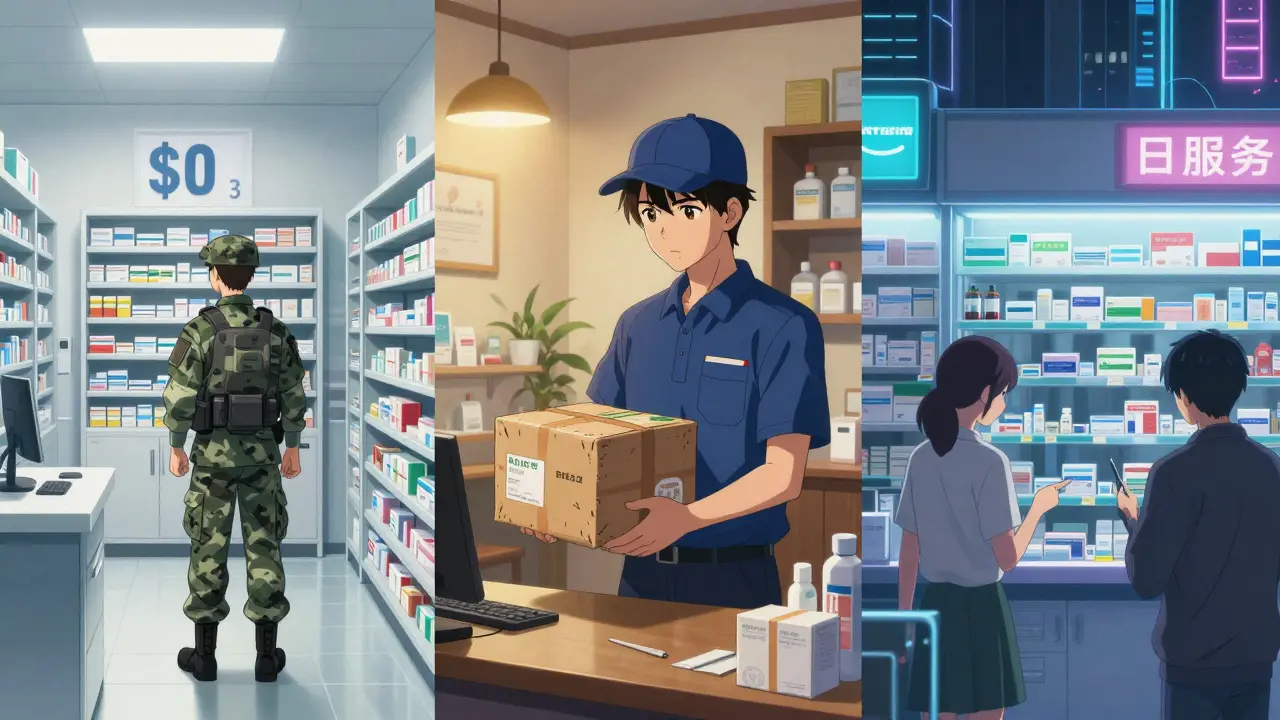
If you have access to a military pharmacy on base, use it. It's the only way to get a $0 copayment for covered generics. For those who prefer the convenience of their own home, TRICARE Home Delivery is a popular choice. As of January 1, 2026, the copayment for a 90-day supply of a generic formulary drug through home delivery is $14. If you need a drug immediately and can't get to a base pharmacy, a retail network pharmacy will charge you $16 for a 30-day supply.
| Pharmacy Type | Copayment (Generic Tier 1) | Supply Duration | Best For... |
|---|---|---|---|
| Military Pharmacy | $0 | Varies | Maximum Savings |
| Home Delivery | $14 | 90-Day | Chronic Conditions/Convenience |
| Retail Network | $16 | 30-Day | Immediate Needs |
Navigating Non-Formulary Generics and Prior Authorization
Not every generic drug is automatically approved. You might find yourself in a situation where your doctor prescribes a generic version of a drug, but the pharmacist tells you it isn't "on formulary." This is where the process gets a bit clunky. When a generic is non-formulary, TRICARE requires a medical necessity determination.
This is essentially a "prior authorization" process. Your doctor has to prove that the formulary options won't work for you. While about 78% of these requests are eventually approved, the wait can be frustrating. On average, it takes about 48 hours to get the green light, though some users report waiting up to 72 hours. To avoid this, use the TRICARE Formulary Search tool before your appointment so you can tell your doctor which generics are already approved.
Key Limitations and Recent Changes
It's not all smooth sailing. There are specific gaps in coverage that can catch you off guard. For example, since August 31, 2025, there has been a blanket exclusion of weight loss generics for those under TRICARE For Life. This has left over a million elderly beneficiaries without coverage for these specific medications, regardless of FDA approval.
Another hurdle is the rise of generic biologics. Because these are more complex to manufacture than "small-molecule" generics (like a standard aspirin or blood pressure pill), they face 22% higher prior authorization requirements. If you are taking advanced biologics for autoimmune disorders or cancer, expect more paperwork and a stricter review process than someone taking a basic statin.

How to Manage Your Prescriptions Like a Pro
If you're new to the system, the learning curve usually takes a couple of refill cycles. Here is the most efficient way to handle your medications:
- Check the Tool: Use the search tool at esrx.com/tform. Input the exact drug name and strength. It will tell you the tier and if you need prior authorization.
- Plan for 90 Days: If you have a chronic condition like hypertension or diabetes, switch to home delivery. It reduces your trips to the pharmacy and keeps your costs predictable.
- Leverage the Helpline: If a retail pharmacy claims a drug isn't covered but your search says it is, call the TRICARE Pharmacy Helpline at 1-877-363-1303. They can often resolve insurance glitches in real-time.
- Audit Your Meds: Since the formulary is updated monthly, a drug that was covered in January might be swapped for a different generic by June. Keep an eye on your notifications from Express Scripts.
Comparing TRICARE to Other Programs
When you look at the broader landscape, TRICARE sits in a unique middle ground. Compared to Medicare Part D, TRICARE's retail copayments are actually a bit higher. While some Medicare plans have generic copays in the $7-$10 range, TRICARE's $16 retail fee is a premium. However, Medicare doesn't have a "military pharmacy" equivalent, so TRICARE users who live near a base actually save significantly more.
On the other hand, the VA prescription benefits are often more generous, offering completely free meds to many veterans. TRICARE is a different beast-it's a hybrid system that emphasizes stability and a massive network of retail pharmacies, making it more flexible for those who move frequently or live far from a VA hospital.
What happens if my generic drug is not on the TRICARE formulary?
If your drug isn't listed, your provider must submit a request for a medical necessity determination. This process involves explaining why the formulary alternatives are not suitable for your condition. Most requests (about 78%) are approved, usually within 48 hours, but you may need to provide additional clinical documentation.
Is there a difference between a generic drug and a formulary generic?
Yes. A "generic drug" is any medication that uses the same active ingredient as a brand-name drug. A "formulary generic" is a generic drug that TRICARE has specifically approved for coverage. Some generics are non-formulary, meaning they exist but aren't automatically covered without prior authorization.
How much does a generic drug cost via home delivery in 2026?
As of January 1, 2026, the copayment for generic formulary drugs delivered via TRICARE Home Delivery is $14 for a 90-day supply.
Can I get generic drugs for free through TRICARE?
Yes, but only at military pharmacies. If you fill your covered generic prescriptions at a military treatment facility pharmacy, the copayment is $0. This is not available at retail or home delivery options.
Are weight loss medications covered as generics?
Coverage is currently restricted. As of August 31, 2025, there is a blanket exclusion for weight loss generics specifically for TRICARE For Life beneficiaries.
How do I know if my medication is a Tier 1 generic?
The fastest way is to use the TRICARE Formulary Search tool at esrx.com/tform. Enter the drug name and strength, and the system will display the tier classification (Tier 1, 2, 3, or non-covered).







Eric Mwiti April 26, 2026
Oh sure, because a 72-hour wait for a "medical necessity determination" is exactly what a sick person needs to feel better.
Edwin Perez April 28, 2026
The whole formulary system is just a way for the pharmaceutical companies to decide who gets to live and who doesn't based on which generic they can squeeze the most profit out of. They switch the drugs every month for a reason and it's definitely not to help the patient. It is all about control and keeping the military population dependent on a system that can be changed on a whim by a few suits in a boardroom. Wake up people.
Majestic Blue Band April 29, 2026
I find it absolutely suspicious that they are specifically excluding weight loss generics for the elderly and it's probably because they've found some way to keep people dependent on those meds for other reasons that they aren't telling us about. If you actually look into the timing of these exclusions, it aligns perfectly with the push for new, more expensive biologics which they admit have higher authorization requirements because that's where the real money is made and they are basically using the military health system as a giant lab experiment to see how much they can get away with before people actually start protesting in the streets.
Jon Moss April 29, 2026
Dealing with insurance glitches at the pharmacy is honestly the worst. Glad there is a helpline though.
Karyn Tindall April 29, 2026
I am absolutely devastated for those over a million elderly beneficiaries who just lost their coverage! This is an utter tragedy and completely heartless!
Michael Chukwuma April 30, 2026
The home delivery option really does make life easier for those of us who can't make the drive to the base every month.
suresh kumar May 2, 2026
This whole setup is a total circus of red tape and dizzying nonsense. Just a bunch of suits playing games with your health!
Beena Garud May 3, 2026
The structural dichotomy between the military pharmacies and retail networks presents a profound reflection on the nature of institutional accessibility. One must contemplate the ethical implications of a system where the geographic proximity to a military installation dictates the financial burden of essential healthcare. It is a complex tapestry of administrative efficiency and human necessity that warrants deeper sociological investigation into how such tiered systems impact the collective well-being of the veteran community over long durations of time and space.