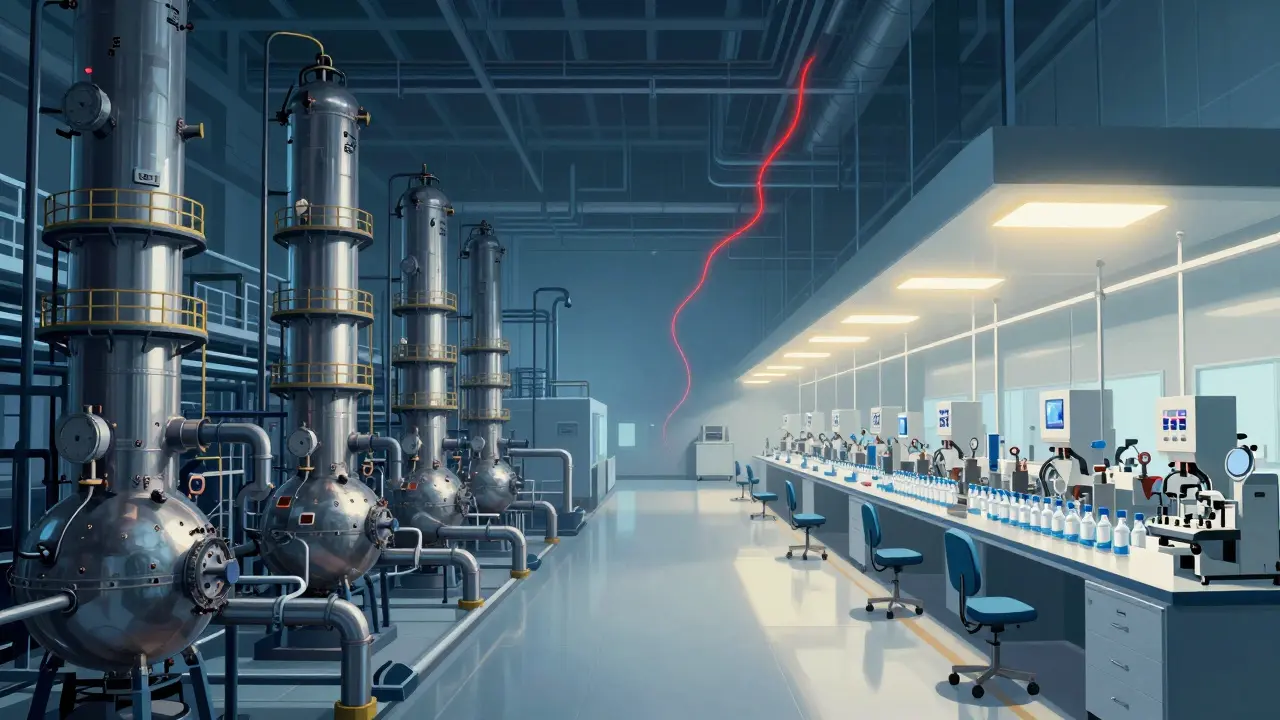
Imagine your blood pressure medication or life-saving antibiotic is sitting in a warehouse. You trust it works. But have you ever wondered where the ingredients actually came from? For most Western consumers, the answer points to two massive countries: China and the world's largest producer of pharmaceutical active pharmaceutical ingredients (APIs). The global supply chain for medicines is not just complex; it is heavily concentrated. Understanding the difference between how these two giants operate under the watchful eye of the US Food and Drug Administration (FDA) is critical for anyone involved in healthcare procurement, regulatory compliance, or even just personal health awareness.
This isn't about picking a winner in a popularity contest. It’s about risk management. One country offers scale and cost efficiency but carries significant geopolitical and historical compliance baggage. The other offers regulatory familiarity and English-speaking expertise but depends dangerously on the first country for raw materials. Let’s break down the real numbers, the FDA inspection data, and what this means for the future of drug safety.
The Core Divide: Scale vs. Compliance
To understand the risk, we first need to look at what each country actually produces. This distinction is often blurred in casual conversation, but in pharma manufacturing, it matters immensely.
Active Pharmaceutical Ingredients (APIs) are the biologically active components in a drug-the actual medicine that treats the illness. Think of it as the flour in a cake. China dominates this space. According to 2023 data from DrugPatentWatch, China controls an estimated 80% of the global generic API supply chain. If you are buying a generic statin or an antibiotic, there is a very high probability the core ingredient was synthesized in a Chinese facility.
India, on the other hand, is the master of formulation and generics. It takes those APIs (often imported from China) and turns them into finished pills, capsules, and injections. India is the world’s third-largest pharmaceutical producer by volume. However, its value output is lower because it sits further up the value chain in terms of labor-intensive assembly rather than capital-intensive chemical synthesis. As of 2024, India operates over 100 US FDA-approved manufacturing plants, compared to China’s 28. This gap-257% more FDA-certified capacity in India-is the single biggest differentiator for Western buyers looking for regulatory ease.
| Metric | China | India |
|---|---|---|
| FDA-Approved Facilities (2022) | 28 | 100+ |
| Global API Share | ~80% | Minority (High dependency on China) |
| Primary Strength | Cost, Scale, Chemical Synthesis | Regulatory Compliance, Generics Formulation |
| Import Alert Rate (2023) | 37% of facilities | 18% of facilities |
| API Import Dependency | Low (Self-sufficient) | High (72% from China) |
FDA Monitoring: What the Inspection Data Says
You might assume that "FDA Approved" means "Safe Forever." That is a dangerous misconception. FDA approval is a snapshot in time. Ongoing monitoring happens through inspections, and the results tell a stark story about operational culture.
The FDA uses Form 483 to list observations of non-compliance found during inspections. These aren’t always fatal flaws, but they indicate systemic issues with hygiene, documentation, or process control. Between 2020 and 2023, industry analyses showed that Indian facilities received 30% fewer Form 483 observations than their Chinese counterparts. Why? Cultural alignment plays a huge role. Indian regulatory bodies, such as the Central Drugs Standard Control Organization (CDSCO), have harmonized their standards closer to US and EU norms over the last decade. Their inspectors speak English, understand FDA 21 CFR Part 211 requirements intuitively, and prepare for audits using similar frameworks.
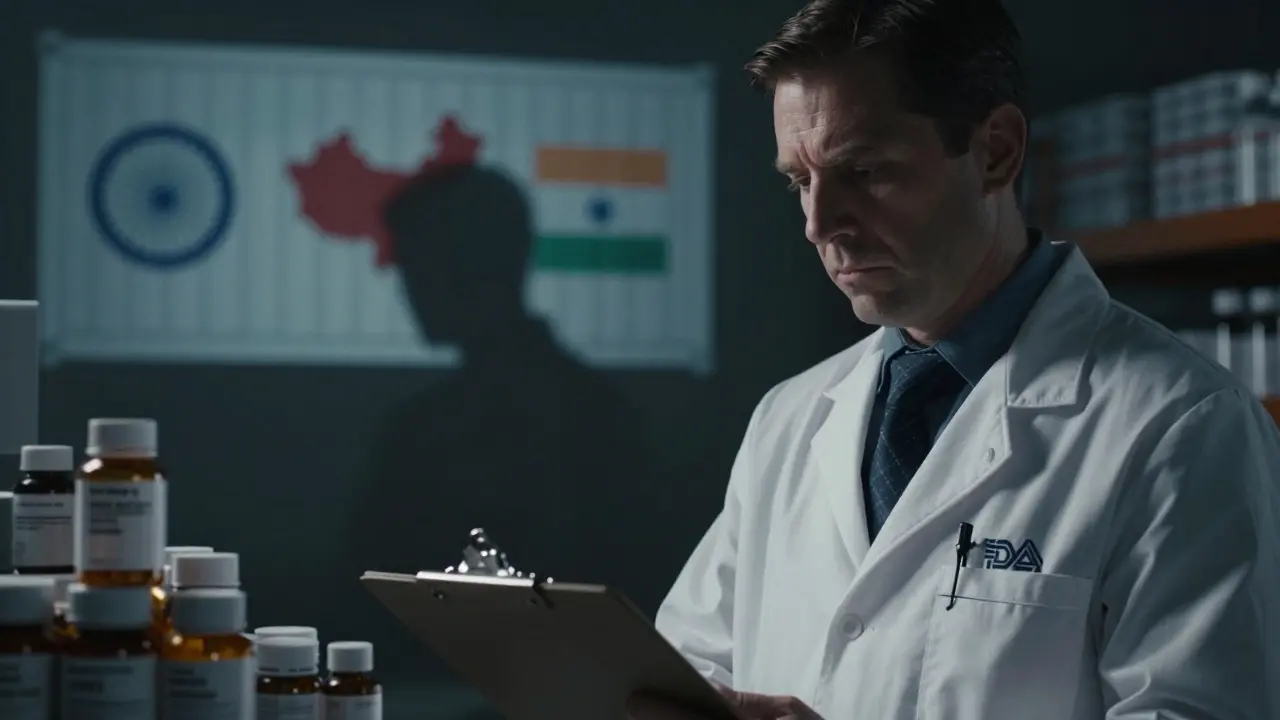
In contrast, Chinese facilities often face a steeper learning curve. While major state-owned enterprises have improved significantly, smaller suppliers still struggle with consistency. In 2023, 37% of Chinese pharmaceutical facilities faced import alerts from the FDA, compared to just 18% of Indian facilities. An import alert effectively bans a product from entering the US until specific corrective actions are taken. For a procurement manager, this means higher volatility and potential supply disruptions when sourcing from China.
However, the FDA has been increasing scrutiny on both nations due to geopolitical tensions. The agency now employs more frequent unannounced inspections for high-risk categories like antibiotics and oncology drugs sourced from Asia. This heightened monitoring is a double-edged sword: it improves safety but increases the administrative burden on manufacturers.
The Hidden Risk: India’s Dependency Trap
Here is the twist that catches many supply chain executives off guard. India looks safer on paper because of its FDA track record. But India is not independent. In fact, it is deeply tethered to China.
In fiscal year 2024, approximately 72% of India’s bulk drug and intermediates imports came from China. That number jumped from 66% in FY2022. This creates a "single point of failure" scenario. If trade relations sour between China and the West, or if a pandemic shuts down Chinese ports, Indian manufacturers cannot simply switch suppliers overnight. They don’t have enough domestic API capacity.
Dr. Renuka Diwan, healthcare practice leader at Bain & Company, noted in a 2024 report that while compliance is key for exports, this dependency erodes India’s strategic position. A senior sourcing executive at a major US pharma company put it bluntly: "The 72% import dependency on China for bulk drugs creates a single point of failure in our supply chain that we're urgently trying to address."
This means that choosing India doesn’t eliminate China risk; it just layers it. You get better regulatory oversight in India, but your raw material security remains vulnerable to Chinese political and economic shifts.
The 'China+1' Strategy in Action
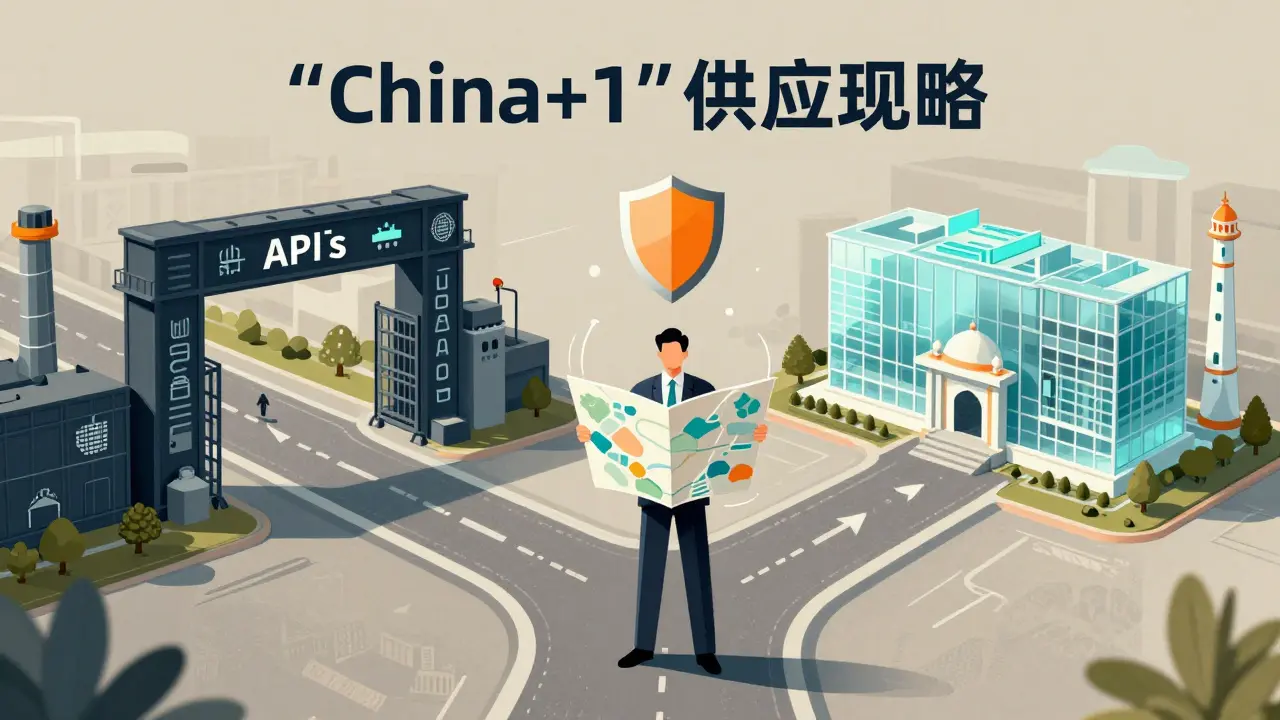
Because of these intertwined risks, most global pharmaceutical companies are adopting a "China+1" strategy. This doesn’t mean leaving China entirely-that would be too expensive and disruptive. Instead, it means diversifying. They keep China for low-cost, high-volume API production but add India (or sometimes Europe) for final formulation and packaging.
Why India? Beyond the FDA stats, it’s about communication. When an auditor asks a question in Mumbai, the response is immediate and culturally aligned. In Shanghai, language barriers and differing interpretations of "good manufacturing practice" (GMP) can lead to misunderstandings that delay approvals by months.
However, the cost advantage of China is narrowing. Rising labor costs and stricter environmental regulations in China are squeezing margins. Meanwhile, India’s "Make in India" initiative has allocated nearly $3 billion in production-linked incentives (PLIs) to boost domestic manufacturing. As of April 2024, these incentives had attracted nearly $4 billion in investments. The goal? To build domestic API capacity so India isn’t held hostage by Beijing.
Future Outlook: Biologics and Innovation
The next frontier isn’t generics; it’s biologics. These are complex drugs made from living organisms, used for cancer, diabetes, and autoimmune diseases. China is investing heavily here, with its biopharmaceutical market projected to grow at a 19.3% compound annual growth rate (CAGR). India is also growing fast (22% CAGR for biosimilars), but from a smaller base.
If you are a regulator or a buyer, watch this space. The companies that solve the API dependency problem will win the next decade. Until then, the safest bet is a diversified portfolio: use China for cost-effective raw materials, but insist on rigorous third-party testing and audit trails. Use India for final assembly where regulatory transparency is paramount.
Practical Checklist for Procurement Teams
- Verify Current Status: Don’t rely on old FDA certificates. Check the FDA’s Establishment Registration and Drug Listing database monthly for any new warning letters or import alerts.
- Audit the API Source: Even if your contract manufacturer is in India, ask for the Certificate of Analysis (CoA) and origin proof for every batch of API. Trace it back to the Chinese plant.
- Diversify Suppliers: Never rely on a single source for critical APIs. Maintain a secondary supplier, ideally in a different geographic region (e.g., Europe or Japan) for high-risk drugs.
- Plan for Delays: Assume that geopolitical tensions could cause 2-4 week delays in shipping from Asian hubs. Build safety stock into your inventory planning.
- Invest in Digital Tracking: Use blockchain or serialized tracking systems to monitor the cold chain and handling history of drugs moving from China to India to the US.
Is it safer to buy drugs manufactured in India or China?
For finished generic drugs sold in Western markets, India generally presents a lower regulatory risk due to a higher number of FDA-approved facilities and fewer import alerts. However, India relies heavily on Chinese raw materials (APIs). Therefore, the safety profile depends on the entire supply chain, not just the final assembly location. Both countries require rigorous third-party testing to ensure quality.
What does an FDA Form 483 mean for a manufacturer?
An FDA Form 483 lists observational findings of non-compliance with current Good Manufacturing Practices (cGMP) during an inspection. It is not a ban, but it signals that the facility has issues with hygiene, documentation, or process control. Repeated or severe findings can lead to Warning Letters or Import Alerts, which block products from entering the US.
Why does India depend on China for pharmaceuticals?
India specializes in formulating finished drugs (tablets, capsules), while China dominates the production of Active Pharmaceutical Ingredients (APIs)-the raw chemical substances that make the drug work. China’s early investment in chemical infrastructure gave it a cost and scale advantage that India has struggled to replicate domestically. Currently, about 72% of India’s bulk drug imports come from China.
How has the FDA increased monitoring of Asian manufacturers?
The FDA has increased the frequency of unannounced inspections, particularly for high-risk drug classes like antibiotics and oncology treatments. They have also tightened data integrity requirements, demanding electronic records that prove no tampering occurred during testing. Additionally, the agency actively shares intelligence with other global regulators to coordinate surveillance efforts.
What is the 'China+1' strategy in pharma supply chains?
The 'China+1' strategy involves keeping China as a primary supplier for cost reasons but adding a second supplier in another country (like India, Vietnam, or Poland) to mitigate risk. This ensures that if geopolitical tensions, natural disasters, or regulatory bans disrupt Chinese supply, the company can pivot to the alternative source without halting production.





Aishwarya Thankachan May 31, 2026
OMG this is literally so important!! 😱📉 The API dependency thing is wild right?? Like we are all just one bad inspection away from a total supply chain collapse 🤯💊 I mean seriously who even checks the CoA anymore?? We need to stop ignoring the geopolitical risks in our meds!! 🚨🌏
Jerry Mathews May 31, 2026
Hey Aishwarya, take a breath. It's actually pretty fascinating how these two economies complement each other despite the friction. India really has carved out a nice niche in formulation while China handles the heavy chemical lifting. It's not perfect, but it's a stable ecosystem for now. Let's hope the PLI schemes help balance things out soon.
Lenny Cruz June 2, 2026
The entire premise of this article is built on a fragile understanding of global economics. You assume that 'regulatory ease' is the primary driver for procurement, which is naive at best. Cost efficiency and scale are the only metrics that matter in volume generics. The FDA's whims are secondary to the bottom line. Furthermore, the idea that Indian facilities are somehow morally superior in compliance is laughable when you look at the data integrity scandals from the last decade. It's all theater.
Aswin Narayan J June 4, 2026
Wake up people! India is being held hostage by Chinese raw materials and nobody wants to admit it because it hurts national pride. We are just packaging houses for Beijing now. 72% dependency? That's not a strategy, that's surrender. Our politicians talk about Make in India but they don't build the actual chemical infrastructure. It's pathetic. We need to stop pretending we are independent when we can't make a single aspirin without Chinese intermediates. This is economic colonization.
Jennifer Legore June 5, 2026
I must say, this is an exceptionally well-researched piece! :) It is truly encouraging to see such detailed analysis regarding the 'China+1' strategy. While the dependencies are concerning, the proactive steps taken by both nations are commendable. We should remain optimistic that increased scrutiny will lead to higher safety standards for everyone involved. Thank you for sharing this valuable insight! :)
Alyssa Zucker June 5, 2026
I've been thinking about this a lot lately. It's scary to realize how much trust we place in these systems without seeing the backend. The part about India importing most APIs from China really stuck with me. It makes you wonder if there's any true redundancy in the system or if we're all just riding the same wave.
Francis Saul June 6, 2026
hey guys its realy simple stuff here. dont over complicate it. china makes the chemicals cause its cheap. india makes the pills cause labor is cheap. fda watches them. thats it. why are we writing essays about it? just buy the meds and dont worry about it unless u r a regulator lol. peace out.
Dave Villeneue June 7, 2026
Your analysis lacks rigor. The correlation between Form 483 observations and actual drug safety outcomes is negligible. You are conflating bureaucratic paperwork with clinical efficacy. Furthermore, the assertion that language barriers in Shanghai delay approvals is anecdotal nonsense. Most audits are conducted via digital portals where translation software is standard. Stop spreading fear-mongering narratives based on superficial metrics.
Rachel Harrypersad June 8, 2026
we are all just puppets dancing on strings made of active pharmaceutical ingredients... the body politic is sick because the medicine is tainted by geopolitics... i feel empty when i swallow my pills knowing they traveled through ports controlled by empires... what is the meaning of health if the supply chain is a lie?
Brian Irwin June 9, 2026
i think the point about auditing the api source is super valid though. even if the final pill is made in india tracing back to the chinese plant is crucial. it gives me peace of mind knowing that transparency matters. we should push for more blockchain tracking like the post suggests. it feels like a small step but it could make a big difference in trust.
ANGELA CHINENYE June 10, 2026
As someone who works in regulatory affairs, I can confirm that the checklist provided is spot on. Many procurement teams still rely on outdated certificates. The key is continuous monitoring. Do not assume that an FDA-approved facility remains compliant indefinitely. Import alerts are a major red flag that should trigger immediate supplier diversification. Always verify the Certificate of Analysis for every batch.
Rosy Centire June 10, 2026
This is precisely why we need stricter enforcement of Good Manufacturing Practices globally. The disparity in import alert rates is unacceptable. While India does have better regulatory alignment, the reliance on Chinese APIs creates a vulnerability that cannot be ignored. We must demand full traceability from raw material to finished product. No exceptions. Safety is not negotiable.
Aswin Ashokan June 11, 2026
typical western bias. always trying to tear down asia. india is doing great. we have the best generic manufacturers in the world. china is just a factory. we are the brain. stop complaining and start buying indian pharma. it is safe and effective. your fears are unfounded. move on.
William Storm June 11, 2026
The concept of 'risk management' in this context is merely a euphemism for cost-cutting disguised as prudence. One might ponder whether the FDA's increasing scrutiny is truly about public health or simply a tool for geopolitical leverage. The nuances of chemical synthesis are lost on those who prefer simplistic narratives of good versus evil. It is all quite tedious, really.