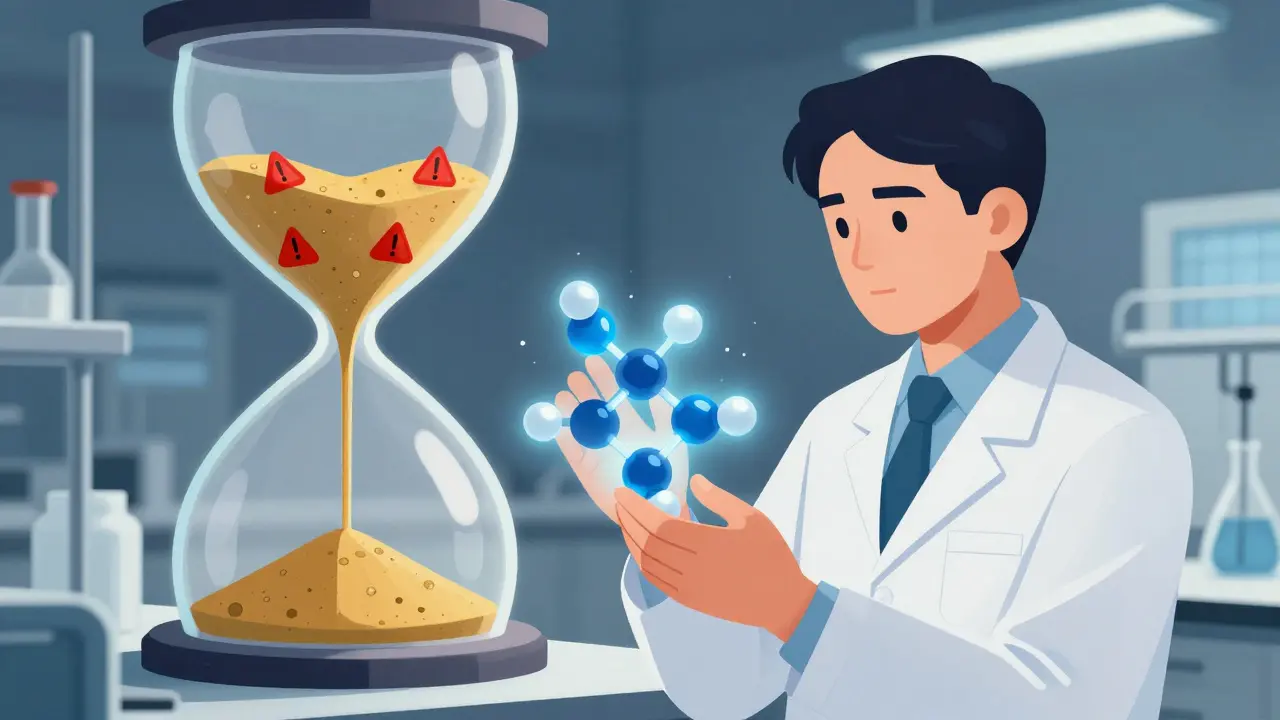
You see a price tag for your prescription medication and wonder why it costs hundreds of dollars. Then, suddenly, a cheaper version appears on the shelf. What changed? A patent expired. But here is the twist: drug patents are not simply 20-year timers that start when you buy the pill. They are complex legal constructs that often run out long before they actually expire on paper.
If you think a drug patent gives a company 20 years of exclusive sales starting from today, you are mistaken. The clock starts ticking the moment the application is filed with the United States Patent and Trademark Office (USPTO). By the time the Food and Drug Administration (FDA) approves the drug for public use, half that time has usually vanished into clinical trials and regulatory reviews.
The Myth of the 20-Year Market Monopoly
The law states that utility patents last for 20 years from the earliest effective filing date. This rule was solidified by the Uruguay Round Agreements Act of 1994 to align U.S. laws with international standards. However, developing a new drug takes anywhere from 10 to 15 years. You spend those early years proving the molecule works in labs and then testing it safely on humans through Phase I, II, and III trials.
By the time the FDA says "yes," you might only have 7 to 12 years left of actual market exclusivity. That is the window where the brand-name company can charge premium prices without competition. After that, the gates open for generics. This gap between the legal term and the real-world commercial life is what industry experts call the "effective patent life." It is much shorter than the headline number suggests.
| Metric | Typical Duration | Notes |
|---|---|---|
| Legal Patent Term | 20 Years | Starts at filing date with USPTO |
| R&D and Clinical Trials | 8-12 Years | Time consumed before FDA approval |
| Effective Market Exclusivity | 7-12 Years | Time remaining after FDA approval |
How Companies Buy Back Time: PTE and PTA
Because losing 10 years of potential profit to bureaucracy seems unfair, Congress created safety valves. The most famous is the Hatch-Waxman Act of 1984. This legislation introduced Patent Term Extension (PTE). It allows companies to add up to 5 extra years to their patent to compensate for the time spent waiting for FDA approval.
There is a catch, though. The total period of market exclusivity cannot exceed 14 years from the date of FDA approval. So, even with extensions, you rarely get more than a decade and a half of monopoly power. To get this extension, the company must file an application within 60 days of FDA approval. Miss that deadline, and you lose the right forever.
Another mechanism is Patent Term Adjustment (PTA). If the USPTO drags its feet-taking longer than 14 months to issue an initial office action or longer than three years to grant the patent-they owe the applicant time. This adjustment adds days back to the patent term to make up for government delays. It does not account for delays caused by the applicant themselves, but it helps keep the timeline fair.

The Patent Cliff: When the Money Stops
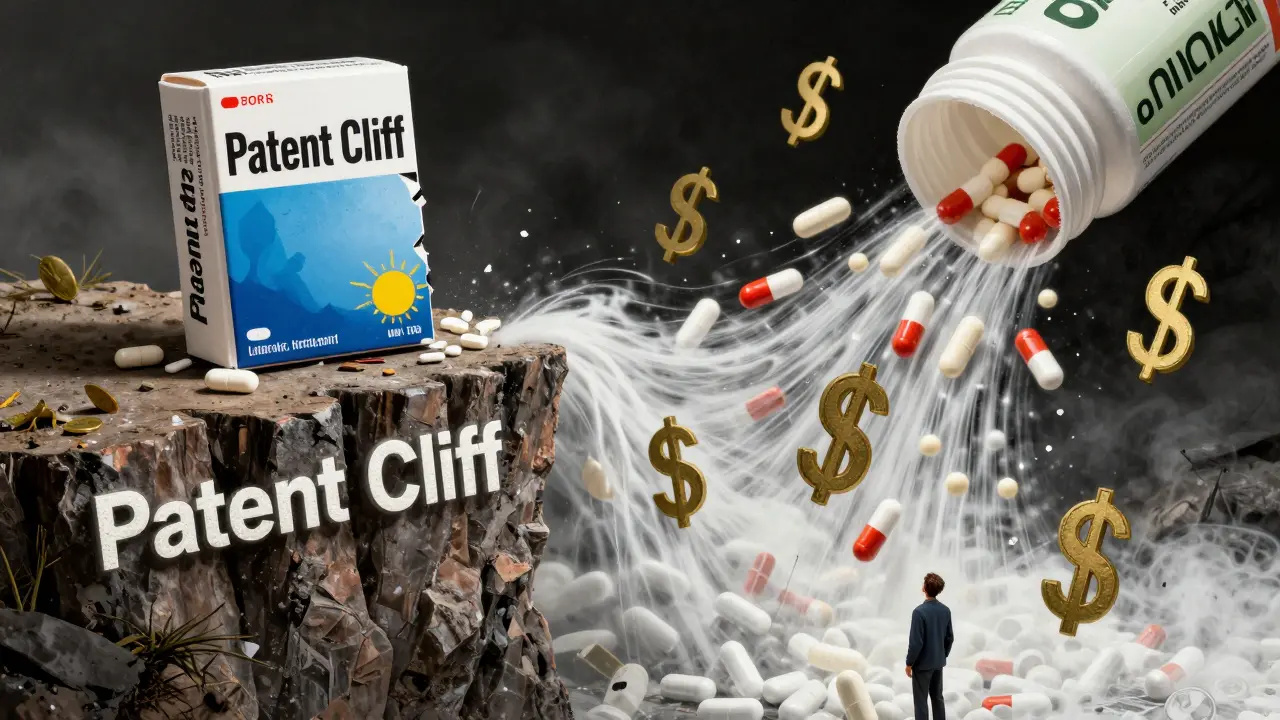
The moment the last enforceable intellectual property right expires, the drug hits the "Patent Cliff." This is a terrifying term for pharmaceutical executives because revenue plummets. According to data from the National Bureau of Economic Research, the average price of physician-administered drugs drops by 38% to 48% shortly after generic competitors enter the market.
For patients, this is good news. For the original manufacturer, it is a crisis. Take Eliquis (apixaban), for example. When its patent protection weakened in late 2022, generic versions captured 35% of the market share within just six months. Prices dropped by 62% in the first year. The shift happens fast. For small-molecule drugs, generics often grab 90% of the market within 18 months of full patent expiration.
Biologics, which are larger, more complex proteins rather than simple chemical compounds, face a slower transition. Biosimilars-the biological equivalent of generics-typically reach only 40% to 60% market share due to higher barriers to entry and interchangeability rules. But the pressure is still there.
Beyond the Main Patent: Layered Protection Strategies
Pharma companies know the main compound patent will eventually expire. So, they build a fortress around it. This is called lifecycle management. Instead of relying on one patent, they file dozens. Think about the formulation, the manufacturing process, the specific dosage form, or even the method of using the drug for a new condition.
Each of these secondary patents has its own 20-year term. For instance, Spinraza (nusinersen) maintains a web of patents extending protection well into the 2030s, even if the core ingredient patent were to lapse earlier. Critics call this "evergreening"-a tactic to delay generic entry by 2 to 3 years on average by challenging these minor patents in court.
The Federal Trade Commission (FTC) has flagged this practice. In their 2021 report, they noted that some firms file patents on delivery mechanisms or slight formulation tweaks solely to block competition. While legal, it frustrates consumers who want lower prices sooner.
Regulatory Exclusivity: A Separate Shield
Patents are not the only thing keeping generics away. The FDA grants separate periods of exclusivity that operate independently of patent law. These are statutory blocks that prevent the FDA from accepting generic applications, regardless of patent status.
- New Chemical Entity (NCE) Exclusivity: Grants 5 years of protection. During this time, the FDA cannot accept an Abbreviated New Drug Application (ANDA) for a generic version.
- Orphan Drug Exclusivity: Offers 7 years of market protection for drugs treating rare diseases affecting fewer than 200,000 Americans.
- New Clinical Investigation Exclusivity: Provides 3 years for drugs requiring new clinical studies essential for approving new indications or dosages.
- Pediatric Exclusivity: Adds 6 months to all existing patent terms and exclusivity periods if the company conducts requested pediatric studies.
This layering means a drug might still be protected by regulatory exclusivity even if its primary patent has technically expired. Conversely, a patent might expire while regulatory exclusivity still holds off generics. Navigating this maze requires specialized teams of legal and regulatory professionals.
What Happens Next for Patients?
As we look toward 2026 and beyond, the landscape is shifting. Legislative proposals like the "Restoring the America Invents Act" bill aim to tweak how patent term adjustments work, potentially shaving off 6 to 9 months of average market exclusivity. Meanwhile, the World Health Organization continues to push for harmonized reductions in patent terms to balance innovation incentives with global access to medicines.
For you, the consumer, understanding these timelines helps explain why some drugs stay expensive for so long while others drop in price overnight. It also highlights why switching to generics when available is one of the most effective ways to reduce healthcare costs. The system is designed to reward innovation, but it is equally driven by the inevitable march toward competition.
Does a drug patent always last exactly 20 years?
No. While the statutory term is 20 years from the filing date, the actual period of market exclusivity is often shorter due to the time spent in clinical trials and FDA review. Additionally, Patent Term Extensions (PTE) and Adjustments (PTA) can add or subtract time, making the final expiration date unique to each drug.
What is the "Patent Cliff"?
The Patent Cliff refers to the sharp decline in revenue a pharmaceutical company experiences when a blockbuster drug's patent expires and generic competitors enter the market. Prices typically drop by 40% to 80%, and the original manufacturer loses the majority of its market share.
Can a company extend a patent indefinitely?
No. Under the Hatch-Waxman Act, the maximum total market exclusivity period from FDA approval is capped at 14 years. Companies cannot extend the primary patent beyond this limit, though they may file secondary patents for formulations or methods of use to create additional, albeit temporary, barriers.
Why do some drugs have multiple patents?
Pharmaceutical companies use a strategy called lifecycle management. They patent the active ingredient, the formulation, the manufacturing process, and specific uses. This creates a "patent thicket" that makes it harder for generic manufacturers to enter the market immediately after the main compound patent expires.
How soon after patent expiration do generics appear?
Generics often launch immediately upon patent expiration if they have already received FDA approval pending the expiry date. In many cases, generic manufacturers file applications years in advance. Once the barrier is removed, they capture significant market share within months, often reaching 80-90% penetration within 18 months for small-molecule drugs.