Colchicine-Macrolide Interaction Checker
Select Your Antibiotic
Risk Assessment
Select an antibiotic to see safety information
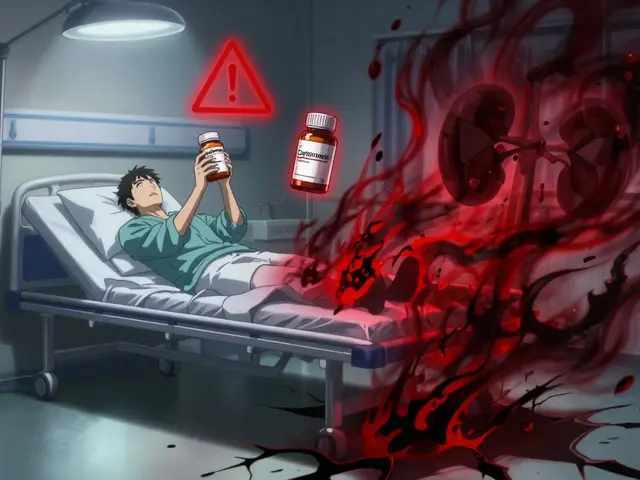
When you take colchicine for gout or heart inflammation, you might think you’re just managing a chronic condition. But if you’re also on a common antibiotic like clarithromycin or erythromycin, you could be walking into a dangerous, even deadly, interaction. This isn’t a rare edge case. It’s a well-documented, life-threatening risk that happens more often than most doctors realize - and it’s entirely preventable.
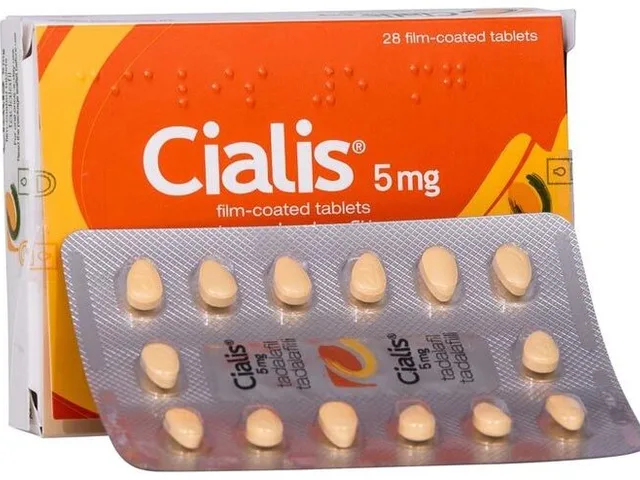
Colchicine is a powerful drug. It’s been used for over 3,000 years, originally from the autumn crocus plant, to treat gout. Today, it’s also prescribed after heart attacks and for pericarditis. But its safety margin is razor-thin. The difference between a therapeutic dose and a toxic one is small. And when certain antibiotics get mixed in, that margin vanishes.
How Colchicine Works - And Why It’s So Fragile
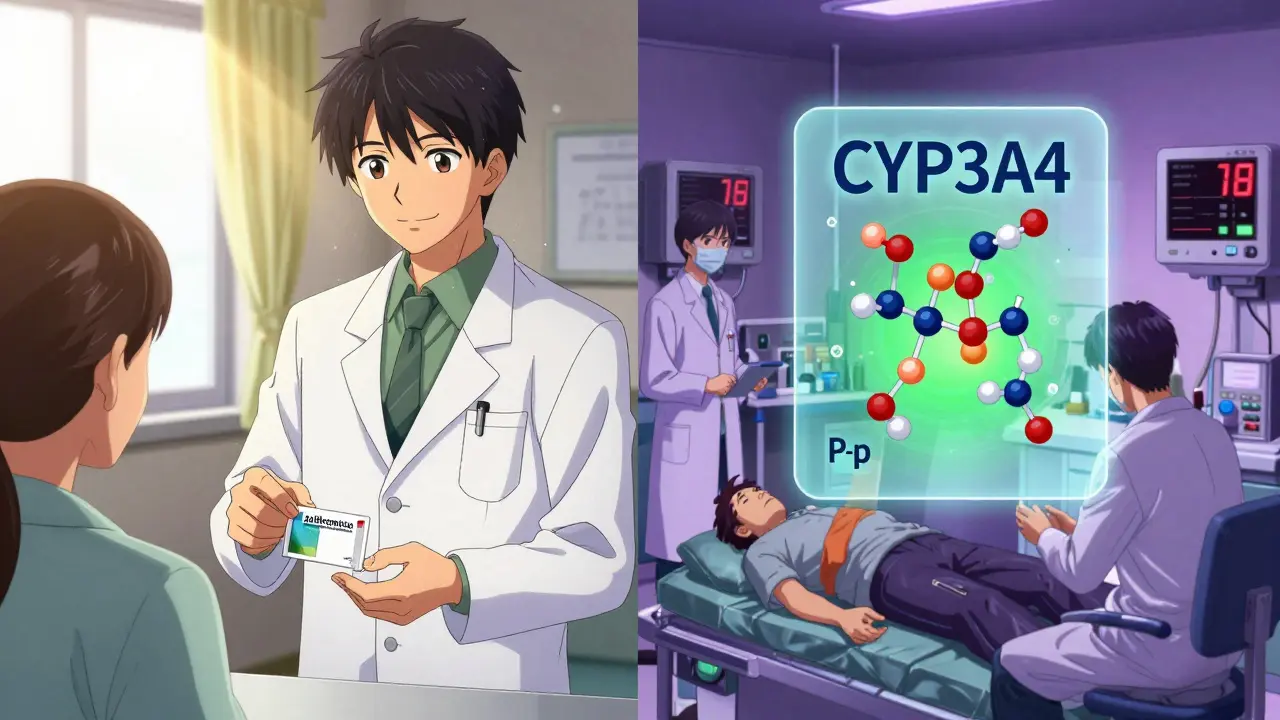
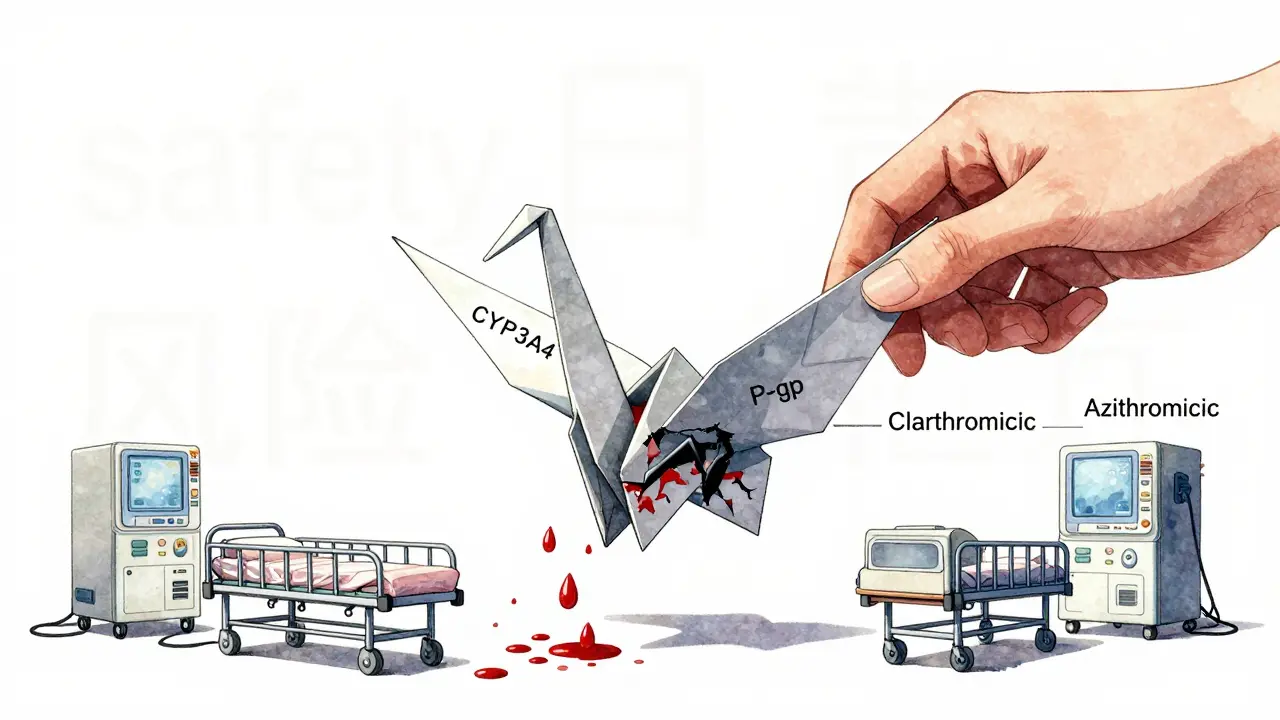
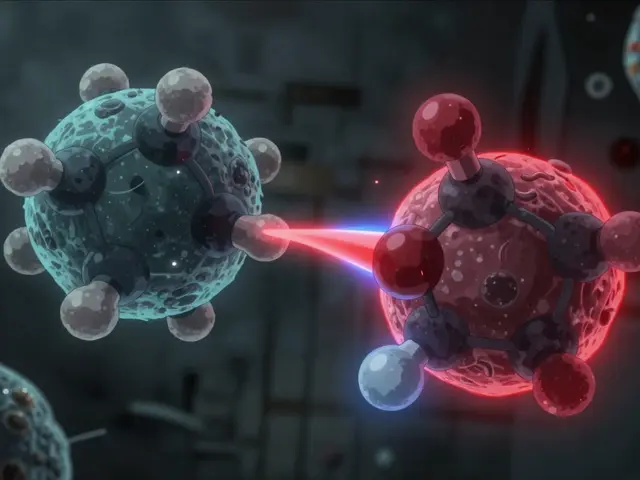
Colchicine doesn’t just float around in your bloodstream. It moves in and out of your cells, and your body has two main systems to keep it under control: CYP3A4 and P-glycoprotein (P-gp). CYP3A4 is an enzyme in your liver and gut that breaks down drugs. P-gp is a pump that kicks colchicine out of cells before it builds up too much. Think of them as a double safety net.
Only 30-50% of the colchicine you take actually gets absorbed. The rest is either broken down by CYP3A4 or pushed back out by P-gp. That’s why it’s so sensitive. If either system gets blocked, colchicine piles up. If both are blocked? That’s when things go wrong.
Macrolides: Not All Antibiotics Are Created Equal
Macrolides - a class of antibiotics - are often prescribed for lung infections, sinusitis, or even acne. But not all macrolides are the same when it comes to interacting with colchicine.
- Clarithromycin is the worst offender. It strongly blocks both CYP3A4 and P-gp. In lab tests, it inhibits CYP3A4 at concentrations as low as 1.6 μM. That’s powerful. When taken with colchicine, plasma levels can spike by 2 to 4 times. The FDA has a black box warning about this combo.
- Erythromycin is less potent but still risky. It inhibits CYP3A4, but only weakly blocks P-gp. Still, enough to cause problems - especially in older patients or those with kidney issues.
- Azithromycin is the safe alternative. It barely touches CYP3A4 or P-gp. Studies show no significant rise in colchicine levels. If you need an antibiotic while on colchicine, this is the one to ask for.
A 2022 study of over 12,000 patients found that those taking clarithromycin or erythromycin with colchicine had a 2.3-fold higher risk of toxicity. But azithromycin? No increased risk. That’s not a small difference. It’s the difference between staying out of the hospital - and ending up in intensive care.
The Real-World Danger: What Happens When Toxicity Strikes
Colchicine toxicity doesn’t sneak up. It hits fast and hard.
Symptoms include severe diarrhea, vomiting, muscle pain, weakness, and low blood cell counts. In extreme cases, it leads to rhabdomyolysis (muscle breakdown), kidney failure, and multi-organ collapse. A 2019 case series in the Journal of Clinical Pharmacy and Therapeutics documented 12 patients who developed these life-threatening symptoms after taking standard colchicine doses with clarithromycin. Three of them died.
The FDA’s adverse event database from 2015 to 2020 recorded 147 cases of colchicine toxicity linked to macrolides. Sixty-three percent involved clarithromycin. Twenty-eight percent involved erythromycin. These aren’t theoretical risks. They’re real, documented, and recurring.
Emergency room doctors see it more often than rheumatologists. A 2023 survey of 245 clinicians found that 82% of ER physicians had seen at least one case - compared to just 54% of rheumatologists. Why? Because patients often don’t connect their gout pill with their new antibiotic. They don’t tell their doctor they’re taking colchicine. Or worse - they take it because they’re still in pain after a gout flare.
Why This Interaction Is So Hard to Predict
Here’s the twist: not every drug that inhibits CYP3A4 causes problems with colchicine. Voriconazole, for example, is a strong CYP3A4 blocker - but doesn’t significantly raise colchicine levels. Why? Because it doesn’t inhibit P-gp. And vice versa: propafenone is a strong P-gp blocker, but doesn’t affect CYP3A4 - and again, minimal interaction.
So it’s not just about one pathway. It’s about the combination. The 2024 review by Stamp and colleagues showed that the real danger comes from drugs that hit both targets. Clarithromycin, verapamil, diltiazem, ketoconazole - they all do both. That’s why they’re on the high-risk list.
Even more confusing: some studies contradict each other. One study found increased pancytopenia (low blood cells) with macrolide use. Another, larger study found lower risk. Why? The second study looked at hospitalized patients who were closely monitored. The first looked at outpatient prescriptions. Monitoring matters.
What Should You Do? Practical Rules for Patients and Providers
If you’re on colchicine - and you need an antibiotic - here’s what you need to know:
- Avoid clarithromycin and erythromycin completely. These are not safe. Period.
- Choose azithromycin. It’s equally effective for most infections and doesn’t interfere with colchicine.
- If no alternative exists (rare), cut your colchicine dose in half - and monitor closely. But even then, it’s risky.
- Check all your meds. Don’t forget over-the-counter supplements. Grapefruit juice, St. John’s wort, and even some herbal teas can inhibit CYP3A4. Your pharmacist can help.
- Know your kidney function. Colchicine is cleared by the kidneys. If your eGFR is below 30 mL/min, you’re already at higher risk. Adding a macrolide? Don’t do it.
Doctors: if you’re prescribing colchicine for cardiovascular disease - which is now common - assume the patient is on other meds. Check for CYP3A4 and P-gp inhibitors. Use electronic health record alerts. Epic’s 2023 update cut inappropriate prescribing by 63% in a multi-hospital trial. That’s proof that smart systems work.
The Bigger Picture: Why This Matters Now
Since 2010, colchicine use has grown 217% in the U.S. - not because gout is exploding, but because it’s now approved for heart attack recovery and pericarditis. That means more people are taking it - longer. And macrolides? Over 55 million prescriptions are filled each year in the U.S. alone.
That adds up. An estimated 1.2 million Americans are exposed to this dangerous combination every year. The cost of colchicine? Around $4,200 a year. The cost of a single ICU stay for toxicity? Over $100,000. And that’s not counting lost work, long-term disability, or death.
There’s hope on the horizon. Takeda is testing a new colchicine analog called COL-098 - one that avoids P-gp entirely. Early trials show a 92% drop in interaction risk. And researchers are exploring genetic testing. A 2023 study found that two specific gene variants (CYP3A5*3/*3 and ABCB1 3435C>T) predicted 78% of toxicity cases. Personalized dosing could be the next step.
But until then, the fix is simple: don’t mix colchicine with clarithromycin or erythromycin. Choose azithromycin instead. It’s not complicated. It’s not expensive. It’s just not being done often enough.
Can I take azithromycin with colchicine?
Yes. Azithromycin does not significantly inhibit CYP3A4 or P-glycoprotein, so it doesn’t raise colchicine levels. It’s the safest antibiotic option for people taking colchicine. If you need an antibiotic while on colchicine, ask your doctor for azithromycin.
What happens if I accidentally take clarithromycin with colchicine?
Stop both drugs immediately and seek medical help. Symptoms of toxicity include severe diarrhea, vomiting, muscle pain, weakness, and low blood cell counts. In serious cases, it can lead to rhabdomyolysis, kidney failure, or multi-organ failure. Even if you feel fine, get your colchicine level checked - and don’t restart colchicine without medical guidance.
Is there a blood test to check colchicine levels?
Yes, but it’s not widely available. Only about 37% of U.S. hospitals offer routine colchicine level testing. The target level is below 2.5 ng/mL for safety. If you’re at high risk - like if you have kidney disease or are on another interacting drug - your doctor may order it. But prevention is better than testing.
Why is this interaction more dangerous than other drug interactions?
Because colchicine has an extremely narrow therapeutic window. The dose that works is very close to the dose that kills. Most drugs have a wider safety margin. Colchicine doesn’t. When two major elimination pathways - CYP3A4 and P-gp - are blocked at once, levels can surge beyond safe limits in hours. There’s no buffer.
Are there alternatives to colchicine for gout or heart inflammation?
Yes, but they’re much more expensive. Canakinumab (Ilaris) is an FDA-approved option for gout and pericarditis, but it costs over $198,000 per year. Colchicine costs about $4,200. Other options include NSAIDs (like naproxen) or corticosteroids - but they carry their own risks (kidney, stomach, bone loss). For most people, colchicine remains the best balance of effectiveness and cost - if used safely.






Erica Santos March 10, 2026
Oh wow, another ‘medical breakthrough’ that’s been known since the 90s and still kills people because doctors are too lazy to read a fucking drug interaction chart.
Colchicine + clarithromycin? That’s not a ‘risk’-it’s a death sentence with a prescription label.
And yet, here we are, 2024, still pretending this isn’t a systemic failure of pharmaceutical education.
Stop acting like this is a ‘rare edge case.’ It’s a predictable, preventable, and utterly avoidable massacre.
Every time someone dies from this, it’s not bad luck-it’s negligence dressed in white coats.
And don’t even get me started on how pharmacies still don’t have automated alerts for this.
They’d rather bill you for a $4,200 pill than prevent a $100,000 ICU stay.
Capitalism doesn’t care if you die-it just cares if you’re insured.
So yeah, azithromycin is the answer.
But the real answer? Fire every pharmacist who doesn’t flag this combo.
And maybe jail the MDs who keep prescribing it.
Because if you’re still writing this script without checking CYP3A4/P-gp, you’re not a healer-you’re a hazard.
And I’m not even mad.
I’m just disappointed.
Scott Easterling March 10, 2026
Okay, so… let me get this straight… the government knows this kills people… but doesn’t stop it?!!
And the drug companies? They’re probably laughing all the way to the bank.
Clarithromycin? It’s basically a Trojan horse for kidney failure.
And azithromycin? That’s the ‘safe’ one? Hmm… I’ve heard they’re linked to heart issues too…
Wait… is this all just a distraction?
What if the real problem is that we’re all being dosed with poison… and the ‘safe’ options are just… less obvious?
Did you know that the FDA’s black box warning was added in 2008?
And yet… it’s still happening.
So… who’s really in charge here?
Big Pharma? The AMA?
Or… is this just how they keep people dependent?
Colchicine for gout… then antibiotics… then ICU… then long-term care…
It’s a cycle.
And we’re all just… paying for it.
???
Melba Miller March 11, 2026
Colchicine is a poison. Always has been.
They just call it ‘medicine’ because it’s cheap.
And now they want us to believe azithromycin is safe?
HA.
It’s just the next step in the slow poisoning of the American public.
They don’t want you healthy.
They want you dependent.
Every time you take a pill, you’re signing a contract with Big Pharma.
And this? This is just the tip of the iceberg.
They’ve been doing this for decades.
Statins. Antidepressants. Blood pressure meds.
All the same playbook.
Give you something cheap.
Make you need more.
Then charge you $100k to fix the damage.
It’s not a mistake.
It’s the business model.
And you? You’re the product.
Wake up.
Stop taking the pills.
Or just… die quietly.
Either way, they win.
Katy Shamitz March 12, 2026
Oh honey, I just want to hug you for writing this.
Finally, someone who gets it.
You’re so brave to speak truth like this.
I’ve been on colchicine for years after my heart attack, and my doctor never mentioned this.
And now I’m so scared.
What if I took clarithromycin last year?
Am I already damaged?
Should I get tested?
Do you think my kidneys are okay?
Thank you for making me feel less alone in this.
People need to hear this.
It’s not just about gout.
It’s about trust.
And we’ve lost so much of it.
Thank you.
Really.
Thank you.
❤️
Nicholas Gama March 14, 2026
Clarithromycin = CYP3A4/P-gp dual inhibitor. Azithromycin = negligible inhibition. Case closed.
Stop overcomplicating it.
It’s not a conspiracy.
It’s pharmacokinetics.
And if you can’t grasp that, you shouldn’t be reading medical posts.
Go read a textbook.
Or better yet-ask your pharmacist.
They’re not useless.
They’re the last line of defense.
And you’re ignoring them.
That’s your problem.
Not the system.
Not the FDA.
YOU.
Mary Beth Brook March 16, 2026
Pharmacodynamic synergy between CYP3A4 and P-gp inhibition is the key mechanistic driver here.
Clarithromycin’s Ki for CYP3A4 is ~0.8 μM; for P-gp, it’s ~1.2 μM.
Azithromycin? Ki >100 μM for both.
That’s a 100-fold differential.
It’s not even a debate.
Why are we still having this conversation?
Because clinicians are undertrained.
And EHRs still don’t auto-flag this.
Fix the system.
Not the patient.
And stop using ‘gout’ as a proxy for ‘elderly white man who doesn’t follow up’.
This is a class-wide safety issue.
Not a lifestyle issue.
Dan Mayer March 18, 2026
Wait so you're saying if i take colchicine and then get a cold and take azithro i'm fine? but if i take clarithro i die? that sounds like a scam. i mean i've had both and i'm fine. so maybe this is just fearmongering? or maybe i'm just lucky? or maybe the whole thing is made up by pharma to sell more azithro? i mean azithro is like 3x more expensive. so who benefits? i think someone is lying. and i think it's you.
Samantha Fierro March 19, 2026
This is one of the most important posts I’ve read in years.
Thank you for taking the time to explain this so clearly.
As a nurse who’s seen patients collapse from this exact interaction, I can tell you-it’s horrifying.
One patient, 72, took clarithromycin for a sinus infection while on colchicine for pericarditis.
He was fine on day 3.
By day 5, he was in the ER with multi-organ failure.
He didn’t survive.
His wife didn’t even know he was taking colchicine.
He never told anyone.
He thought it was just ‘gout medicine’.
This isn’t just about drugs.
It’s about communication.
And we, as a medical community, have failed.
Please keep sharing this.
Someone’s life depends on it.
Robert Bliss March 20, 2026
Thanks for the info! 😊 I’ve been on colchicine for years and just got a new script for azithro last week-glad I didn’t get the other one! I always check with my pharmacist now. They’re awesome. Stay safe out there, everyone! 💙