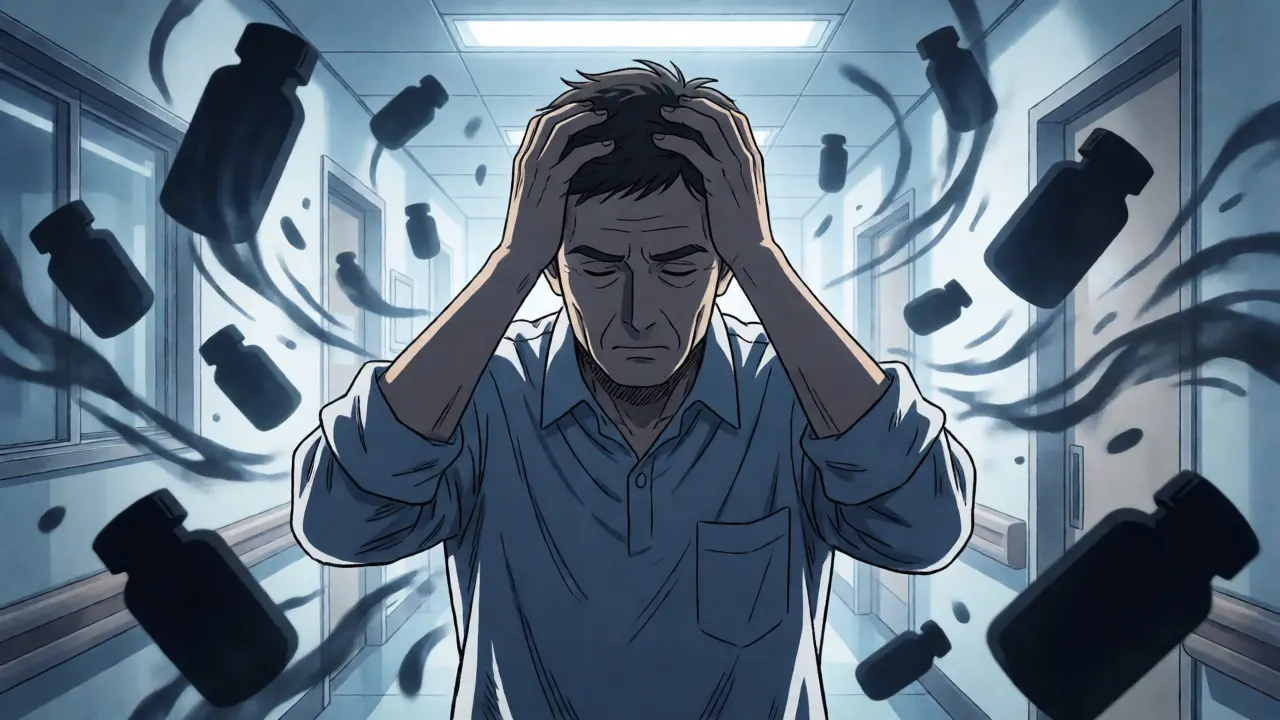
You walk into an emergency room or see a new specialist, and the first question is always the same: "What medications are you taking?" You might rattle off your blood pressure pill and maybe your daily aspirin. But what about that herbal supplement your friend recommended for sleep? Or the over-the-counter painkiller you’ve been popping for your back pain? If you forget those, you’re not just being vague-you’re risking a dangerous drug interaction.
Medication reconciliation isn't just hospital jargon; it's the process of creating an accurate, complete list of every substance you put in your body. According to the FDA, medication errors contribute to roughly 7,000 deaths annually in the U.S. alone. A 2020 study in the Journal of Patient Safety estimated that proper reconciliation could prevent up to 80% of these errors during care transitions. That’s a massive number for something as simple as writing down what you take. This guide will show you exactly how to build, maintain, and use a medication list that actually saves your life.
Why Your Brain Isn’t Enough
Most people think they know what they take. They don’t. Dr. Harlan Krumholz from Yale University warned in JAMA that over-reliance on patient self-reporting creates false confidence. In one study, 56% of patient-reported lists contained at least one critical error. Why? Because we compartmentalize. We view prescription drugs as "medical" and vitamins or supplements as "food." But your liver doesn’t make that distinction. It processes everything.
The Institute of Medicine identified incomplete medication histories as a top contributor to adverse events. The American Heart Association has stressed this since 2010, noting that many patients won’t mention non-prescription drugs because they don’t consider them "real" medicine. When you combine multiple prescribers-say, a cardiologist, a dermatologist, and a primary care doctor-without a central list, you create silos where no single provider sees the full picture. This fragmentation is why keeping your own record isn’t optional; it’s a safety net.
Building the Ultimate Medication List
A generic list saying "Take one pill daily" is useless to an ER doctor. You need specific data points. The ECRI Institute’s Targeted Medication Safety Best Practices specify that an accurate list must include allergies, prescription drugs, OTC meds, herbals, and dietary supplements. Here is the exact structure you should use:
- Drug Name: Both brand name (e.g., Lipitor) and generic name (e.g., atorvastatin). Doctors often prescribe generics but refer to brands.
- Dose and Strength: Be precise. Is it 10 mg or 20 mg? Take it with food or on an empty stomach?
- Frequency: Once a day, twice a day, as needed? Note the time if it matters (e.g., morning vs. night).
- Route: Oral, topical, inhaler, injection?
- Indication: What is it for? "High blood pressure" or "Pain relief." This helps doctors understand intent if the drug name is unfamiliar.
- Prescriber: Who ordered it? Useful if you have multiple specialists.
- Allergies: Not just "Penicillin," but the reaction. Did you get a rash or go into anaphylactic shock? These are very different clinical pictures.
Don’t forget the "invisible" meds. Include eye drops, creams, patches, and even occasional uses like antacids or melatonin. If you take it more than once a month, it goes on the list.
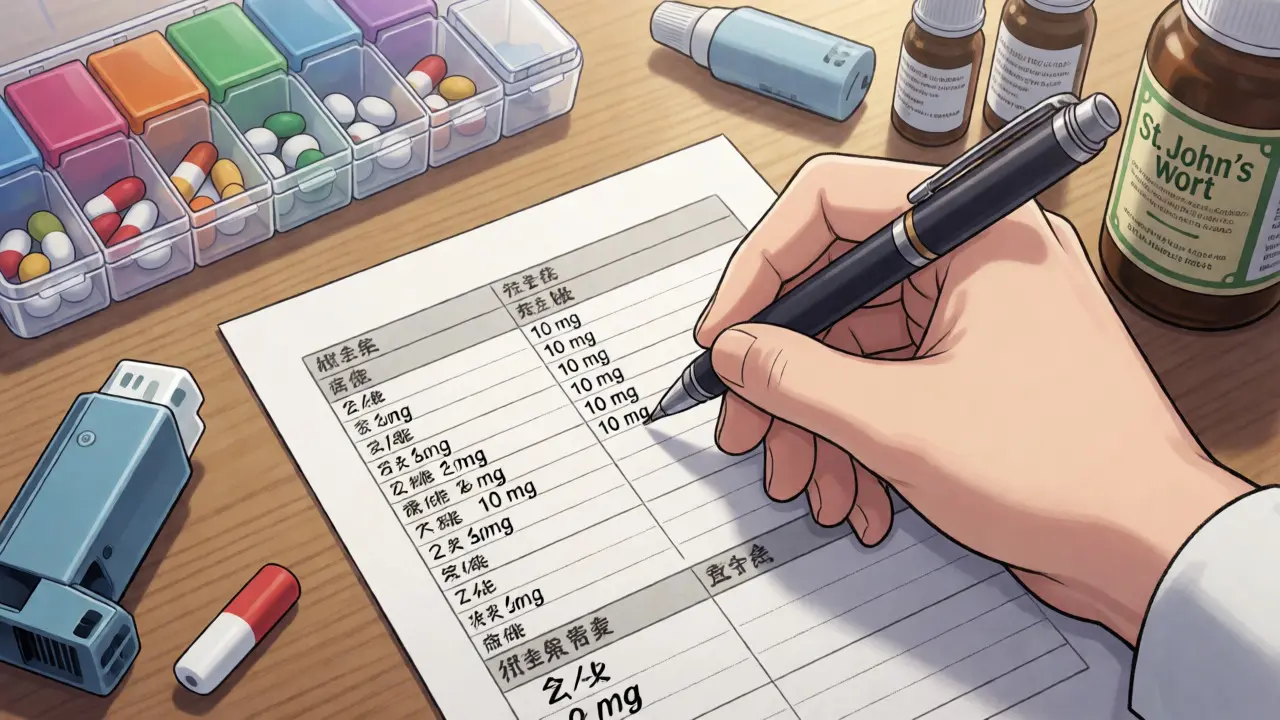
Paper vs. Digital: Choosing Your Format
There is no one-size-fits-all solution. Your choice depends on your comfort with technology and your healthcare complexity. Here’s how the main options stack up:
| Format | Pros | Cons | Best For |
|---|---|---|---|
| Paper Card (Wallet Size) | Always accessible, works without battery/internet, easy to hand to any provider. | Easily lost, hard to update frequently, can become outdated quickly. | Emergency situations, elderly patients, those with low tech literacy. |
| Smartphone Apps | Automatic reminders, refill alerts, easy sharing via email/text, searchable. | Requires charging/internet, interface can be complex, privacy concerns. | Tech-savvy users, complex regimens needing timing precision. |
| EHR Portal (MyChart, etc.) | Integrated with medical records, visible to providers, auto-updates from pharmacy. | Only visible to participating providers, requires login, may miss OTC/supplements. | Patients within large health systems (e.g., Kaiser, Mayo). |
A 2022 study in JAMA Internal Medicine found that paper lists had a 43% rate of outdated information. However, digital apps face adoption barriers among seniors; only 35% of adults aged 65+ regularly use medication apps. The best approach is often hybrid: keep a master digital copy but carry a printed wallet card updated monthly.
The Maintenance Routine
Creating the list is step one. Keeping it current is where most people fail. Research from the University of Michigan showed that 68% of patients fail to update their lists after hospital discharge. To avoid becoming part of that statistic, tie updates to existing habits.
The Pill Box Rule: Every Sunday, when you fill your weekly pill organizer, spend two minutes reviewing your list. Did anything change? Did you start a new vitamin? Update the app or rewrite the card immediately.
The Appointment Trigger: Before any medical appointment, check your list. Bring the physical bottles if possible. This is known as the "brown bag method." Pharmacists recommend this because seeing the actual bottle eliminates ambiguity about strength or formulation. A 2023 ASHP survey found that 82% of geriatric pharmacists prefer photos or physical bottles over verbal reports.
The Pharmacy Sync: Ask your pharmacist to review your entire list annually. Since Medicare Part D covers medication therapy management services, this is often free. They can spot interactions your doctor might miss, especially between prescriptions and OTC drugs.

Using Your List in Critical Moments
Your medication list is most valuable when you can’t speak for yourself. In an emergency, seconds count. Paramedics and ER doctors rely on rapid assessment. If you have a QR code on your wallet card linking to your digital list, or simply a clear photo on your phone lock screen, you speed up triage.
Dr. Scott Gottlieb, former FDA Commissioner, called accurate medication lists the "single most important tool" for preventing adverse events in polypharmacy patients. Polypharmacy generally refers to taking five or more medications. If you fall into this category, your list is non-negotiable. A 2023 systematic review in the Annals of Internal Medicine found that pharmacist-led reconciliation reduced adverse drug events by 31.2%. By handing them a verified list, you enable that efficiency.
Also, use your list for coordination. If you see a dentist, show them the list. Some antibiotics and painkillers interact with heart meds or blood thinners. If you visit an urgent care clinic, don’t assume they’ll call your pharmacy. Hand them the list. It removes guesswork.
Pitfalls to Avoid
Even with a good system, mistakes happen. Watch out for these common traps:
- The "PRN" Trap: "As needed" is vague. Specify the maximum daily dose. If you take ibuprofen for headaches, note "Max 3 tablets/day." An ER doctor needs to know if you’ve already taken 2000mg today before prescribing another NSAID.
- Discontinued Meds: Stop taking a med? Cross it off immediately. Don’t leave it on the list "just in case." Stale entries cause confusion.
- Supplement Secrecy: Never hide supplements. St. John’s Wort, for instance, reduces the effectiveness of birth control and some antidepressants. It’s a chemical, treat it like one.
- Outdated Allergies: Sometimes children grow out of allergies, or reactions were misdiagnosed. Review this section annually with your allergist or PCP.
Remember, the goal isn’t perfection; it’s accuracy. A list that is 95% correct and current is infinitely safer than a perfect list from three years ago. Start small. Write down what you take tonight. Update it tomorrow. Make it a habit, and you’ll navigate the healthcare system with far fewer surprises.
Do I really need to list vitamins and supplements?
Yes. Vitamins and supplements contain active compounds that can interact with prescription medications. For example, Vitamin K can interfere with blood thinners like warfarin, and calcium can block the absorption of certain antibiotics. Listing them ensures your provider has the full metabolic picture.
What is the "Brown Bag Method"?
The Brown Bag Method involves bringing all your current medication bottles (prescription, OTC, and supplements) to your appointment. This allows the provider or pharmacist to verify the exact names, strengths, and expiration dates directly from the labels, reducing errors caused by memory or transcription.
How often should I update my medication list?
Update your list immediately whenever a medication is added, stopped, or changed in dosage. Additionally, perform a comprehensive review at least once a year, ideally during your annual physical. After any hospital stay or surgery, verify the list before leaving the facility.
Is there a standard format for a medication list?
While formats vary, the FDA’s "My Medicines" template is a widely recognized standard. It includes sections for drug name, dose, frequency, purpose, and prescriber. Many hospitals also accept lists formatted this way. The key is consistency and clarity rather than a specific layout.
Can I use an app instead of a paper list?
Apps are excellent for reminders and tracking, but they shouldn't replace a portable backup. Battery death, forgotten passwords, or lack of Wi-Fi can render an app inaccessible in an emergency. A hybrid approach-using an app for daily management and a printed card for emergencies-is often the safest strategy.







Laura Banuelos September 5, 2026
omg this is so true!! 🥺 i used to just say "uh, some pills" at the er and my nurse looked like she was gonna cry 😭 now i keep a little card in my wallet with everything listed out even my vitamins!! its saved me twice already when i passed out from low blood sugar lol. highly recommend everyone do this!! 💖✨
Christopher Ornelas September 6, 2026
You're missing the point entirely if you think a list solves the systemic issue of fragmented care records. The problem isn't patient memory; it's that Epic and Cerner don't talk to each other. I've been dealing with interoperability issues for a decade. A piece of paper doesn't fix backend data silos.
Taylor Tomita September 6, 2026
I completely agree with the need for a physical backup. In my experience working as a pharmacist, digital apps are great for reminders but terrible for emergency triage because nobody has time to unlock your phone and find the app. The brown bag method mentioned here is actually the gold standard we teach in pharmacy school for geriatric patients. It removes all ambiguity about dosage forms and strengths.
Ankur Saini September 7, 2026
this is good advice honestly. i started doing this after my mom had a bad reaction to a drug interaction. its scary how much we forget. simple lists work best dont overcomplicate it.
Daniel Beckett September 7, 2026
It is truly wonderful to see such comprehensive guidance on maintaining one's health records because taking proactive steps toward medication reconciliation can significantly enhance the quality of life and safety for individuals who navigate complex medical regimens daily and often feel overwhelmed by the sheer volume of information they must manage without proper support systems or clear organizational strategies that align with their personal habits and technological comfort levels.
Sayan Kanjilal September 8, 2026
Dude, the healthcare system is a dumpster fire 🔥 and trying to organize your meds feels like trying to put out that fire with a spitball 💦. You write down 'Tylenol' and suddenly you're in a philosophical debate with a doctor about whether it counts as 'real medicine'. It’s exhausting. Just accept the chaos and hope for the best, man. 😩💀
Sophia Calimbahin September 8, 2026
Finally someone says it plain and simple. We spend billions on defense but can't get our own damn doctors to look at a piece of paper? Typical American inefficiency. If you don't have your list ready, you're wasting tax dollars and your own time. Get organized or get left behind. 🇺🇸👊
Elizabeth Lucero September 9, 2026
This article assumes a level of literacy and executive function that simply does not exist in the general population. Most people cannot distinguish between a brand name and a generic name, let alone maintain a dynamic database. It’s performative health advice for people who already have their lives together. The rest of us are just surviving.
Will Ryan September 10, 2026
The ontology of the self is fractured by pharmacological intervention. To list is to define. But what defines the pill? Is it the molecule or the intent? We seek order in the chemical chaos of existence, yet the map is never the territory. The list is a simulacrum of health.
Emily Hinckley September 12, 2026
Standardized templates rarely account for individual metabolic variability. ❌ Also, the citation density is excessive for a blog post. 🤔
James Ego September 14, 2026
Good points on the hybrid approach. Respecting different tech comforts is key here.
Equipment Strategy Strategy September 14, 2026
From an equipment strategy perspective, relying on single-point-of-failure devices like smartphones introduces unacceptable risk vectors into the critical path of emergency response protocols Furthermore the lack of standardized interoperability across disparate electronic health record ecosystems necessitates a redundant analog fallback mechanism to ensure continuity of care during high-acuity events
Mike Murphy September 15, 2026
i tried the app thing once forgot my password while waiting in the er lobby felt stupid just wrote it on a napkin instead works fine
Katie Evans September 15, 2026
We treat our bodies like machines that require precise inputs, yet we refuse to acknowledge the subjective experience of taking those inputs. The list is a mirror reflecting our anxiety about control in a world where biology is inherently unpredictable. Perhaps the error is not in forgetting the dose, but in believing we can ever fully know ourselves through external documentation.
Tara Smith September 16, 2026
Stop telling people to use apps. Half these updates break the UI and then you're stuck clicking through menus while your heart rate is up. Paper doesn't crash. Paper doesn't need wifi. Keep it simple or stop pretending you care about elderly patients who can't figure out which button means 'save'.