Prescription drug bills can feel like a financial trap for many retirees. You have your medication, you have your insurance, yet the bill at the pharmacy counter still stings. The secret to keeping those costs down isn't just luck-it's built into the economic engine of Medicare Part D, which is a voluntary outpatient prescription drug benefit program administered through private insurance companies contracted with CMS. At the heart of this system lies a simple but powerful strategy: the aggressive promotion and utilization of generic medications.
If you are trying to understand why your pharmacist keeps asking if you want the generic version, or why switching plans changes your copay from $5 to $45, you need to look at how these programs use generics as their primary economic lever. This article breaks down the mechanics of that system, showing you exactly how tiered formularies work, where the savings come from, and how recent laws like the Inflation Reduction Act are reshaping what you pay in 2026.
The Economic Engine: Why Generics Are Central to Part D
Medicare Part D was not designed to simply cover whatever drug a doctor prescribes. It was designed to manage billions of dollars in federal spending while providing access to care. To do this, the Centers for Medicare & Medicaid Services (CMS) requires private insurers to create structured lists of covered drugs, known as formularies. These aren't random lists; they are strategic tools.
The core economic function of Part D is to reduce out-of-pocket costs by incentivizing the use of lower-cost alternatives. Generic drugs serve as the backbone of this model. According to data from the CMS 2022 Part D Drug Utilization Report, generic drugs make up 87.3% of all Part D prescriptions filled. That is a massive number. But it’s not just about volume; it’s about value. While brand-name drugs account for only 12.7% of prescriptions, they consume 75.9% of total drug spending. Generics, conversely, represent only 24.1% of spending despite being the vast majority of pills dispensed.
This disparity creates the economic foundation for the entire program. By driving beneficiaries toward generics, plans keep their overall costs low, which allows them to offer lower premiums and more stable coverage. For the beneficiary, this means that choosing a generic isn't just a suggestion; it is often the difference between affording your medication and struggling to pay the bill.
Decoding the Tiered Formulary System
To understand how programs enforce this preference for generics, you have to look at the tiered structure used by nearly every plan. Most Medicare Part D plans utilize a five-tier formulary system. Think of these tiers as price brackets. The lower the tier, the less you pay.
- Tier 1 (Preferred Generics): These are the most cost-effective options. Copayments here are typically the lowest, often ranging from $0 to $10 for a 30-day supply at preferred pharmacies. Plans actively steer patients here.
- Tier 2 (Standard Generics): Still affordable, but slightly more expensive than Tier 1. Average copays hover around $15.25 based on 2024 data.
- Tier 3 (Preferred Brand-Name): Here, costs jump significantly. A comparable brand-name drug might cost $45 to $75 per month.
- Tier 4 & 5 (Non-Preferred/Specialty): These tiers contain high-cost specialty drugs, both brand and generic, with much higher coinsurance percentages.
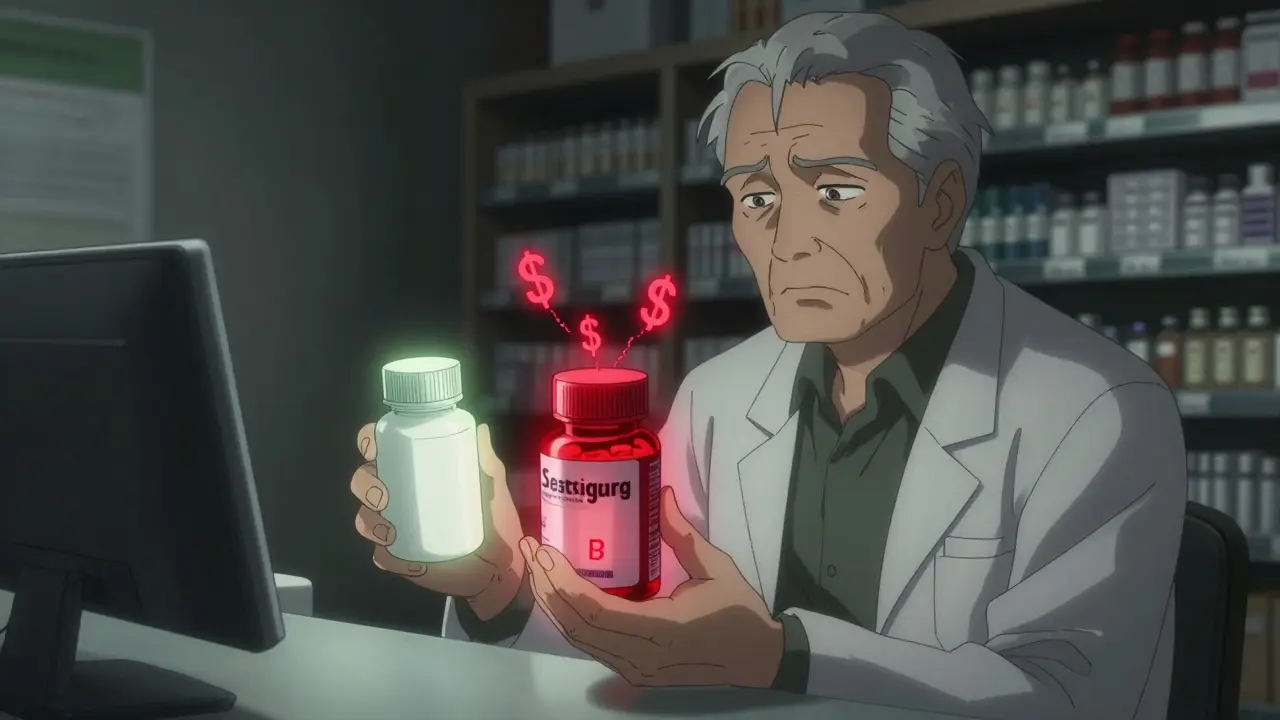
The key insight here is that generics are systematically placed in Tiers 1 and 2. Brand-name drugs are pushed into Tiers 3 and above. This structural placement creates a clear financial signal. If you take a blood pressure medication like amlodipine, the generic version sits in Tier 1 with a $0 copay. The brand-name equivalent, Norvasc, sits in Tier 3 with a $45 copay. The math is obvious, and the plan relies on that obviousness to drive its economic efficiency.

The Coverage Gap and Catastrophic Phase
The economics get even more nuanced once you enter the different phases of coverage. Medicare Part D has an annual deductible, an initial coverage phase, a coverage gap (often called the "donut hole"), and catastrophic coverage. Your share of the cost changes depending on which phase you are in, and generics play a critical role in each.
In 2025, the annual deductible was set at $595. Once you meet that, you enter the initial coverage phase, where you typically pay 25% coinsurance for both generic and brand-name drugs. However, because the base price of a generic is so much lower, your actual dollar amount paid is far less. For example, 25% of a $20 generic bill is $5. Twenty-five percent of a $200 brand-name bill is $50.
When you hit the coverage gap, the incentives shift further. Thanks to the Bipartisan Budget Act of 2018, beneficiaries now pay only 25% of the negotiated price for generics in this phase, down from 44% previously. In the catastrophic coverage phase, which begins after $2,000 in out-of-pocket spending in 2025 (rising to $2,100 in 2026), you pay the greater of 5% coinsurance or a nominal copayment. In 2024, that nominal copay was $4.15 for generics versus $10.35 for brand-name drugs. Every step of the way, the system is engineered to make generics the financially rational choice.
| Coverage Phase | Generic Cost Share | Brand-Name Cost Share | Typical Beneficiary Impact |
|---|---|---|---|
| Deductible | 100% of cost until limit met | 100% of cost until limit met | No difference in responsibility, but generic base price is lower. |
| Initial Coverage | 25% coinsurance | 25% coinsurance | Generic results in significantly lower dollar amount due to lower acquisition cost. |
| Coverage Gap | 25% of negotiated price | 25% of negotiated price | Manufacturer discounts apply, but generic remains cheaper overall. |
| Catastrophic | 5% or nominal copay ($4.15 in 2024) | 5% or nominal copay ($10.35 in 2024) | Generics cap out at a lower absolute cost. |
Impact of Recent Legislation on Generic Pricing
The landscape of Medicare Part D economics is shifting rapidly due to new federal laws. The Inflation Reduction Act of 2022 introduced several mechanisms that directly affect how generics are priced and accessed. One of the most significant changes is the $35 monthly cap on insulin products, effective starting in 2023. While insulin is often brand-name, this cap sets a precedent for capping essential drug costs.
More broadly, the act includes a provision requiring drug manufacturers to pay rebates if their price increases exceed the rate of inflation. This has had a stabilizing effect on generic pricing. According to the Medicare Payment Advisory Commission (MedPAC), 14.7% of generic drugs experienced price decreases in 2023, compared to only 8.3% in 2022. This suggests that the threat of rebates is encouraging manufacturers to keep prices competitive.
Effective January 1, 2025, the Manufacturer Discount Program went into full force. This program requires manufacturers to provide additional discounts on applicable drugs during both the initial coverage and catastrophic phases. The Congressional Budget Office (CBO) projects that this will increase generic utilization by an additional 3.2 percentage points by 2026. Essentially, the government is squeezing more value out of the supply chain to protect beneficiaries from runaway costs.

Navigating Your Plan: Practical Strategies for Savings
Understanding the economics is one thing; applying it to your own healthcare is another. Many beneficiaries fall into the trap of staying with their current plan without reviewing the formulary. This is a costly mistake. A 2023 CMS Office of Inspector General report found that 63.2% of beneficiaries would face higher out-of-pocket costs if they switched plans without carefully reviewing formulary differences.
Here is how you can leverage the generic advantage:
- Review Tiers During Open Enrollment: Between October 15 and December 7, use the Medicare Plan Finder tool. Look specifically for plans that place your specific medications in Tier 1 or Tier 2. A plan might seem cheaper on paper, but if it puts your necessary generic in Tier 3, you will pay more.
- Check for Preferred Pharmacies: Many plans offer $0 copays for Tier 1 generics, but only at preferred pharmacy networks. If you always go to a non-preferred pharmacy, you miss out on the deepest discounts.
- Understand Therapeutic Interchange: Pharmacists are often authorized to automatically substitute a generic for a brand-name drug unless the doctor writes "dispense as written." Embrace this. Unless you have a documented adverse reaction to the generic, there is no medical reason to pay extra for the brand.
- Appeal When Necessary: If a generic causes side effects, you can request a "coverage determination" for the brand-name drug. CMS data shows a 78.4% approval rate for these appeals when medically necessary. Don't assume you are stuck with the generic if it doesn't work for you.
Research from the Urban Institute indicates that beneficiaries who spend just 3-5 hours researching their options using these tools save an average of $427 annually. In the context of fixed incomes, that is a substantial sum.
The Future of Part D and Generic Utilization
Looking ahead, the reliance on generics is only going to intensify. The Medicare Trustees Report from April 2024 highlights that continued high generic utilization is essential for the long-term solvency of the Part D trust fund. The program is projected to remain solvent through 2093, but only if generic utilization continues to increase at its current rate of 1.2 percentage points annually.
By 2030, industry analysts project that generics will account for 91.5% of all Part D prescriptions. This trend is driven not just by policy, but by market consolidation. The top three generic manufacturers-Teva, Mylan, and Sandoz-control over 63% of the Medicare Part D generic market. This consolidation allows for efficient production and distribution, keeping costs down for the program.
However, challenges remain. Critics point out that the 25% coinsurance in the initial coverage phase can still be a barrier for low-income beneficiaries. A KFF analysis from September 2023 noted that 32.1% of beneficiaries in the lowest income bracket skip doses due to cost concerns, even when generics are available. The $2,000 annual out-of-pocket cap, fully effective in 2025, aims to mitigate this by providing a hard ceiling on spending, but gaps in affordability persist.
For the individual, the message is clear. The system is designed to reward those who choose generics. By understanding the tiered structure, leveraging the protections offered by recent legislation, and actively managing your plan selection during enrollment periods, you can align yourself with the economic flow of Medicare Part D. You don't have to fight the system; you just have to know how it works.
Why does my pharmacist always ask if I want the generic?
Your pharmacist asks because Medicare Part D plans place generic drugs in the lowest cost tiers (Tier 1 or 2). Choosing the generic often reduces your copay from tens of dollars to zero or a few dollars. It is also part of the plan's strategy to control overall costs, which helps keep premiums stable for everyone.
What is the difference between Tier 1 and Tier 2 generics?
Both tiers contain generic drugs, but Tier 1 is designated for "Preferred Generics," which have the lowest copayments (often $0-$10). Tier 2 covers standard generics with slightly higher copays (averaging around $15). The difference usually comes down to which manufacturer the insurance plan has negotiated the best deal with.
How does the $2,000 out-of-pocket cap affect generic usage?
The $2,000 annual out-of-pocket cap, effective in 2025, limits how much you pay for covered drugs in a year. Since generics are cheaper, you are less likely to hit this cap quickly. This protects you from catastrophic expenses, especially if you need multiple medications. It makes the financial risk of taking necessary medications much more predictable.
Can I refuse the generic and take the brand-name drug?
Yes, you can refuse the generic. However, you will likely pay a higher copay because brand-name drugs are placed in higher tiers (Tier 3 or above). If you have a medical reason why the generic does not work for you, you can ask your doctor to write "dispense as written" or file an appeal for a coverage determination to get the brand covered at a lower cost.
When should I review my Medicare Part D plan?
You should review your plan during the Annual Enrollment Period, which runs from October 15 to December 7 each year. Formularies change annually, and a drug that was in Tier 1 last year might move to Tier 3. Checking the formulary ensures you are still getting the best price for your specific medications.