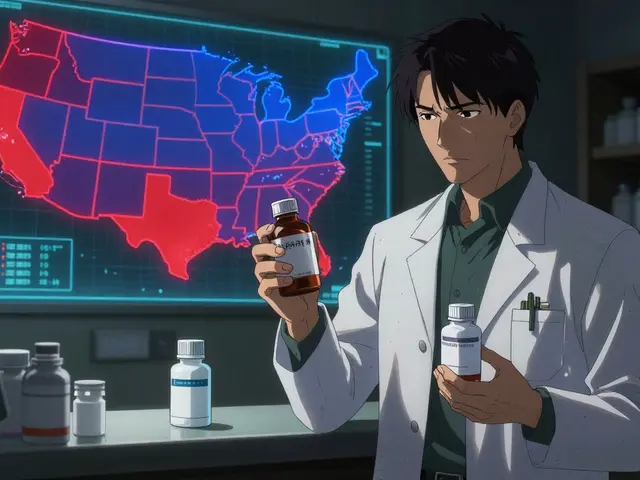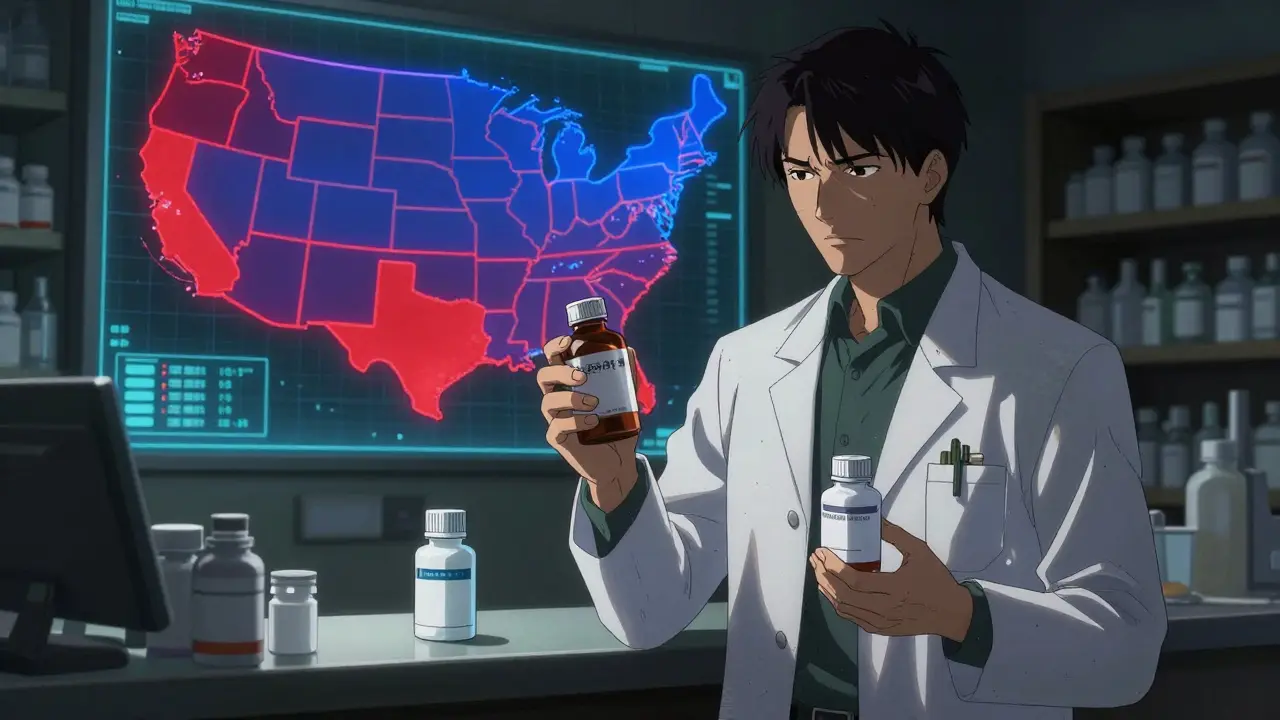
Imagine walking into a pharmacy in New Jersey with a prescription for a blood thinner. The pharmacist hands you a generic version without asking. Now imagine crossing the border into neighboring New York with the same prescription. Suddenly, you must give explicit permission before that switch happens. This isn't a hypothetical scenario; it is the daily reality for millions of Americans navigating a fragmented patchwork of state laws on generic substitution that govern how pharmacists can swap brand-name drugs for cheaper equivalents.
This regulatory maze affects roughly 6 billion prescriptions filled annually in the United States. While the goal is always to balance cost savings with patient safety, the methods vary wildly from one state line to the next. For patients, this means confusion. For pharmacists, it means complex compliance checks. And for healthcare systems, it creates a landscape where saving money often comes at the cost of administrative complexity.
The Patchwork Reality: Mandatory vs. Permissive Laws
At the heart of this issue is the fundamental question: does the pharmacist have the right-or the duty-to substitute a generic drug? There is no single national rule. Instead, we have two main camps.
In mandatory substitution states (22 as of recent data), pharmacists are required by law to automatically dispense the generic equivalent unless the prescriber explicitly writes "dispense as written" or the patient objects. Think of this as the default setting. In these jurisdictions, the system assumes generics are safe and effective unless proven otherwise. This approach has been shown to boost generic usage rates significantly. A study published in *Health Economics* found that mandatory states saw 12.3% higher substitution rates for statins compared to their permissive counterparts.
On the other side, permissive substitution states (28 states plus Washington, DC) allow pharmacists to substitute but do not require it. Here, the pharmacist has discretion. They might choose to substitute based on formulary guidelines, insurance requirements, or personal judgment. Oklahoma stands out as an extreme outlier here, effectively prohibiting substitution without direct authorization from both the prescriber and the purchaser, creating a high-friction environment for cost-saving measures.
| Feature | Mandatory States (e.g., Texas) | Permissive States (e.g., California) | Outlier (Oklahoma) |
|---|---|---|---|
| Pharmacist Duty | Must substitute unless prohibited | May substitute at discretion | Prohibited without dual authorization |
| Patient Consent Model | Often Presumed (Opt-out) | Varies (Explicit or Presumed) | Explicit Required |
| Generic Fill Rate Impact | Higher (~94.1%) | Lower (~88.3%) | Lowest |
| Primary Goal | Cost reduction & efficiency | Flexibility & clinical judgment | Strict control |
The Consent Conundrum: Who Decides?
Even within these broad categories, the mechanism for patient consent varies, creating another layer of complexity. You might wonder why your pharmacist asked you a question in one state but not in another. It likely comes down to whether your state uses presumed consent or explicit consent.
In 32 states, presumed consent is the norm. This means the substitution happens automatically unless you actively object. It streamlines the process and reduces wait times. However, critics argue it can lead to patients receiving medications they didn't fully agree to, particularly if they have specific preferences about manufacturers.
In contrast, 18 states require explicit consent. Here, the pharmacist must get your affirmative approval-often through a signature or verbal confirmation documented in the system-before switching the drug. This model prioritizes patient autonomy but adds friction. Pharmacists report spending an average of 12.7 minutes per prescription verifying eligibility and obtaining consent, which can slow down workflow during peak hours.
Hawaii represents a unique middle ground for certain drugs. For antiepileptic medications, Hawaii requires consent from both the practitioner and the patient. This double-lock system reflects deep concerns about stability in treatment for conditions where even minor fluctuations in drug levels can be dangerous.

Narrow Therapeutic Index Drugs: The Safety Exception
Not all generics are created equal in the eyes of the law. While most small-molecule drugs are considered therapeutically equivalent, a specific subset known as Narrow Therapeutic Index (NTI) drugs demands extra caution. These are medications where a tiny difference in dose can lead to toxicity or treatment failure. Examples include warfarin (a blood thinner), levothyroxine (for thyroid issues), and certain antiepileptics like phenytoin.
All states reference the FDA's Orange Book to determine equivalence, but 15 states maintain their own additional lists of NTI drugs that cannot be substituted freely. Kentucky, for instance, specifically restricts substitution for digitalis glycosides and antiepileptic drugs. Even in states with liberal substitution laws, pharmacists often exercise caution here. Why? Because the consequences of error are severe. The FDA’s Adverse Event Reporting System documented cases in Minnesota where warfarin substitution led to adverse events, despite the drugs having equivalent ratings. This highlights a gap between theoretical equivalence and real-world biological response.
If you are taking an NTI drug, you should never assume automatic substitution is safe. Always ask your pharmacist if the generic manufacturer matches your previous fill. Consistency in the manufacturer is often more important than the generic status itself for these specific medications.
Biosimilars: The New Frontier
The conversation around substitution is shifting rapidly due to the rise of biologics and their generic counterparts, called biosimilars. Unlike small-molecule generics, which are exact chemical copies, biosimilars are highly similar to reference biologic products but may have minor differences in inactive ingredients. This makes regulation trickier.
As of 2023, 49 states and Washington, DC have implemented specific biosimilar substitution laws. However, the rules are still evolving. Florida requires community pharmacies to establish a formulary ensuring substitutions "would not pose a threat to health and safety." Iowa advises using the Orange Book for equivalency determinations. The FDA introduced a new "interchangeable" designation in 2020, and 12 states have since updated their laws to align with this framework. If a biosimilar is labeled "interchangeable," it can generally be substituted without prescriber intervention, provided state law allows it.
Despite progress, confusion remains. Dr. Aaron Kesselheim of Harvard Medical School noted that the variation in state laws creates unnecessary complexity for Pharmacy Benefit Managers (PBMs) operating across state lines. For patients, this means that while biosimilars offer promise for lowering costs for expensive treatments like insulin or cancer therapies, access depends heavily on where you live.

Economic Impact and Patient Experience
Why do these laws matter beyond legal technicalities? Money. Generic substitution saves billions. From 2009 to 2019, the Association for Accessible Medicines estimated $1.7 trillion in savings thanks to generics. Today, generics account for 92.5% of all prescriptions filled, representing $313 billion in annual savings. Mandatory substitution states contribute disproportionately to these figures, with generic fill rates averaging 94.1% compared to 88.3% in permissive states.
However, the human experience is mixed. A 2022 survey by the National Community Pharmacists Association found that 63% of independent pharmacists reported reduced patient abandonment rates in mandatory states. When the generic is available and affordable, patients are less likely to skip doses or abandon prescriptions entirely. Texas pharmacists, for example, noted decreased abandonment for atorvastatin prescriptions under mandatory rules.
Yet, patient complaints persist. Between 2020 and 2022, the FDA’s MedWatch system received 217 reports of perceived therapeutic differences after substitution, predominantly involving levothyroxine and warfarin. Online forums reveal frustration among patients who feel unheard. One Reddit user highlighted the confusion for those living near state borders: "In my New York store, I must ask every patient... but in neighboring New Jersey, I automatically substitute... it confuses patients."
This disconnect underscores the need for better communication. Pharmacists are trained to navigate these laws, but patients often lack visibility into the decision-making process.
What You Can Do: Navigating the System
You don’t need to be a lawyer to protect your health in this system. Here are practical steps to ensure you get the medication that works best for you:
- Know Your State’s Law: Check if your state mandates or permits substitution. Most state boards of pharmacy publish clear guides online.
- Ask About NTI Drugs: If you take warfarin, levothyroxine, or seizure medications, explicitly discuss manufacturer consistency with your pharmacist. Request that the bottle label includes the manufacturer name.
- Understand "Dispense as Written": If your doctor believes a brand-name drug is necessary, they can write "DAW" or "Brand Medically Necessary" on the prescription. This overrides automatic substitution in most states.
- Speak Up: If you notice a change in how you feel after a substitution, contact your pharmacist immediately. Do not stop taking your medication without consulting your provider, but document any symptoms.
- Check Insurance Formularies: Sometimes, substitution is driven by insurance plans rather than state law. Know which tier your drug falls into and whether alternatives are covered.
The future of generic substitution points toward greater standardization. The Uniform Law Commission released a draft Model State Biologics and Biosimilars Act in 2023 aiming to harmonize the 49 different state frameworks. Meanwhile, the Congressional Budget Office projects that further harmonization could generate an additional $8.7 billion in annual savings by 2028. But until then, the patchwork remains.
For now, awareness is your best tool. Understanding that state laws vary helps you advocate for yourself when standing at the pharmacy counter. Whether you benefit from the cost savings of mandatory substitution or require the precision of restricted NTI protocols, knowing the rules empowers you to make informed decisions about your health.
Can a pharmacist refuse to substitute a generic drug?
Yes, in permissive states, pharmacists have the discretion to decide whether to substitute. Even in mandatory states, they can refuse if the prescriber has marked the prescription "dispense as written" or if the patient objects. Additionally, pharmacists may refuse substitution for Narrow Therapeutic Index (NTI) drugs if they believe it poses a safety risk, depending on state-specific lists.
What is the difference between a generic and a biosimilar?
A generic drug is an exact chemical copy of a brand-name small-molecule drug. A biosimilar is a highly similar version of a biologic drug (made from living cells). Biosimilars may have minor differences in inactive ingredients or structure, which is why they require a separate "interchangeable" designation for automatic substitution in many states, unlike traditional generics.
Why do some states ban substitution for certain drugs?
Some states restrict substitution for Narrow Therapeutic Index (NTI) drugs, such as warfarin or antiepileptics, because these medications have a very small margin between a therapeutic dose and a toxic dose. Even slight variations in bioavailability between manufacturers can lead to serious adverse events or treatment failure.
Does my insurance company force generic substitution?
Insurance companies often encourage or require generic substitution through their formularies to lower costs. However, state law ultimately dictates whether the pharmacist must or can perform the substitution. If state law prohibits substitution without consent, the insurance preference cannot override that legal requirement.
How can I prevent generic substitution for my medication?
You can ask your prescriber to write "Dispense as Written" (DAW) or "Brand Medically Necessary" on the prescription. Alternatively, you can verbally instruct the pharmacist not to substitute and sign any required refusal forms. In presumed consent states, you must explicitly opt-out to prevent the switch.