
Side Effect Risk Calculator
This calculator helps you understand what drug side effect frequency means in real-world terms. Based on data from Section 6 (Postmarketing Experience) of drug labels, input the side effect frequency and population size to see how many people might experience the side effect.
When you pick up a new prescription, the prescribing information tucked inside the box might seem like a legal document written in invisible ink. But one section-Section 6, labeled Postmarketing Experience-holds real-world clues about what could go wrong after millions of people start taking the drug. This isn’t theoretical. These aren’t lab results. These are reports from real patients, doctors, and pharmacists who noticed something unusual after the drug was already on the market.
What Exactly Is Postmarketing Experience?
Postmarketing experience is the FDA’s way of saying: "We tested this drug in a few thousand people before approval. Now we’re watching what happens when a million people use it." Clinical trials are controlled. Participants are carefully selected. Side effects are tracked under ideal conditions. But real life? People take other meds. They have other health problems. They’re older, sicker, or pregnant. That’s when rare or unexpected side effects show up.
The FDA requires drugmakers to report any serious or unexpected adverse reactions within 15 days of learning about them. These reports go into the FDA’s Adverse Event Reporting System (FAERS), which now holds over 35 million entries. That’s not just noise-it’s the early warning system for drugs that might be safer in theory than in practice.
Why This Section Looks So Confusing
Look at Section 6 and you’ll see phrases like:
- "Reported cases of liver injury"
- "Isolated reports of severe skin reactions"
- "Adverse reactions occurring in less than 1 in 10,000 patients"
These aren’t random words. They’re coded language. "Reported cases" means someone noticed something odd and told the FDA-but we don’t know for sure if the drug caused it. "Isolated reports" doesn’t mean "harmless." It means "we’ve seen it a few times, but not enough to say it’s common."
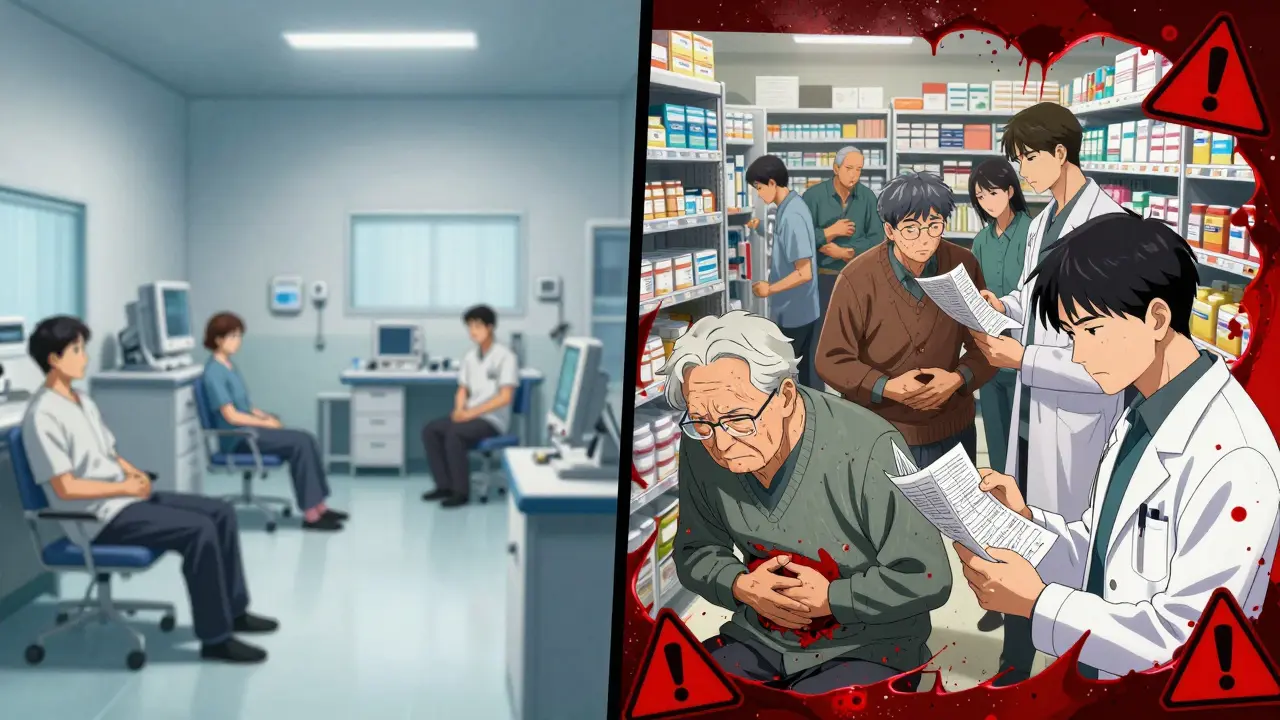
Here’s the trap: many doctors and patients assume that if a side effect is only listed in the postmarketing section, it’s not serious. That’s wrong. A 2022 study by the American Medical Association found that 41% of physicians regularly underestimated the severity of reactions listed only in this section. One anticoagulant had 17 fatal bleeding cases labeled as "isolated reports"-until enough piled up to trigger a safety alert.
Frequency Doesn’t Equal Risk
Drug labels break down side effects by how often they happen:
- Very common: ≥1 in 10
- Common: ≥1 in 100 to <1 in 10
- Uncommon: ≥1 in 1,000 to <1 in 100
- Rare: ≥1 in 10,000 to <1 in 1,000
- Very rare: <1 in 10,000
But here’s what no one tells you: rare doesn’t mean safe. A reaction that affects 1 in 50,000 people might still be life-threatening. If you’re that one person, frequency doesn’t matter. What matters is whether the reaction is serious-like liver failure, heart rhythm problems, or severe allergic reactions.
The FDA’s own 2019 review says: "The absence of a reaction in the postmarketing section doesn’t mean the drug doesn’t cause it." That’s critical. Just because it’s not listed doesn’t mean it won’t happen.
What’s the Difference Between Clinical Trial Side Effects and Postmarketing Side Effects?
Section 6 isn’t the only place you’ll see side effects. Section 6.1 lists adverse reactions from clinical trials. Section 6.2 is postmarketing. Here’s the key difference:
- Section 6.1: Side effects seen in controlled trials. These are usually more common, well-documented, and have stronger evidence of causation.
- Section 6.2: Side effects seen after approval. These are often rarer, less certain, and sometimes surprising.
But here’s the twist: the same side effect can show up in both sections with different frequency estimates. A 2023 Reddit thread from a cardiologist described seeing the same drug list "dizziness" as "common" in 6.1 and "uncommon" in 6.2. That’s not a mistake-it’s a reflection of how data changes over time. More people = more reports = better signal.
How Clinicians Are Supposed to Use This Info
The FDA doesn’t expect you to be a statistician. But they do expect you to ask four questions when you see a new side effect in Section 6.2:
- Did it happen after the drug started? Timing matters. If the rash appeared two days after the first pill, that’s a red flag.
- Is it biologically plausible? Does the drug’s mechanism make this side effect likely? For example, a drug that affects blood clotting might cause bleeding, but not sudden hearing loss.
- Did it go away when the drug was stopped? This is called "dechallenge." If symptoms improve after stopping the drug, it’s more likely the drug caused it.
- Does it match what we know? Is this reaction similar to other drugs in the same class? If yes, it’s more credible.
Pharmacists at the American Society of Health-System Pharmacists recommend spending 3-5 minutes on Section 6.2 for any new prescription. Focus on reactions marked as "serious" or "unexpected." Don’t skip the fine print.
Why This Matters for You
Let’s say you’re prescribed a new antidepressant. The clinical trial section says nausea and drowsiness are common. The postmarketing section says: "Rare reports of suicidal ideation in adults under 25."
That’s not a warning to avoid the drug. It’s a heads-up: if you’re under 25, pay attention to your mood. Talk to your doctor if you feel worse. This section turns a generic drug label into a personalized safety net.
Patients who understand this section report fewer surprises. A 2021 FDA survey found that 28% of patients didn’t understand postmarketing risk language. Those who did were more likely to report symptoms early and avoid hospitalization.

The Future Is Real-World Data
The FDA is moving fast. Starting January 2025, drugmakers must submit postmarketing data in a machine-readable format called SPL-ESD. That means AI can scan thousands of reports daily, spot patterns, and update labels in real time-no more waiting years for a safety alert.
The 21st Century Cures Act already pushed drugmakers to use real-world data from electronic health records and patient registries. Between 2017 and 2023, postmarketing studies using this data jumped 214%. The goal? To catch problems before they become epidemics.
By 2027, the FDA wants 45% of label updates to come from real-world evidence-not just lab reports or small trials. That’s a huge shift. The future of drug safety isn’t just in clinical trials. It’s in the lives of the people taking the drugs.
What to Do Next
If you’re a patient:
- Don’t ignore Section 6.2. It’s not filler.
- Ask your doctor: "Are there any serious side effects that only showed up after the drug was approved?"
- Report anything unusual to the FDA through MedWatch-even if you’re not sure.
If you’re a healthcare provider:
- Review Section 6.2 before prescribing any new drug.
- Don’t assume "rare" means "safe."
- Use the four-question framework to evaluate new reports.
- Teach your team how to read this section-it’s a skill, not common sense.
Postmarketing experience isn’t a flaw in the system. It’s the system working as designed. Drugs aren’t perfect. But the more we learn after they’re out there, the safer they become.
Are side effects listed in the postmarketing section less serious than those in clinical trials?
No. Side effects listed in the postmarketing section are not necessarily less serious. In fact, some of the most dangerous reactions-like liver failure, severe allergic reactions, or sudden heart rhythm changes-are often first detected after a drug is widely used. The difference is not severity, but certainty and frequency. Clinical trial data shows reactions seen in controlled settings; postmarketing data reveals rare or unexpected reactions in real-world populations. A reaction listed only in postmarketing experience may be life-threatening even if it affects only 1 in 50,000 people.
What does "isolated reports" mean on a drug label?
"Isolated reports" means the FDA has received a small number of reports about a side effect, but there isn’t enough evidence to confirm it’s caused by the drug or to determine how often it happens. It does NOT mean the reaction is harmless. In several documented cases, including with anticoagulants and diabetes drugs, "isolated reports" of serious events like internal bleeding or pancreatitis later turned out to be part of a larger pattern. The term is a placeholder for uncertainty-not a reassurance of safety.
Why are some side effects listed in both clinical trial and postmarketing sections?
Some side effects appear in both sections because they were observed in clinical trials but became more common or better understood after the drug entered the market. For example, a drug might show mild nausea in trials (Section 6.1), but postmarketing reports reveal it also causes severe vomiting in elderly patients with kidney issues (Section 6.2). This isn’t a contradiction-it’s refinement. Real-world data adds context: who is most at risk, under what conditions, and how severe it can get.
Can a drug be safe even if it has side effects listed in the postmarketing section?
Yes. All medications carry some risk. The presence of postmarketing side effects doesn’t make a drug unsafe-it makes it transparent. The goal isn’t to eliminate all side effects, but to understand them so they can be managed. For example, a cholesterol drug might have a rare risk of muscle damage, but for a patient with a high risk of heart attack, the benefit outweighs the risk. What matters is whether the side effect is serious, how often it happens, and whether you’re in a group more likely to experience it.
How often are drug labels updated based on postmarketing data?
Between 2007 and 2017, 38% of all drug label updates were driven by postmarketing safety data, according to an FDA analysis. Since then, the rate has increased as real-world evidence becomes more integrated into decision-making. In 2022 alone, over 1,200 active safety surveillance reports were generated from the FDA’s Sentinel Initiative, which monitors hundreds of millions of patient records. Labels are updated continuously as new signals emerge-sometimes within months of a serious report.
Final Thought
Postmarketing experience sections are the drug industry’s way of saying: "We’re still learning." They’re not perfect. They’re messy. But they’re the best tool we have to catch problems that clinical trials simply can’t see. Ignoring them is like driving with your eyes closed after the first mile. Pay attention. Ask questions. Report what you see. Your safety depends on it.








MARILYN ONEILL January 21, 2026
So let me get this straight-you’re telling me the FDA just sits on a mountain of reports and waits for someone to die before they update the label? That’s not safety, that’s a waiting game with people as test subjects. I’ve seen this with anticoagulants. One lady in my book club got internal bleeding and the doctor said, 'It’s rare.' Rare? It happened to HER. And now she’s on disability. This isn’t science-it’s corporate liability dressed up in Latin.
Coral Bosley January 22, 2026
I read this section once and cried. Not because I was scared, but because I realized how little they tell you. My mom took that diabetes drug and developed pancreatitis. The doctor said, 'It’s not common.' But common doesn’t mean it won’t happen to you. And when it does? You’re alone in a hospital wondering why no one warned you. This isn’t just fine print-it’s a betrayal wrapped in a brochure.
Steve Hesketh January 22, 2026
Hey everyone, I just want to say thank you for this post. Seriously. As someone who’s been on multiple meds over the years-some for chronic pain, some for anxiety-I’ve learned the hard way that the real danger isn’t the drug itself, it’s the silence around it. I had a rash that lasted three weeks after starting a new antidepressant. My doctor brushed it off. But when I reported it to MedWatch? They called me back within a week. That’s the power of real-world data. Don’t be afraid to speak up. Your voice might save someone else’s life.
shubham rathee January 23, 2026
you know what this is really about right? the pharma companies pay the fda to keep things quiet. they dont want to scare people off their billion dollar drugs. thats why they use words like 'isolated' and 'rare'-so you think its fine. but if you dig deep in faers youll see the same names popping up over and over. its all a cover up. and dont even get me started on how they use ai now to bury the real signals. theyre not fixing the system-theyre automating the lie.
MAHENDRA MEGHWAL January 24, 2026
The methodology underpinning postmarketing surveillance is fundamentally sound, yet its operational implementation remains gravely under-resourced. The disparity between the volume of adverse event reports and the analytical capacity to interpret them constitutes a systemic vulnerability. It is imperative that regulatory bodies prioritize the integration of structured data formats, such as SPL-ESD, to enable timely signal detection and evidence-based label revision. Patient safety is not a byproduct-it is the primary objective.
Sangeeta Isaac January 25, 2026
so like... i read the label and thought 'oh cool, only 1 in 50k get liver failure' and then i remembered my cousin died from that exact thing. like. yeah. it's rare. but also. it's my cousin. so maybe stop calling it 'rare' and start calling it 'someone's funeral'. also why is the font smaller than the ingredients list? is this a joke?
Alex Carletti Gouvea January 26, 2026
This whole thing is just woke medical nonsense. If you can’t handle a little risk, don’t take the medicine. We don’t need more bureaucracy, we need more backbone. The FDA is just trying to scare people so they can get more funding. Back in my day, people took pills and didn’t whine about every little thing. This isn’t safety-it’s weakness.
lokesh prasanth January 27, 2026
the truth is nobody cares until its too late. we live in a world where profit is the only metric. this post is just another pretty lie wrapped in data. the system is broken. and you? you’re just a number in the algorithm.